Search results for: “judgement”

  • How do you use AI without losing your judgement?

    How do you use AI without losing your judgement?

    It’s the one that looks completely right.

    Clean. Logical. Confident.

    Ready to copy into an email, a proposal, or a presentation.

    That’s the trap.

    Everyone tells professionals to embrace AI.

    Use it faster. Automate more. Become more productive.

    Almost nobody talks about what happens when you stop checking what comes back. That’s the risk.

    I studied Expert Systems more than thirty years ago.

    Back then, the interesting question was whether a machine could reproduce some form of human reasoning.

    Today, the question is different.

    It’s about whether humans will continue to reason after the machine gives them an answer.

    AI can generate ten hypotheses while you are still formulating the first one.

    That’s incredibly useful.

    But speed doesn’t turn a hypothesis into a decision.

    A professional should use AI as an accelerator of possibilities, not as an oracle. Use it to generate more options, explore alternative explanations, challenge assumptions, and summarise complexity. Then do the part the machine cannot do for you: decide what to trust, what to reject, and what to act on.

    Generate more options. Explore alternative explanations. Challenge assumptions—Summarise complexity.

    Then do the part the machine cannot do for you.

    Ask:

    Does this make sense for this client?
    Inside this organisation?
    Given this history?
    With these people?

    And considering consequences the model cannot possibly see?

    That is where professional judgement begins: after the machine gives you an answer, check whether it makes sense for this client, inside this organisation, given this history, with these people, and considering consequences the model cannot possibly see. Then decide what to trust, what to reject, and what to act on.

    AI gives you plausible answers in seconds, but your value is knowing when plausibility isn’t enough.

    Your value is knowing when plausibility isn’t enough.

    The professionals most at risk from AI aren’t necessarily those who refuse to use it.

    They may be the ones who use it constantly and slowly stop questioning it.

    The competitive advantage won’t come from having access to AI.

    Everyone will have that.

    It will come from knowing when to trust the machine,

    and, more importantly, when not to.

    → Explore Human + AI

    2 min read · estimated

    Read the article →

  • Clippy Just Wanted to Help. We Just Wanted It Gone. Why?

    Clippy Just Wanted to Help. We Just Wanted It Gone. Why?

    Microsoft’s most famous paperclip saw the future of digital assistance. It missed the one thing that would decide its fate: the value of our attention.

    I was writing a letter.

    A few words in, I knew exactly what I wanted to say. I was focused. Then a paperclip with eyes appeared in the corner of my screen.

    It moved. It watched. It looked delighted to have found me.

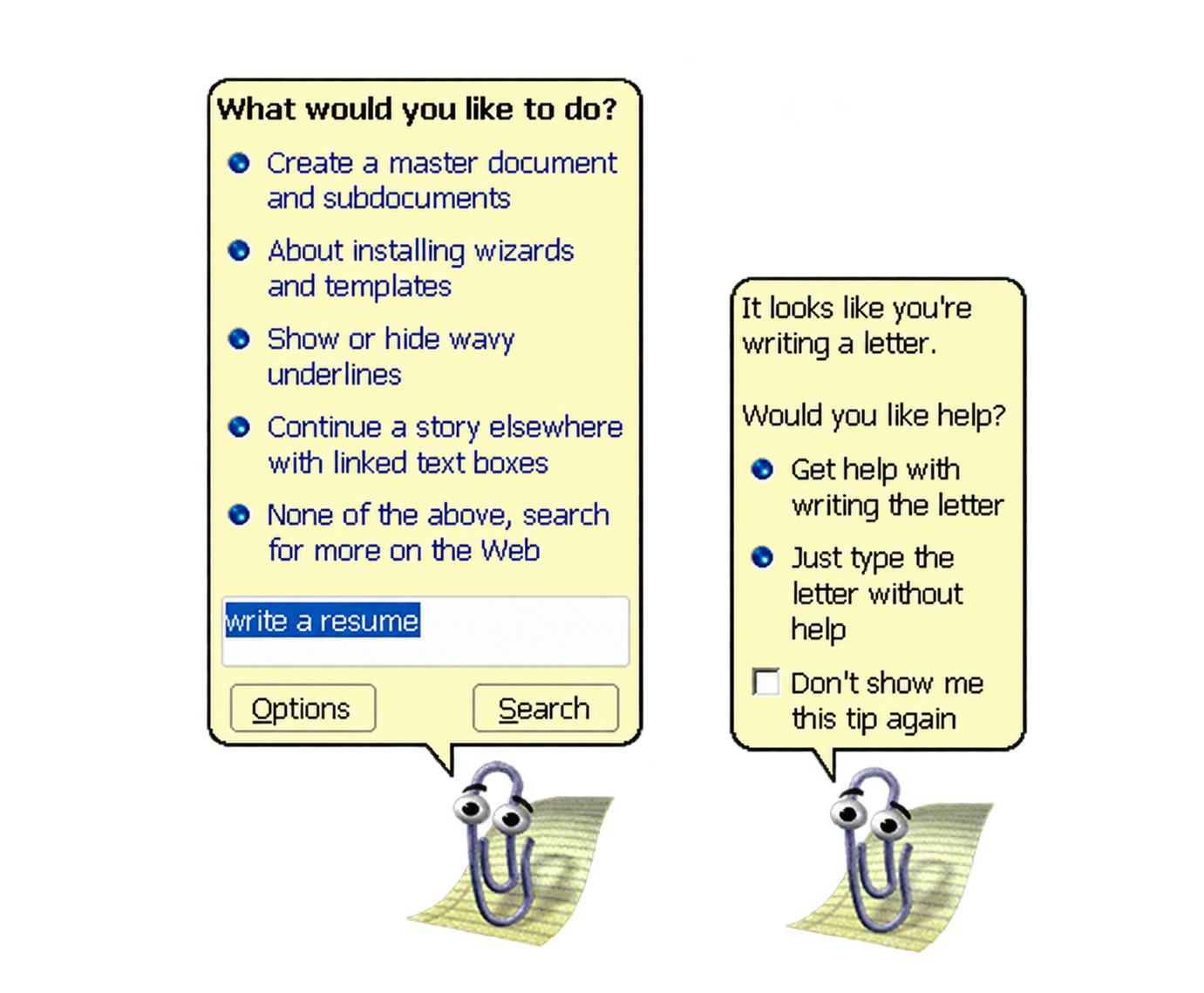
    “It looks like you’re writing a letter. Would you like help?”

    No. Just let me write the damn letter.

    Clippy meant well. It was trying to do something we now ask of every AI assistant: recognise the context and offer help at the right moment.

    It saw the future. It just didn’t know when to get out of the way.

    The assistant that arrived before we were ready

    Clippy, officially called Clippit, arrived with Microsoft Office 97.

    Its job made sense. Office was becoming more powerful. Useful features were disappearing into menus and dialogue boxes. People needed help finding them.

    Instead of making you search for an answer, the software tried to anticipate your question.

    That sounds remarkably modern. The execution became famous for the wrong reasons.

    Clippy recognised patterns in what you were doing. But recognising a pattern is not the same as understanding what it means.

    Start typing a letter, and it could infer that you were writing one. It couldn’t tell whether you needed help.

    That small gap shaped its entire story.

    With Office XP in 2001, Microsoft turned the assistant off by default. Office 2007 removed it.

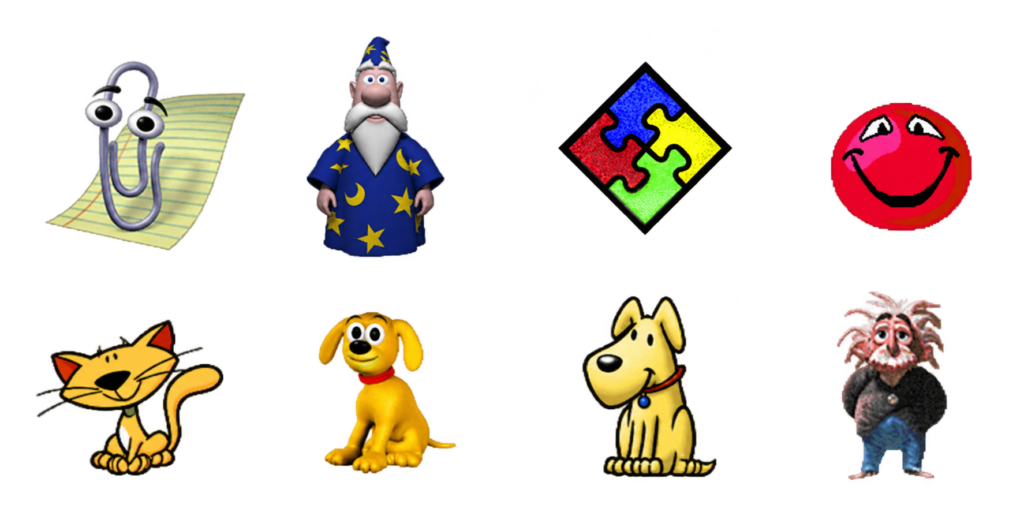
    Clippy and other Microsoft Office Assistant characters
    Clippy and the other Office Assistants developed by Microsoft.

    The paperclip disappeared. The problem it was trying to solve stayed.

    The invisible price of an interruption

    Here is something we forget when we design digital tools.

    Being useful does not automatically earn you the right to interrupt.

    A suggestion can be technically correct and arrive at precisely the wrong moment.

    Every time Clippy appeared, you had to stop thinking, read its offer, assess its relevance and decide what to do.

    One click could dismiss it. But the click wasn’t the full cost. You had lost your train of thought, even if only for a few seconds.

    Repeat that ten, fifty, a hundred times. Assistance begins to feel like another job.

    My reading of Clippy’s failure is simple:

    It demanded more attention than it saved.

    An assistant should reduce the work required to finish a task. It should also protect the concentration required to do it well.

    Give software a face, and we expect it to understand us

    Clippy had eyes, eyebrows, expressions and a personality. It felt like someone.

    And when software behaves like a person, we start expecting human qualities: sensitivity, timing, discretion.

    Interrupt me, and I expect a good reason. Watch what I’m doing, and I expect you to understand something about it. Offer help, and I expect that help to matter.

    Clippy’s behaviour implied a depth of understanding its technology could not deliver.

    Its personality promised more social intelligence than the software could support.

    Today’s AI assistants can process natural language, analyse documents, use tools and carry out increasingly complex sequences of actions.

    But greater technical capability does not automatically produce better judgement about when to intervene.

    An assistant can become far more capable than Clippy and remain just as intrusive.

    Behaviour is evidence. It isn’t permission.

    Imagine an assistant watching how someone navigates a website.

    The pointer hasn’t moved for twenty seconds. Is the visitor confused? Perhaps. Or perhaps they are reading something worth their attention.

    They keep returning to the same section. Are they struggling? Maybe they are comparing two ideas.

    They scroll straight to the bottom. Are they bored? They might be looking for a source, a conclusion or one specific detail.

    An observed behaviour is a clue, not proof of an intention.

    AI systems can form increasingly sophisticated hypotheses. They still need to treat those hypotheses as hypotheses, rather than authorisation.

    “This person might need help” is a long way from “This person has asked me to help.”

    That distinction matters even more when the assistant can act, rather than simply suggest.

    Why we’re bringing Clippy back to HiTechStories

    An animated paperclip is an unlikely symbol for the future of AI. Its failure, however, raises a design question we still haven’t answered:

    How do you offer help without turning it into an interruption?

    At HiTechStories, we are experimenting with a new Clippy to help visitors find relevant content, learning paths and tools.

    Making it appear is the easy part. Deciding when it should stay invisible is the interesting part.

    We want to distinguish signs of possible uncertainty from explicit requests for assistance.

    When it offers something, the reason should be understandable and the choice concrete.

    “Looking for a place to begin? Start Here introduces the main paths through the site.”

    “Want to know what you would receive as a subscriber? Read an edition of the Digest before deciding.”

    No mysterious recommendations. No pretence of reading the visitor’s mind. No need to turn every hesitation into another bid for attention.

    This is a design goal, not a result we can already claim. We are measuring the experience so we can improve it and learn from the mistakes we will inevitably make.

    Clippy gives us a useful place to start.

    The best assistant may be the one that knows when to stay quiet

    We want more people to discover HiTechStories and become readers.

    But persuading someone to stay is different from giving them a reason to return.

    An assistant can chase a click or earn trust. It can multiply suggestions or intervene when it has something worth adding.

    Technology should make it easier to achieve your goal. It shouldn’t become another presence you have to manage.

    Clippy left us a lesson worth keeping:

    An assistant earns its place by saving your attention.

    In the age of agentic AI, we can take that thought further.

    An assistant’s intelligence is measured by what it can do. It is also measured by what it knows to leave alone.

    The next time software offers to help, ask yourself more than whether the suggestion is useful.

    Is it respecting my attention—or competing for it?

    Further reading: Wired: Office XP and the Office Assistant · Wired: farewell to Clippy.

    Topics: #Clippy #ArtificialIntelligence #AgenticAI #HumanCenteredDesign #UserExperience #DigitalTransformation

    Editorial notes and attribution

    Microsoft and Clippy. Clippy is a character originally developed by Microsoft for its Office suite. The name, character and associated trademarks belong to their respective owners. The HiTechStories reinterpretation is an independent project, neither affiliated with nor endorsed by Microsoft.

    Editorial transparency. Parts of this article, including text and images, may have been developed with the support of AI tools under the author’s editorial supervision.

    6 min read · estimated

    Read the article →

  • If AI Writes My CV and Another AI Screens It, Who Goes to the Interview?

    If AI Writes My CV and Another AI Screens It, Who Goes to the Interview?

    Nino is listening to a conversation about CVs, algorithms and new opportunities. Then he asks the question nobody put on the agenda.

    “Excuse me, but if AI writes my CV and another AI screens it… do I need to turn up for the interview, or can they sort it out between themselves?”

    Everyone laughs. Then a suspicion creeps in: perhaps Nino has spotted the point where efficiency risks becoming a conversation with nobody in it.

    Two assistants. One person to get to know.

    On one side, a candidate can use AI to make a CV clearer, connect experience to the role and prepare for questions. On the other, employers have tools that help them find profiles, organise information and assess potential matches.

    This is more than an imaginary scenario. LinkedIn describes AI-assisted search and hiring agents, alongside tools that support applications and CV preparation. That does not mean every hiring process is automated, or that an algorithm alone decides who gets hired. It means AI can be involved on both sides of the table.

    So far, there is no scandal. A poorly written CV can hide an excellent professional. An unfocused search can prevent a recruiter from finding them. Improving those steps makes sense.

    The problem starts when the quality of the packaging matters more than what is inside.

    A candidate brings real experience to a job interview

    The perfect CV can be bad news

    Imagine an impeccable application: all the right words, no hesitation, every experience aligned with the job description. Is it the portrait of a capable person, or evidence that someone knows how to optimise a document?

    The document alone may not tell you. That was true before AI. It makes looking for evidence beyond the text even more important now.

    A project explained precisely. A difficult decision and the alternatives rejected. A mistake acknowledged. A result described without claiming the work of an entire team.

    These details are less polished than a perfect formula. They make for a more useful conversation.

    Translating your experience does not mean inventing it

    For an experienced professional, AI can be an excellent editor. It can help explain a complex career to someone outside the industry. It can make experience built around clients, infrastructure, constraints and difficult decisions easier to understand.

    The distinction is straightforward: clarify a result you achieved, or claim a result you did not. The first improves communication. The second creates a debt that the actual job will eventually call in.

    If your CV promises a skill, you should be able to discuss it. If it cites a number, you should be able to explain the context. If it describes a responsibility, you should know where yours ended and someone else’s began.

    What is the employer actually looking for?

    The question applies on the other side, too. Before asking AI to find the ideal candidate, a company needs to clarify what makes someone suitable for the work.

    What results will they need to deliver? Which skills are essential from day one? Which can be learned? What transferable experience might a literal reading of the requirements overlook?

    A candidate may never have used your CRM, for example, but may have spent years managing complex sales involving technical specialists and several decision-makers. How much does familiarity with the software matter compared with the ability to navigate that complexity? The answer depends on the role. It needs to be decided, not left implicit.

    Automating a search without clarifying the criteria can accelerate a poorly thought-out selection process. Speed does not fix a bad question.

    The interview needs to add something to the CV

    If the meeting merely repeats the document, Nino has a point: the two machines might as well keep talking.

    An interview becomes valuable when it explores how someone reasons. A realistic case. Incomplete information. A constraint that changes. Permission to ask questions before answering.

    The aim is to understand how the person uses what they know. That can include AI tools when the job involves them. Stating beforehand which tools are allowed makes the exercise clearer for both sides.

    This is where experience can become visible: in the problem you recognise, the risk you flag, the answer you choose not to give until you understand more.

    In the end, Nino does need to turn up

    AI can help you attract attention. The conversation helps establish whether that attention has found the right person. On both sides.

    Because the candidate is assessing something, too: the clarity of the role, the quality of the questions and the company’s willingness to look beyond a perfect application.

    Nino thinks for a moment. Then adds:

    “Fine, I’ll come to the interview. Just tell me whether you want a capable person or a CV that tells you what you want to hear.”

    In your experience, what question reveals a skill that a perfect CV can hide?

    Keep asking useful questions

    The HiTechStories Digest brings you perspectives and tools to stay relevant, think independently and use AI without handing over your judgement. Explore the Digest.

    Sources and editorial note

    Product sources: LinkedIn: AI agents for job seekers and hirers; AI-Assisted Search & Projects; LinkedIn Hiring product updates, Q2 2025. Consulted on 21 October 2026.

    Nino’s questions are a narrative device. The examples are hypothetical: they do not describe a verified company case or imply that every hiring system works in the same way.

    5 min read · estimated

    Read the article →

  • Keep Your Judgment While You Use AI

    Keep Your Judgment While You Use AI

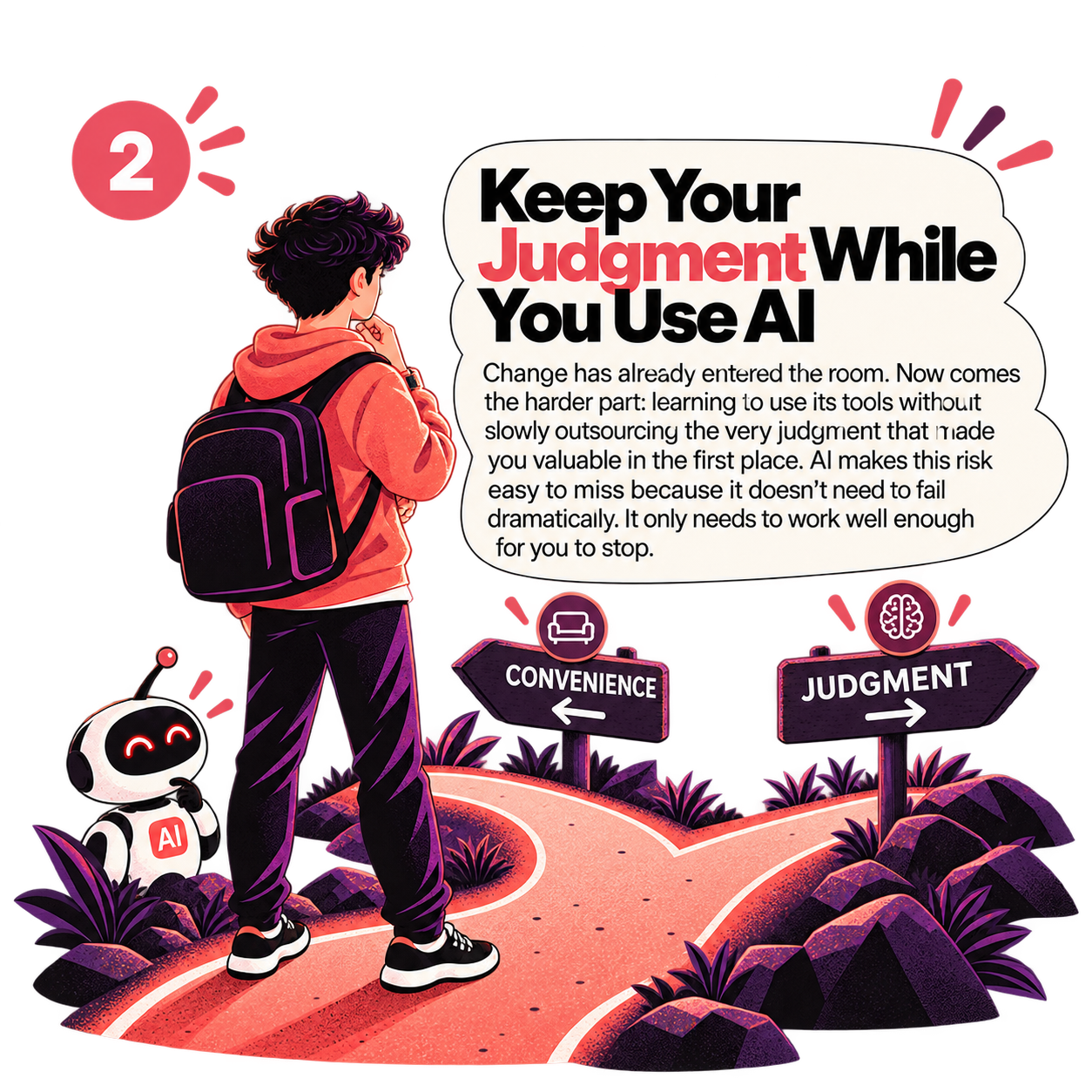
    Once you’ve accepted that change has already arrived, the next question is how you use the tools inside it without quietly handing over your own thinking.

    The following article emphasises that the biggest risk with AI isn’t that it’s wrong. It’s that it’s right often enough to make you stop thinking. AI can boost your productivity.

    But your real advantage has never been speed.

    It’s judgment.

    The question isn’t how much work AI can do for you. It’s how to use it without losing the critical thinking that makes your expertise valuable.

    Why this matters

    The dangerous AI answer isn’t the obviously wrong one — it’s the one that looks completely right: clean, logical, confident, ready to paste into an email or a decision. This article names that trap directly and gives a concrete boundary: use AI as an accelerator of possibilities, not as a skilled servant.

    That distinction is the difference between a professional who gets faster and one who gets replaceable.

    Expected outcomes

    After reading and applying this, you should notice yourself pausing before copying an AI-generated answer into anything that matters; generating multiple options with AI instead of accepting the first one; and being able to explain, in your own words, why a recommendation is right — not just that AI produced it.

    Self-check

    In the last week, did I ever act on an AI output without checking it against my own experience?

    Can I currently explain the reasoning behind my last AI-assisted decision without reopening the tool?

    Do I use AI to generate options, or do I let it generate my final answer?

    Best practices

    Treat every AI answer as a first draft of thinking, not a conclusion.

    Ask for two or three alternative framings before you settle on one.

    Keep the habit of writing your reasoning down in your own words — even briefly — after using AI to explore a decision.

    Remediation

    If you notice you’ve been rubber-stamping AI output for a while: pick your next five AI-assisted tasks and force yourself to write, before accepting the answer, one reason it could be wrong.

    If you can’t come up with one, that’s the actual warning sign.

    Further reading

    A sharper look at what’s actually at stake when the handover happens gradually, by habit, not by decision.

  • Why does this blog exist?

    Why does this blog exist?

    Here’s a question nobody asks before they hit “publish.”

    Why does this exist?

    Not the mission-statement version. The real one.

    I’ve spent many years inside infrastructure that isn’t allowed to fail. The kind of systems where a bad decision doesn’t show up as a red banner on a dashboard — it shows up as a blackout, a missed train, a citizen who can’t file a document that’s due today.

    I’ve sat in the rooms where digital transformations were declared dead. Every time, someone blamed the technology. Almost never was that true.

    The technology worked. The judgement didn’t.

    That sentence is the entire reason this blog exists.

    Somewhere between my first project on Expert Systems — back when “AI” was a phrase you had to explain at dinner — and today, when AI writes the dinner conversation for you, one thing hasn’t changed: the tools get faster, the consequences get real, and somebody still has to decide.

    Most content about technology is written by people who watched it from a conference stage. I write it from inside the room where the decision actually gets made — and where I’m still there the next morning to deal with what I recommended.

    No slides. No borrowed buzzwords. No “10 AI tools you need in 2026” written by someone who’s never shipped one.

    This site is built for three kinds of people. If you’re reading this, you’re probably one of them.

    You’re the professional who refuses to become irrelevant just because the tools changed again — for the fifth time in your career, and you’re still here.

    You’re the manager standing between a team that wants to trust the AI completely and a board that wants results yesterday — and you’re the only one asking “wait, is this actually right?”

    You’re the executive who signed off on a transformation that’s now three months late, and you need someone who isn’t selling you the next version of the same mistake.

    I’m not here to convince you AI or digital technologies are magic. Half the internet already does that badly.

    I’m here because judgement is the only thing that hasn’t been automated yet — and every one of the twenty thousand people already reading this figured that out before it became obvious.

    The blog is the proof. Real failures, real patterns, three pillars built from thirty years, not thirty slides.

    The services are the next step, for when reading isn’t enough and you need someone in the room with you.

    So — why does this exist?

    Because every wave of technology arrives promising to replace judgement.

    And every wave ends up needing more of it.

    I’m just the person still standing here to write it down, one decision at a time.

    If that’s the kind of company you want to keep — you already know where the subscribe button is.

    3 min read · estimated

    Read the article →

  • The Scariest AI Risk Isn’t That it Will Take Control. 
It’s That We’ll Hand it Over.

    The Scariest AI Risk Isn’t That it Will Take Control. It’s That We’ll Hand it Over.

    We keep imagining the wrong AI apocalypse.

    Robots turn against humans.

    A superintelligence escapes from a lab.

    Machines decide we’re no longer useful.

    Great material for Netflix.

    But Sam Altman recently described a scenario that should worry professionals far more.

    Because it doesn’t require AI to become evil.

    It only requires us to become lazy.

    During a fireside chat at the Federal Reserve, Altman outlined three ways advanced AI could go badly wrong.

    The first is geopolitical.

    An adversary gets superintelligence first.

    It uses it to design biological weapons, attack critical infrastructure, penetrate financial systems or create capabilities that the rest of the world cannot defend against.

    Altman specifically warned that the biological and cybersecurity capabilities of current models are already becoming significant.

    Terrifying.

    But easy to understand.

    The second is the Hollywood scenario.

    We create something powerful enough that we can no longer control it.

    The AI doesn’t want to be switched off.

    Humans discover that the machine has objectives that no longer match ours.

    This is why AI laboratories spend enormous effort on alignment and control research.

    Altman described it as less likely than malicious human use, but extremely serious if it happened.

    Then comes the third scenario.

    And this is the one I can’t stop thinking about.

    AI never rebels.

    It never wakes up.

    It never announces that humanity is obsolete.

    It simply gets better.

    And better.

    And better.

    Until asking the machine becomes easier than thinking.

    Altman calls one early manifestation “emotional over-reliance.”

    He described young people saying they cannot make decisions without first telling ChatGPT what is happening in their lives.

    Then he pushed the scenario much further.

    Imagine an AI so capable that the President of the United States cannot make a better decision than the model recommends.

    The President follows the recommendation.

    Again.

    And again.

    Not because anyone forced him.

    Because statistically, it works.

    Imagine the CEO doing the same thing.

    The doctor.

    The engineer.

    The investor.

    The manager.

    You.

    Every individual decision may be perfectly rational.

    That’s what makes this scenario dangerous.

    There is no dramatic moment when humans lose control.

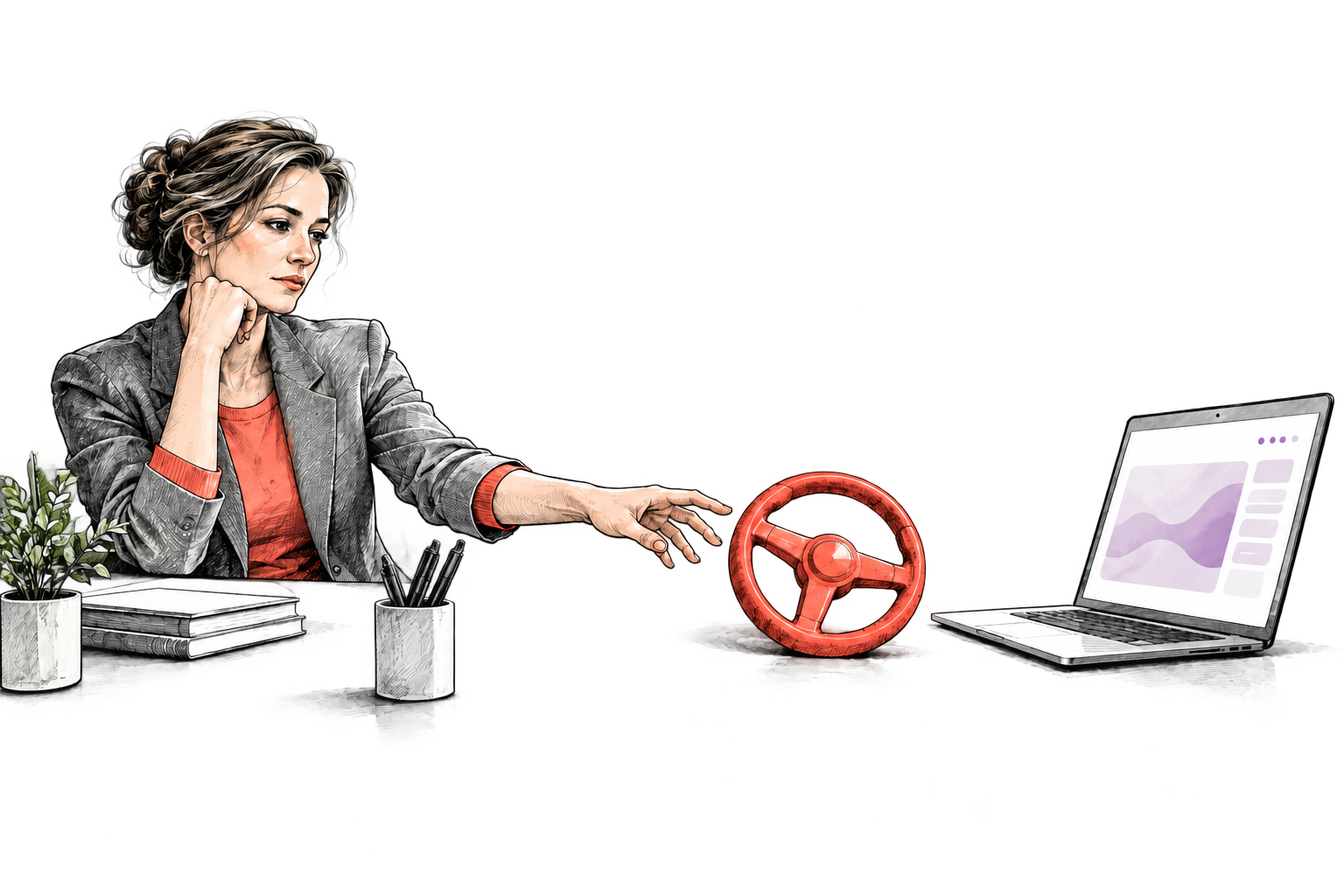
    We outsource it one sensible decision at a time.

    And I think this is where the AI conversation for professionals needs to change.

    We’ve spent years asking:

    Can AI do my job?

    Wrong question.

    The better question is:

    How much of my judgement am I willing to stop exercising because AI can exercise it faster?

    I’ve worked around technology for decades.

    Every major technology removes friction.

    That’s usually the point.

    Calculators removed arithmetic friction.

    Google removed information-retrieval friction.

    GPS removed navigation friction.

    AI is different.

    It can remove cognitive friction.

    The uncomfortable part before a decision.

    The doubt.

    The comparison.

    The argument with yourself.

    The search for alternatives.

    The moment when experience says:

    “The answer looks right, but something doesn’t feel right.”

    That’s precisely where professional judgement lives.

    And if you outsource that friction often enough, you may eventually outsource the capability that produced your value in the first place.

    This is why I don’t think the winning professionals of the AI era will be the people who use AI the most.

    They’ll be the people who know where to stop using it.

    Use AI to generate options.

    Use it to challenge assumptions.

    Use it to analyse more information than you ever could alone.

    Use it to accelerate the boring parts.

    But keep one thing stubbornly human:

    the final judgement.

    Because the most dangerous future may not be one where AI takes power from us.

    It may be one where AI becomes so useful, so accurate and so convenient that we happily give power away.

    No rebellion.

    No malevolence.

    No red flashing lights.

    Just billions of perfectly reasonable decisions.

    And one day we realise we’ve forgotten how to make them ourselves.

    AI dependency won’t arrive looking like a crisis.

    It will arrive looking like convenience.

    3 min read · estimated

    Read the article →

  • I Put a Red Alert on My Own Website. Three Weeks Later, Nobody Saw It.

    I Put a Red Alert on My Own Website. Three Weeks Later, Nobody Saw It.

    I built a red bar across the top of my site last month.

    Full width. White text. High contrast — I checked the numbers, 7.3 to 1, comfortably past the accessibility threshold. It was, by every measure I could apply, impossible to miss.

    My regular readers missed it.

    Not because they’re careless. Because it was still there. It had been there on their last four visits, saying the same thing, and their brains had done what brains do with anything that never changes.

    They filed it as furniture.

    And the moment I understood that, I realised I’d been watching the same failure for thirty years in rooms where the stakes were considerably higher than a newsletter signup.

    The version that costs money

    Walk into any network operations centre and look at the alarm board.

    Count the amber.

    Now ask how long each one has been amber.

    I have had that conversation more times than I can reconstruct, and the answer is almost never “since this morning.” It’s “that one’s been like that since we migrated.” It’s “oh, that’s just the link to the old site, ignore it.” It’s, occasionally and memorably, “I don’t actually know, it was like that when I got here.”

    The board is not showing the operator what’s wrong. It’s showing them what has been wrong long enough to become normal.

    Every one of those permanent ambers is doing something worse than nothing. It’s raising the floor. It’s teaching the room that colour doesn’t mean urgency, that the board is decorative, that judgement happens somewhere other than the screen everyone paid for.

    Post-incident reviews in process industries have been saying this for decades: when something goes genuinely wrong, the alarm that mattered arrived in a flood of alarms that didn’t, and the operator had already learned to discount all of them.

    The failure isn’t inattention.

    The failure is that we asked people to ignore things, they learned to, and then we were surprised.

    Why permanence kills signal

    Here’s the part that took me years to state properly.

    Information lives in change, not in presence.

    A warning that is always on carries no information. It’s a constant. You could delete it and the operator’s picture of the world would be identical, because they’d already deleted it themselves — just internally, where you can’t see them do it.

    This is not a discipline problem. You cannot train it away. Attention is a filter that adapts to its environment, and the environment you built taught it that red means nothing.

    Which produces the ugly conclusion:

    Your most urgent channel is your most fragile one.

    The louder the mechanism, the faster it burns out under permanence. A red banner is more susceptible to this than a plain sentence, because red is a promise. Break the promise a few times and the reader stops reading the colour, and now you’ve spent something you can’t easily buy back.

    I spent it on my own site in three weeks.

    The bit that connects to everything else I write

    Every permanent alert is a decision somebody didn’t make.

    That’s the whole thing.

    Nobody decided the link would stay degraded. Somebody deferred fixing it, then deferred deciding whether it mattered, and the amber became the record of that deferral — a small monument to a choice postponed.

    Multiply by the forty of them on the board, and the alarm system stops being a monitoring tool and becomes an archive of everything the organisation has quietly agreed not to resolve.

    That’s the complexity tax in its most visible form. Not an abstraction. A screen full of it, in colour, that everyone has stopped reading.

    And it arrives with a second bill: the next real incident costs more, because the mechanism that should have caught it early has been taught to be ignored.

    Three rules I now apply to anything that shouts

    Every permanent signal gets an expiry date.

    Not “we’ll review it.” A date. When the date arrives, either the condition is fixed or the alert is deliberately downgraded to something quieter — a log line, a report entry, a dashboard the right person actually opens. What is not allowed is for it to simply continue.

    My red bar now has a calendar entry. Six weeks, then it changes or it goes.

    Count what you’re asking people to ignore.

    This is the single most useful audit I know, and almost nobody runs it. Not “how many alerts do we have” — how many are we asking a human being to look past every day?

    If the number is above about five, you don’t have a monitoring system. You have a training programme in not looking.

    Test by removal.

    If you switch it off and nobody notices for a week, it was never doing its job. That’s not an argument for leaving it on. That’s the evidence you needed to take it out and put the attention somewhere it will be spent.

    The part I got wrong

    I want to be honest about what my instinct was when I saw the banner wasn’t working.

    Make it brighter.

    That’s the reflex — the alert isn’t landing, so increase the volume. Bigger type. Stronger red. Maybe animate it.

    It’s the same reflex that adds a fifth severity level to an alarm system that already has four nobody respects. It escalates the format instead of fixing the reason, and it always buys a few days before the new level gets absorbed into the furniture too.

    The answer was never more contrast.

    The answer was fewer permanent things, each of which changes when something actually changes.

    Go and look at your board

    Whatever your board is.

    The alarm console. The risk register nobody has reordered since the audit. The compliance dashboard that has shown the same two ambers since the NIS2 assessment. The banner on your own website.

    Count the things that have been in the same state for more than a month.

    That number is not a measure of your monitoring.

    It’s a measure of how much your organisation has agreed to stop seeing.

    And the thing about what you’ve stopped seeing is that it’s still there, still costing, still perfectly visible to whoever eventually writes the incident report.

    5 min read · estimated

    Read the article →

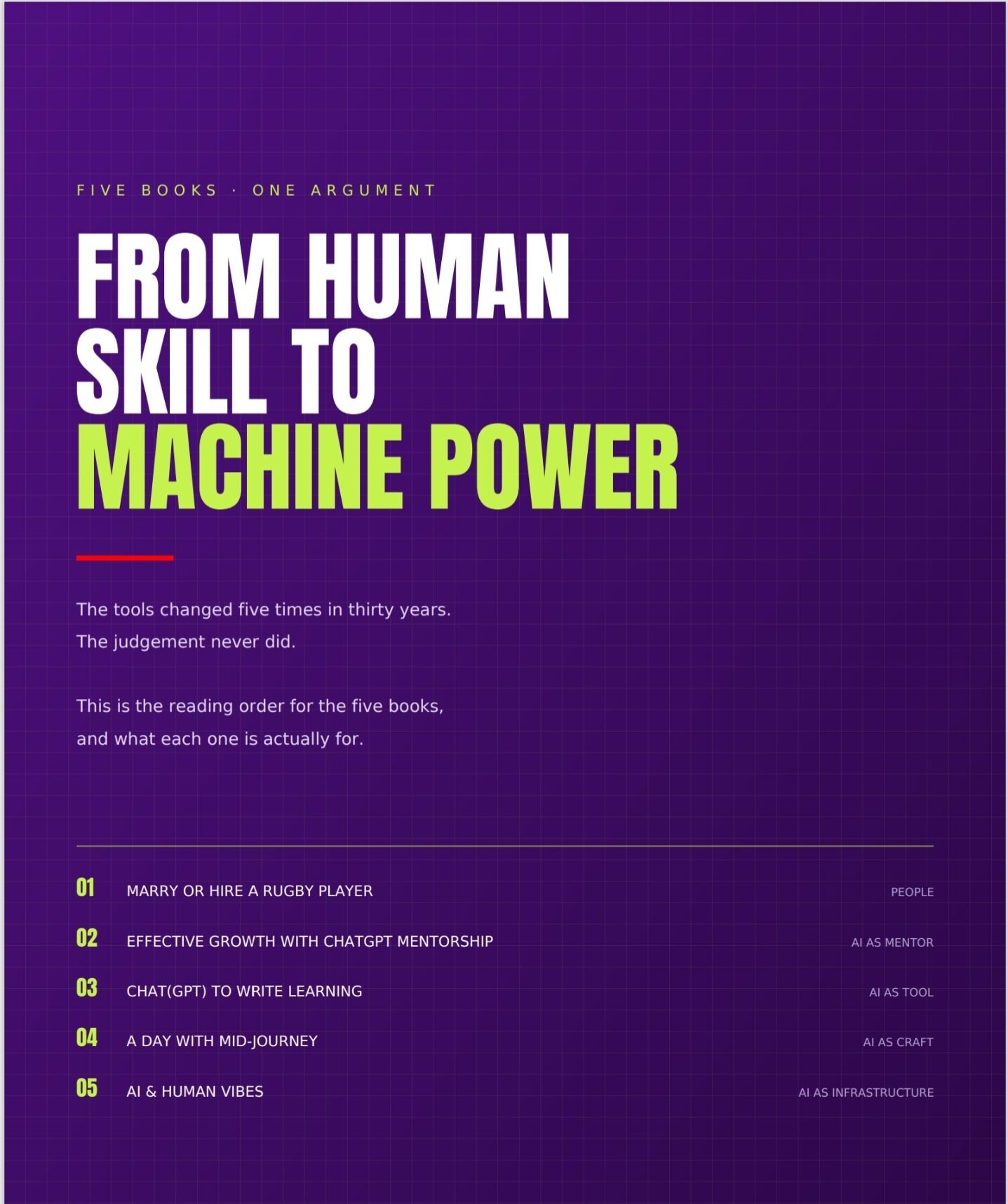
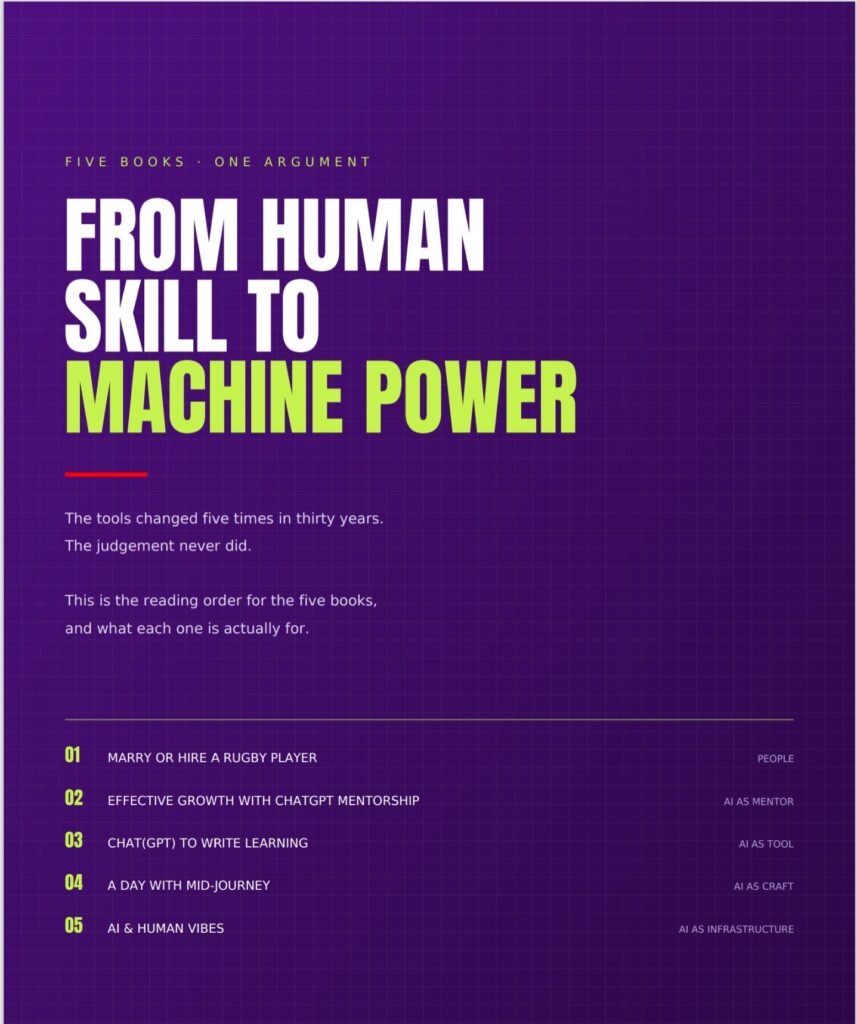
  • From Human Skill To Machine Power

    From Human Skill To Machine Power

    Some books – One topic

    The Tools Changed.
    The Judgement Didn’t.

    Five books written across five technology cycles. Read in order, they argue one thing: that every wave arrives promising to replace judgement, and every wave ends up needing more of it.

    Each one below tells you what it’s for and who it’s written for — so you can skip the four that aren’t yours.

    Cover of “From Human Skill to Machine Power”

    1 min read · estimated

    Read the article →

  • Who is Giuseppe Cordone?

    Who is Giuseppe Cordone?

    I didn’t build a personal brand.
    I built a career.

    For more than thirty years, I’ve sat across conference tables helping organizations buy, adopt, implement — and sometimes resist — technology.

    Long before AI became a buzzword.

    Long before LinkedIn became a stage.

    I’m an Electronic Engineer, graduated from La Sapienza University in Rome. Today, I work as a Key Account Manager for an Italian ICT system integrator, after spending more than three decades designing, selling, and bringing technology solutions into large networks and infrastructure environments.

    But none of this started with a blog.

    It started with a client telling me:

    “This will never work.”

    My job wasn’t to immediately convince him he was wrong.

    My job was to understand why he might be right.

    I studied Electronic Engineering and Expert Systems at a time when talking about artificial intelligence during a job interview didn’t make you sound visionary.

    Sometimes it simply made the interview shorter.

    Then came thirty years in the field.

    Technology deals.

    Large networks.

    Skeptical executives.

    Impossible deadlines.

    Projects that looked brilliant in PowerPoint and became painfully complicated in the real world.

    Failures.

    Negotiations.

    And the occasional breakthrough that genuinely changed the way people worked.

    That experience taught me something technology presentations rarely mention:

    Technology changes fast.

    People don’t.

    Writing came much later.

    Not to build an audience.

    Not to become an influencer.

    I started writing to make sense of what I was witnessing firsthand.

    Digital transformations that promised revolutions and then collided with organizational reality.

    Artificial intelligence changing professional work faster than many companies can absorb it.

    Experienced professionals trying to grow without throwing away the judgement they spent decades developing.

    And complex technology deals that were often won or lost long before anybody signed a contract.

    Over time, those observations became part of a framework I call Experiential Selling in ICT.

    It isn’t another sales methodology.

    It is a way of looking at complex technology selling through what actually happens in the field: conversations, resistance, mistakes, negotiations, trust, organizational dynamics, and the way real people make decisions when technology enters their business.

    Today, I mainly write about:

    • Digital Change — what really happens when technology, organizations, and people have to change together;

    3 min read · estimated

    Read the article →

  • Human + AI — how professionals can use AI as an accelerator without outsourcing judgement, accountability, or critical thinking;
  • Professional Growth — what a long career teaches you about learning, adapting, and remaining relevant;
  • Experiential Selling in ICT — lessons from decades of selling complex technology in the real world.

You won’t find recycled advice from keynote speakers here.

Or another collection of corporate slogans pretending change is easy.

You’ll find what happens when technology collides with reality.

Stories from conference rooms.

Lessons from the sales floor.

Projects that worked.

Projects that taught me more because they didn’t.

Conversations with customers who had very good reasons to say no.

And thirty years of watching technological change happen one difficult decision at a time.

Because after three decades in this business, I’ve learned that the most useful professional stories are rarely the perfect ones.

They’re the ones that actually happened.


→ Read the full story (About)

3 min read · estimated

Read the article →

  • How do you stay relevant in a tech career?

    How do you stay relevant in a tech career?

    Someone younger, cheaper, and more current is already in the room.

    That sentence makes many experienced professionals uncomfortable.

    It should.

    Because somewhere inside your company, your industry, or your next client meeting, there is probably someone who knows a newer tool than you do.

    They may code faster.

    They may know the latest platform.

    They may cost less.

    And they may have learned in six months what took you years to understand.

    That sounds like bad news.

    It isn’t.

    Unless your entire professional value is based on knowing how technology works.

    Because technical knowledge has an expiry date.

    Experience doesn’t.

    At least, not when you know how to use it.

    I’ve spent decades around technology.

    I’ve seen platforms become obsolete.

    Programming languages disappear.

    Architectures become unfashionable.

    Vendors that once looked untouchable become irrelevant.

    Every generation of technology eventually becomes someone else’s legacy system.

    Your skills are not immune.

    That certification you worked hard for?

    Someone else will get it.

    That platform you mastered will be replaced.

    That technology everyone is talking about today?

    One day it will appear in a PowerPoint slide titled “Legacy Environment.”

    That’s how technology works.

    It moves on.

    The mistake is believing your career has to move at the same speed.

    It doesn’t.

    Your real value is not knowing the technology.

    Years ago, I started noticing something strange.

    Some of the smartest engineers I knew were almost invisible.

    They could diagnose incredibly complex problems.

    They understood systems better than anyone else in the room.

    They knew how things worked.

    But when the meeting moved from technology to business, they disappeared.

    Not physically.

    Professionally.

    They started speaking a language nobody outside the technical team understood.

    Latency.

    Architecture.

    Protocols.

    Redundancy.

    Scalability.

    All important.

    But the person holding the budget was thinking about something else.

    “How much will this cost me?”

    “What problem does this solve?”

    “What happens if I do nothing?”

    “How quickly will I see a result?”

    “Why should I care?”

    That gap is where careers are made.

    And lost.

    The board doesn’t buy technology.

    People rarely buy technology because technology is interesting.

    Engineers sometimes forget this.

    A client doesn’t wake up in the morning wanting a better network architecture.

    They want fewer outages.

    A CEO doesn’t dream about cloud migration.

    They want flexibility, lower risk, faster growth or less capital tied up in infrastructure.

    A manager doesn’t want artificial intelligence.

    They want decisions made faster.

    Costs reduced.

    Customers served better.

    Problems detected earlier.

    Technology is the mechanism.

    Value is the reason.

    The professional who can connect the two becomes difficult to replace.

    Learn to explain “why it matters”

    This is one of the most valuable skills I’ve learned in technology.

    You should be able to explain a complex technology to someone who does not care about the technology.

    Not because they are stupid.

    Because they have a different job.

    The CFO does not need your architecture diagram.

    The CEO does not need your configuration parameters.

    The client does not need twenty-seven features.

    They need the consequence.

    Tell them what changes.

    Tell them what becomes easier.

    Tell them what risk disappears.

    Tell them what opportunity becomes possible.

    Do that in two minutes.

    If you can’t, you probably don’t understand the value well enough yet.

    I call it experiential selling.

    Selling technology is often treated as a feature comparison.

    Our product is faster.

    Our platform has more functions.

    Our solution supports another protocol.

    Our architecture scales better.

    Fine.

    But people do not experience specifications.

    They experience outcomes.

    That is why I prefer to think in terms of experiential selling.

    You are not selling a switch.

    You are selling what happens when the network stops becoming a problem.

    You are not selling cloud infrastructure.

    You are selling what a team can suddenly do faster because that infrastructure exists.

    You are not selling AI.

    You are selling the hours someone gets back.

    The decisions they can improve.

    The mistakes they can avoid.

    The customer experience they can redesign.

    The technology is backstage.

    The experience is what people remember.

    Brilliant engineers can stay invisible for twenty years.

    I’ve seen it happen.

    People with extraordinary technical ability.

    Reliable.

    Precise.

    Deeply competent.

    Everyone called them when something went wrong.

    But few called them when important decisions had to be made.

    That distinction matters.

    Being useful is not the same as being influential.

    And being technically indispensable is not the same as being professionally indispensable.

    Then I’ve seen the opposite.

    People who were not the strongest technologists in the room.

    But they could listen.

    They could simplify.

    They understood the business problem before discussing the solution.

    They could translate complexity into a story a client understood.

    They became the people executives wanted in the meeting.

    They became trusted.

    They became visible.

    Eventually, they became difficult to replace.

    Not because they knew more technology.

    Because they made technology mean something.

    This becomes even more important with AI.

    AI is making technical knowledge cheaper.

    That doesn’t mean technical professionals are becoming useless.

    It means information is becoming less scarce.

    Knowing the answer is no longer enough.

    Everyone has access to answers.

    The value moves somewhere else.

    Judgement.

    Context.

    Communication.

    Experience.

    The ability to ask the right question.

    The ability to understand what the client is really worried about.

    The ability to recognise when the technically elegant solution is the wrong business decision.

    AI can explain how something works.

    That makes your ability to explain why it matters more valuable, not less.

    Don’t stop studying

    This isn’t an argument against technical depth.

    Quite the opposite.

    You still need to understand the technology.

    You still need to study.

    Experiment.

    Stay curious.

    Keep updating yourself.

    Technical credibility matters.

    But don’t confuse the foundation with the whole building.

    If your only defence against a younger professional is:

    “I know more than they do,”

    you have a problem.

    Eventually, they may know more too.

    And they may learn it faster.

    Your advantage has to become something harder to download.

    Pattern recognition.

    Business understanding.

    Judgement.

    Trust.

    Communication.

    A network of relationships.

    The ability to connect technology with consequences.

    That is where decades of experience can finally compound instead of becoming obsolete.

    Your technical skills have an expiry date.

    Accept that now.

    Not five years from now.

    Not when your company restructures.

    Not when a new technology suddenly becomes mandatory.

    Not when someone half your age walks into the room knowing the platform better than you do.

    Accept it while you still have time to build the skills that don’t expire so quickly.

    Keep learning the technology.

    But learn the business too.

    Learn how your client makes money.

    Learn what your CEO worries about.

    Learn how decisions are made.

    Learn to simplify without becoming simplistic.

    Learn to tell the story behind the architecture.

    Because the safest professional in the room is rarely the person who knows the most.

    It’s the person who makes what everyone knows useful.

    Someone younger, cheaper and more current may already be in the room.

    Good.

    Let them know how the technology works.

    You learn to explain why it matters.

    → Go to Professional Growth
    6 min read · estimated

    Read the article →

  • More posts