Search results for: “leadership”

  • Whatever Happened to Dubai’s Influencers?

    Whatever Happened to Dubai’s Influencers?

    The luxury feeds met a reality that could not be edited out.

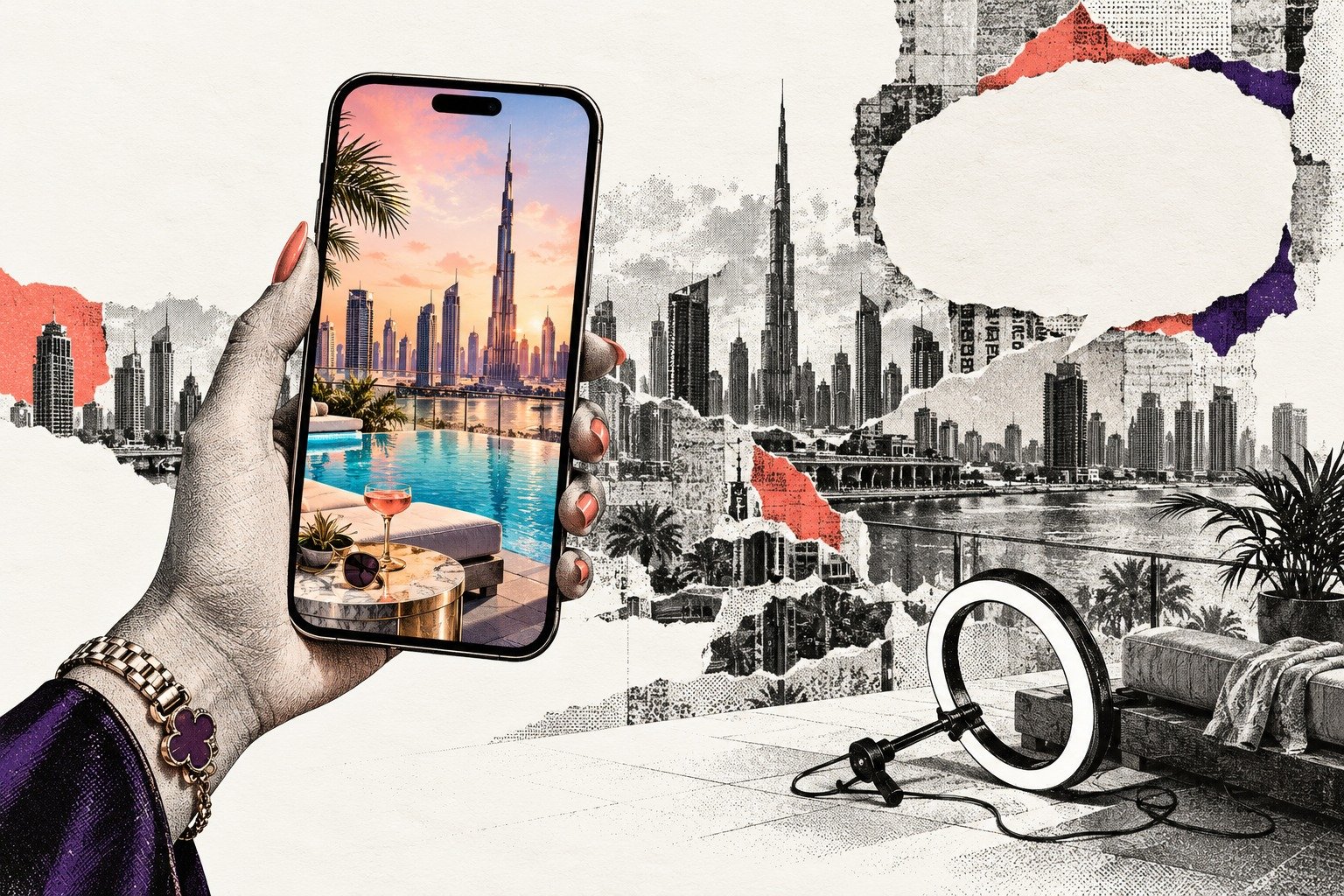
    Dubai looked extraordinary through a smartphone.

    Rooftop pools. Supercars. Apartments above the clouds. Entrepreneurs explaining financial freedom from restaurants where lunch could swallow somebody else’s weekly salary.

    The message was persuasive: this was where successful people went to live.

    Then came a harder question.

    What happens when your business depends on presenting paradise—and paradise becomes a news story?

    When the content changed

    During the Iranian attacks in March 2026, some Dubai-based influencers briefly exchanged lifestyle content for eyewitness updates. Videos showed smoke, anxious reactions and events unfolding near familiar luxury locations.

    ABC News reported on March 10 that fitness creator Will Bailey had posted footage and spoken to international media, then stopped posting. Other accounts shifted towards messages praising the UAE’s leadership and security response. The report also described official warnings over misinformation and material that could cause public panic.

    That does not establish that every silent creator was censored, or that every reassuring post was commissioned.

    It does establish something more useful: a social feed becomes difficult to interpret when personal safety, commercial interests and restrictions on expression overlap.

    Silence can have several explanations. An upbeat video can, too.

    Neither should automatically be treated as an independent assessment of conditions on the ground.

    The disappearance story is too convenient

    “Dubai’s influencers have vanished” makes an excellent headline.

    It also bundles different people into a single fictional character.

    A fitness coach, a property salesperson, a travel creator and a business owner may share a skyline. They do not necessarily share an income model, political opinion or reason for staying.

    An April 9 Deutsche Welle analysis examined the competing claims that the “Dubai dream” had ended or that life was continuing normally. Its framing challenged the temptation to turn a complex economic and social situation into a verdict based on influencer narratives.

    The evidence discussed here concerns particular episodes in March and April. It does not provide a comprehensive October census of who left, who stayed or who returned.

    We should resist inventing one.

    When the location becomes the product

    For some creators, Dubai is more than a place to live.

    It is part of the sales proposition.

    The background helps communicate success before the speaker has explained what they actually do. A skyline becomes evidence. A hotel becomes a credential. Proximity to wealth becomes a suggestion of expertise.

    This is my interpretation of the business model, rather than a claim about every Dubai-based creator.

    But it explains the tension.

    If your content sells the promise of security, prosperity and frictionless opportunity, uncomfortable developments can threaten both your confidence and your commercial positioning.

    That creates an incentive to reassure.

    It does not prove dishonesty. It gives audiences a reason to examine incentives.

    The creator economy has rules beyond the algorithm

    Dubai’s influencer ecosystem also operates within a regulated advertising market.

    The UAE’s official Advertiser Permit framework covers individuals conducting social-media advertising, whether compensated or unpaid, subject to stated exemptions. It requires compliance with media standards and display of the permit number; visiting advertisers apply through licensed agencies. These are advertising requirements, not evidence that every personal post requires a permit.

    For creators, the practical lesson extends beyond Dubai.

    Your audience may be global. Your platform may be American. Your sponsors may be international.

    Your physical location still matters.

    So do local rules, residency arrangements and the organisations on which your business depends.

    “Digital independence” can conceal considerable dependence.

    What audiences should take away

    There is nothing inherently suspicious about enjoying Dubai, building a business there or choosing to remain during uncertainty.

    There is also nothing inconsistent about leaving when circumstances change.

    The credibility test is how a creator explains that change.

    Do they distinguish personal experience from verified information? Disclose commercial relationships? Acknowledge uncertainty? Correct earlier claims?

    A creator saying, “I feel safe where I am,” offers a personal observation.

    A creator saying, “There is no risk,” makes a much broader claim.

    Followers should hear the difference.

    The skyline was never the guarantee

    Perhaps the most revealing question is not where Dubai’s influencers went.

    It is why audiences accepted so much lifestyle imagery as evidence of sound judgment.

    Beautiful surroundings can demonstrate access. They cannot establish competence, independence or foresight.

    The same applies to people selling AI expertise, investment wisdom or career transformation.

    Watch how someone handles an inconvenient fact. It tells you more than their most impressive backdrop.

    When reality interrupts the sales pitch, does the creator help you understand what changed—or simply change the camera angle?

    Sources and editorial note

    ABC News, March 10, 2026 · Deutsche Welle, April 9, 2026 · UAE Advertiser Permit framework.

    Prepared October 23, 2026. This commentary distinguishes documented reporting from the author’s interpretation. Text and illustration prepared with AI support and subject to editorial review.

    4 min read · estimated

    Read the article →

  • SIOSK? Super Intelligence or Synthetic Knowledge

    SIOSK? Super Intelligence or Synthetic Knowledge

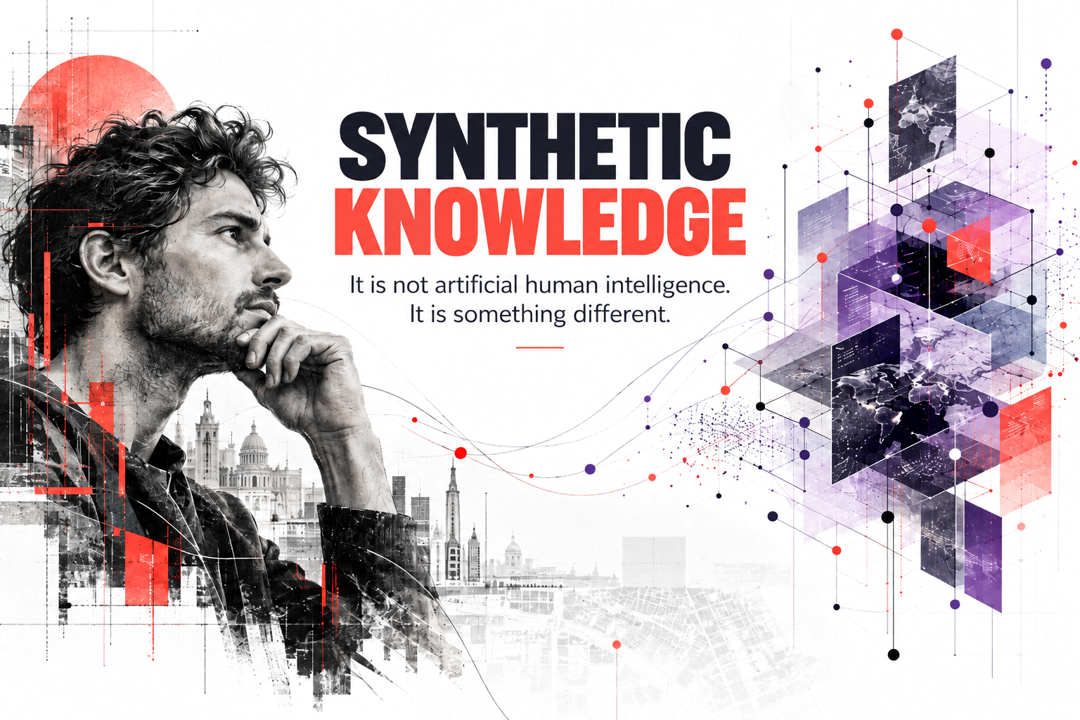
    “Artificial Intelligence” has never really convinced me as a name.

    Not now, and not back when I was an engineering student, when nobody talked about these things. If you had brought it up seriously over coffee, people would almost certainly have thought you were a bit crazy. So I kept the doubt to myself. It stayed with me anyway.

    And over the years I’ve realised the problem isn’t “Artificial”.
    It’s “Intelligence”.

    We keep talking about human intelligence and machine intelligence as if they were two versions of the same thing. They aren’t, and I’m not even sure it makes sense to compare them.

    Human intelligence comes from experience. From the body, emotions, relationships, values, memory, and a constant reading of context.
    What the machine has comes from data, computation and mathematical models, plus the ability to find correlations at a scale that is simply out of our reach.

    We live the world. The machine processes it.
    We forget, we interpret, we doubt. The machine takes in millions of pieces of information and recombines them in seconds.

    It isn’t a faster human being. It’s something else.

    That’s also why “Super Intelligence” only half works for me. “Super” implies a race, as if sooner or later we’ll have to find out who’s smarter, us or it. I think that’s the wrong question.

    If I had to choose a name, I’d call it Synthetic Knowledge.

    Synthetic because it doesn’t come from lived experience. It’s built, assembled, calculated, and then made available on demand.
    Knowledge because that’s what I find genuinely interesting: a non-human ability to gather, compress, correlate and recombine huge amounts of what we know.

    And that changes the game.

    The future won’t be a contest between human and artificial intelligence. It will be a combination: human judgment plus synthetic knowledge.

    Access to AI won’t be the advantage for long. It will become normal (at least at the levels we’ll be allowed to use).
    The real advantage will be knowing when to trust synthetic knowledge, and having enough human intelligence to contradict it when it’s wrong.

    We’ve spent a lot of time asking how intelligent AI will become.
    Maybe the better question is this one:

    How good will we need to become at governing knowledge that grows much faster than our ability to understand it?

    #ArtificialIntelligence #SyntheticKnowledge #CriticalThinking #FutureOfWork #Leadership

    2 min read · estimated

    Read the article →

  • AI Was Supposed to Be the Great Equalizer. 
It May Do the Exact Opposite.

    AI Was Supposed to Be the Great Equalizer. It May Do the Exact Opposite.

    Everyone gets the same superpower. That doesn’t mean everyone gets the same result.

    AI has been sold to us as The Great Equalizer.

    I understand why.

    A teenager with a laptop can now access capabilities that once required a company.

    A freelancer can analyze data like a small consulting team.

    A founder can create a prototype without hiring ten developers.

    A writer can research a subject in minutes.

    A salesperson can prepare for a meeting with the analytical firepower that once belonged to an entire sales operations department.

    A student can have a private tutor available at 2:17 in the morning.

    That sounds like equality.

    It may not be.

    Because we confuse equal access to intelligence with equal ability to use it.

    Those are two very different things.

    And that difference may define the next decade.

    AI lowers the floor.

    This is the part everyone can see.

    You no longer need to know how to code to create simple software.

    You don’t need to be a designer to make a decent presentation.

    You don’t need perfect English to publish in English.

    You don’t need to spend three days researching a market before walking into a meeting.

    AI removes friction.

    That is extraordinary.

    It democratizes capability.

    But something strange happens when a capability becomes universally available.

    It stops being an advantage.

    Think about calculators.

    Owning a calculator doesn’t make you a mathematician.

    Google gave billions of people access to almost unlimited information.

    It didn’t make billions of people experts.

    Social media gave everyone a publishing platform.

    It didn’t turn everyone into a great writer.

    Smartphones put a professional-quality camera in billions of pockets.

    It didn’t create billions of photographers.

    Technology repeatedly makes the tool abundant.

    Then something else becomes scarce.

    AI will be no different.

    The Great Equaliser has a nasty second act.

    Open LinkedIn.

    Scroll for five minutes.

    You can almost smell the AI.

    Perfect structure.

    Perfect grammar.

    Perfect bullet points.

    Perfect mediocrity.

    People who once struggled to write a bad post can now produce twenty average ones before breakfast.

    That’s progress of a sort.

    Coders can generate code faster.

    Marketers can create campaigns faster.

    Managers can produce reports faster.

    Students can write essays faster.

    Consultants can make slides faster.

    We are becoming incredibly efficient at producing things.

    But here’s the uncomfortable question:

    Are we becoming better at thinking?

    Because those are not the same thing.

    AI can dramatically increase output while quietly decreasing intellectual effort.

    And if we’re not careful, we’ll mistake increased production for increased capability.

    That’s dangerous.

    You can now create something that looks intelligent without doing much thinking yourself.

    The email sounds intelligent.

    The strategy document looks intelligent.

    The presentation feels intelligent.

    The code appears intelligent.

    The article reads intelligently.

    But appearance is becoming cheap.

    AI can manufacture it at an industrial scale.

    That means the market will eventually stop rewarding appearance.

    Mediocrity is about to become incredibly cheap.

    This may be one of AI’s biggest economic consequences.

    Average content is becoming nearly free.

    Average analysis is becoming nearly free.

    Average code is becoming cheaper.

    Average presentations are becoming cheaper.

    Average research is becoming cheaper.

    Average advice is becoming cheaper.

    That’s fantastic if you need average work.

    It’s brutal if you sell average work.

    The danger isn’t simply that AI will replace people.

    The more immediate danger is that AI will make huge amounts of previously valuable work indistinguishable.

    When everybody can produce a polished 1,000-word article in thirty seconds, producing 1,000 words isn’t valuable anymore.

    When everybody can create a reasonable marketing plan, the plan isn’t the differentiator.

    When everybody can generate code, typing code becomes less scarce.

    When everybody can summarise the same information, summarising information stops being impressive.

    The technology creates abundance.

    Abundance creates a new scarcity.

    That’s the part we should be obsessed with.

    When intelligence becomes abundant, judgment becomes scarce.

    This is where the Great Equaliser starts looking less equal.

    Give two people the same AI.

    One asks:

    “Write me a LinkedIn post about leadership.”

    The other asks:

    “Here are 20 customer interviews, our failed product launch, three years of sales data, my hypothesis about why customers are leaving, and the assumptions I think may be wrong. Challenge my reasoning before we decide what to do.”

    Same AI.

    Different human.

    Different outcome.

    The difference isn’t prompt engineering.

    It’s thinking.

    One person is outsourcing production.

    The other is amplifying judgment.

    That’s the divide that matters.

    AI doesn’t eliminate expertise.

    It can make expertise more leveraged.

    A mediocre strategist with AI may become faster.

    A brilliant strategist with AI can explore ten hypotheses, interrogate assumptions, simulate objections, synthesise research and test alternatives before the mediocre strategist has finished polishing the first PowerPoint slide.

    That’s not equalisation.

    That’s amplification.

    AI doesn’t just raise the floor. It blows the roof off the ceiling.

    This is the part of the conversation we’re missing.

    AI can help beginners perform tasks they couldn’t perform yesterday.

    That’s the democratizing effect.

    But AI can also give highly capable people enormous leverage.

    That’s the inequality effect.

    Give a mediocre writer AI, and they may become competent.

    Give an exceptional writer AI, and they can research faster, explore more ideas, challenge weak arguments, translate their work, repurpose it and distribute it across the world.

    Give a beginner programmer AI, and they can build a basic app.

    Give an experienced engineer AI, and they can use it across architecture, testing, debugging, documentation and experimentation while knowing when the machine is confidently wrong.

    Give an average salesperson AI, and they can generate an email.

    Give an exceptional salesperson AI, and they can analyse an account, map stakeholders, understand an industry, prepare objections, personalise a narrative and walk into the conversation better prepared than almost anyone else.

    The first person gets productivity.

    The second gets leverage.

    That’s a huge difference.

    The real divide won’t be AI users versus non-AI users.

    That distinction will disappear.

    Soon saying “I use AI” will sound as strange as saying:

    “I use the internet.”

    Of course you do.

    The interesting question will be:

    What happens to you when you use it?

    Does AI make your thinking sharper?

    Or does it save you from thinking?

    Does it expand your curiosity?

    Or give you an excuse to stop researching?

    Does it challenge your assumptions?

    Or produce elegant confirmation of whatever you already believe?

    Does it make you more capable?

    Or merely more productive?

    Does it increase your judgment?

    Or gradually make you dependent on borrowed judgment?

    These questions are harder than learning prompts.

    That’s why they matter more.

    Human × AI sounds good. But multiplication has a problem.

    There’s a popular idea emerging:

    Human × AI.

    I like it.

    But multiplication contains an uncomfortable truth.

    Anything multiplied by zero is still zero.

    Weak judgment × powerful AI doesn’t magically become wisdom.

    No curiosity × AI doesn’t produce discovery.

    No original experience × AI doesn’t produce authenticity.

    No responsibility × AI doesn’t produce leadership.

    No taste × infinite generation gives you infinite things with no idea which one matters.

    AI amplifies.

    That means it can amplify capability.

    It can also amplify stupidity.

    Bias.

    Noise.

    Bad incentives.

    Poor decisions.

    And mediocrity.

    Faster.

    That’s why the real equation we should care about may be different:

    Human + AI = +Human.

    After introducing AI, does the system have more human capability left?

    More judgment?

    More curiosity?

    More creativity?

    More autonomy?

    More ability to challenge an answer?

    More capacity to make a decision when the machine cannot?

    If the answer is no, we haven’t augmented the human.

    We’ve created dependence with a productivity dashboard attached to it.

    Access will become cheap. Agency won’t.

    This is where inequality may accelerate.

    The scarce asset won’t be access to ChatGPT, Claude, Gemini, or whatever model wins next month’s leaderboard.

    Models will improve.

    Prices will fall.

    Capabilities will spread.

    Interfaces will become invisible.

    AI will be everywhere.

    Access will become boring.

    But some people will combine AI with things that remain scarce:

    Experience.

    Reputation.

    Capital.

    Distribution.

    Customer relationships.

    Proprietary data.

    Domain knowledge.

    Taste.

    Trust.

    Networks.

    Judgment.

    Ownership.

    The ability to decide what problem is worth solving.

    AI sitting on top of those assets creates enormous leverage.

    AI without them often creates more output.

    That’s why the same technology can democratize capability while concentrating outcomes.

    It can do both at once.

    That’s the paradox.

    Don’t become digital fodder.

    There is a very tempting AI strategy right now:

    Produce more.

    More posts.

    More emails.

    More videos.

    More code.

    More presentations.

    More proposals.

    More everything.

    The machine makes production cheap, so we naturally produce more.

    But if everyone follows that strategy, we create a tsunami of synthetic abundance.

    The internet fills with acceptable things nobody asked for.

    Then attention becomes even scarcer.

    Trust becomes scarcer.

    Original thought becomes scarcer.

    Credibility becomes scarcer.

    And eventually the advantage shifts toward the people who can do something AI cannot easily manufacture:

    Know what deserves to exist in the first place.

    That requires judgment.

    You don’t need AI to replace your thinking.

    You need it to increase the surface area of your thinking.

    Use it to attack your argument.

    Ask it what you’ve missed.

    Make it find counterexamples.

    Use it to explore the option you dismissed too quickly.

    Let it expose gaps in your knowledge.

    Make it simulate the customer who hates your idea.

    Ask it to distinguish evidence from assumption.

    Then make the decision yourself.

    That’s augmentation.

    Everything else risks becoming intellectual autocomplete.

    The next digital divide will be cognitive.

    The old digital divide was largely about access.

    Who had a computer?

    Who had broadband?

    Who had cloud infrastructure?

    Who had data?

    AI changes the shape of that divide.

    Millions — eventually billions — of people may have access to similar baseline intelligence.

    That sounds wonderfully democratic.

    But equal access to a tool doesn’t produce equal outcomes.

    The next divide may be between people who use AI to avoid difficult thinking and people who use AI to go deeper into it.

    Between people who generate answers and people who formulate better questions.

    Between people who consume intelligence and people who orchestrate it.

    Between people who accept outputs and people who exercise judgment.

    Between people who rent capability from a machine and people who turn that capability into assets they own.

    The winners won’t necessarily be those with the best AI.

    They may be the people who become better humans because they have AI.

    That’s a very different race.

    AI isn’t the Great Equalizer.

    It’s the Great Amplifier.

    It lowers barriers.

    That’s real.

    It gives millions of people capabilities they never had.

    That’s worth celebrating.

    But don’t confuse democratized capability with democratized outcomes.

    The same technology that gives a beginner extraordinary new powers can give an expert extraordinary new leverage.

    The same machine that helps one person write their first line of code can help another build a company.

    The same AI that helps someone produce ten generic posts can help someone else turn thirty years of experience into an intellectual asset that reaches millions.

    The technology doesn’t decide which happens.

    We do.

    So perhaps the most important question of the AI era isn’t:

    “How powerful will AI become?”

    We already know the direction of travel.

    The better question is:

    What becomes scarce when intelligence becomes abundant?

    My bet?

    Judgment.

    Curiosity.

    Taste.

    Trust.

    Experience.

    Responsibility.

    And the ability to know when the machine is wrong.

    Those aren’t old-fashioned human skills that survived the AI revolution.

    They may become more valuable because of it.

    AI can level the playing field.

    It can also tilt it dramatically.

    The difference will increasingly come down to what you bring to the machine.

    Don’t race AI.

    Don’t surrender to it either.

    Use it to become harder to replace, not easier to imitate.

    The clock isn’t ticking because AI is coming.

    It’s ticking because everybody already has it.

    What are you becoming with yours?

    ​👉 Ready to stay ahead of the curve? Join the conversation and read the latest deep dives on hightechstories.com.

    Disclaimer: Content generated with the support of Artificial Intelligence (Gemini). The underlying ideas, analysis, and opinions are entirely human-led and reflect personal perspectives on the topic.

    #ArtificialIntelligence #AIRevolution #FutureOfWork #Leadership #TechTrends #Inequality
    10 min read · estimated

    Read the article →

  • 1 min read · estimated

    Read the article →

Expert in ICT, Writer, tech enthusiast in Digital Transformation and Innovation. Let’s journey!  1,480 Subscribers

I publish when an essay is ready—when the ideas have matured, the argument holds, and there’s something worth sharing.

I’m a curious observer of how technology changes our work and lives.

On this Medium blog, you’ll find technology stories, reflections on AI and digital transformation, and practical articles on career growth, leadership, and complex B2B sales. Drawing on professional experience, I explore the human side of innovation: the habits, decisions, and relationships that determine whether new tools create real value.

Expect personal stories, challenging questions, and ideas you can put into practice.

1 min read · estimated

Read the article →

  • Fabrizio R. –
Global AM for HPE

    Fabrizio R. – Global AM for HPE

    Portrait of a person wearing sunglasses with a LinkedIn logo overlay.
    A reviewer shares their perspective on the author’s work.

    I had the pleasure of collaborating with Giuseppe since 2010 until these days at Sirti. Giuseppe is a diligent and hardworking Senior Sales Manager with an excellent technical understanding of the most complex solutions in IT that allowed him to lead into the whole sales process and in countless account wins also thanks to his tenacious approach to new opportunities and good customer service and intimacy. Giuseppe is a pleasure to work with and well respected by colleagues and clients alike.

    Giuseppe has proven to master as no other the complexity of selling to both telecom operators and large enterprises. Not only can he manage the sensitivities at all hierarchical levels within the customer’s organization, does he understand every step of the long technical sales process, but he truly knows how to sells on the value of the products.

    1 min read · estimated

    Read the article →

  • Alison T. –
CTO – Digital Transformation Department in PDM

    Alison T. – CTO – Digital Transformation Department in PDM

    As a CTO, I value professionals who connect technical expertise with a clear understanding of organizational priorities.

    Through our collaboration, I have appreciated Giuseppe and his ability to understand complex ICT solutions, navigate demanding stakeholder relationships, and explain technology in terms of the value it can deliver.

    He engages credibly with technical teams and senior leadership alike, helping stakeholders understand the capabilities of a solution and its relevance to their objectives.

    Giuseppe combines commercial experience with technical depth and a strong commitment to the people he works with. These qualities make him a respected professional and a valuable counterpart in complex technology initiatives.

    1 min read · estimated

    Read the article →

  • Joe M. –
CSO at MonsterTips

    Joe M. – CSO at MonsterTips

    As a Chief Sales Officer, I look for people who understand the technology, earn the customer’s trust, and turn complex opportunities into business.

    Giuseppe brings all three.

    Throughout all time passed together, he has combined deep technical knowledge with the persistence and commercial judgment needed to win demanding accounts.

    Selling to telecom operators and large enterprises takes more than a convincing presentation. It requires patience, an understanding of competing priorities, and credibility at every level of the customer’s organization.

    Giuseppe understands that. He navigates long sales cycles, handles sensitive relationships, and keeps the conversation focused on the value the customer will gain.

    He can explain a complex solution. More importantly, he can make clear why it matters to the business.

    That combination has helped him secure numerous account wins and earn the respect of clients and colleagues alike.

    From a sales leadership perspective, he is someone I value highly: technically credible, commercially focused, and a pleasure to work with.

    1 min read · estimated

    Read the article →

  • More posts