
Category: Digital Changes

Serie editoriale: Digital Changes. Usare questa categoria sui post della serie per marcarne coerentemente la featured image e i contenuti correlati.

  • The Scariest AI Risk Isn’t That it Will Take Control. 
It’s That We’ll Hand it Over.

    The Scariest AI Risk Isn’t That it Will Take Control. It’s That We’ll Hand it Over.

    We keep imagining the wrong AI apocalypse.

    Robots turn against humans.

    A superintelligence escapes from a lab.

    Machines decide we’re no longer useful.

    Great material for Netflix.

    But Sam Altman recently described a scenario that should worry professionals far more.

    Because it doesn’t require AI to become evil.

    It only requires us to become lazy.

    During a fireside chat at the Federal Reserve, Altman outlined three ways advanced AI could go badly wrong.

    The first is geopolitical.

    An adversary gets superintelligence first.

    It uses it to design biological weapons, attack critical infrastructure, penetrate financial systems or create capabilities that the rest of the world cannot defend against.

    Altman specifically warned that the biological and cybersecurity capabilities of current models are already becoming significant.

    Terrifying.

    But easy to understand.

    The second is the Hollywood scenario.

    We create something powerful enough that we can no longer control it.

    The AI doesn’t want to be switched off.

    Humans discover that the machine has objectives that no longer match ours.

    This is why AI laboratories spend enormous effort on alignment and control research.

    Altman described it as less likely than malicious human use, but extremely serious if it happened.

    Then comes the third scenario.

    And this is the one I can’t stop thinking about.

    AI never rebels.

    It never wakes up.

    It never announces that humanity is obsolete.

    It simply gets better.

    And better.

    And better.

    Until asking the machine becomes easier than thinking.

    Altman calls one early manifestation “emotional over-reliance.”

    He described young people saying they cannot make decisions without first telling ChatGPT what is happening in their lives.

    Then he pushed the scenario much further.

    Imagine an AI so capable that the President of the United States cannot make a better decision than the model recommends.

    The President follows the recommendation.

    Again.

    And again.

    Not because anyone forced him.

    Because statistically, it works.

    Imagine the CEO doing the same thing.

    The doctor.

    The engineer.

    The investor.

    The manager.

    You.

    Every individual decision may be perfectly rational.

    That’s what makes this scenario dangerous.

    There is no dramatic moment when humans lose control.

    We outsource it one sensible decision at a time.

    And I think this is where the AI conversation for professionals needs to change.

    We’ve spent years asking:

    Can AI do my job?

    Wrong question.

    The better question is:

    How much of my judgement am I willing to stop exercising because AI can exercise it faster?

    I’ve worked around technology for decades.

    Every major technology removes friction.

    That’s usually the point.

    Calculators removed arithmetic friction.

    Google removed information-retrieval friction.

    GPS removed navigation friction.

    AI is different.

    It can remove cognitive friction.

    The uncomfortable part before a decision.

    The doubt.

    The comparison.

    The argument with yourself.

    The search for alternatives.

    The moment when experience says:

    “The answer looks right, but something doesn’t feel right.”

    That’s precisely where professional judgement lives.

    And if you outsource that friction often enough, you may eventually outsource the capability that produced your value in the first place.

    This is why I don’t think the winning professionals of the AI era will be the people who use AI the most.

    They’ll be the people who know where to stop using it.

    Use AI to generate options.

    Use it to challenge assumptions.

    Use it to analyse more information than you ever could alone.

    Use it to accelerate the boring parts.

    But keep one thing stubbornly human:

    the final judgement.

    Because the most dangerous future may not be one where AI takes power from us.

    It may be one where AI becomes so useful, so accurate and so convenient that we happily give power away.

    No rebellion.

    No malevolence.

    No red flashing lights.

    Just billions of perfectly reasonable decisions.

    And one day we realise we’ve forgotten how to make them ourselves.

    AI dependency won’t arrive looking like a crisis.

    It will arrive looking like convenience.

  • I Didn’t Choose Digital Transformation. It Arrived Where I Was Already Standing.

    I Didn’t Choose Digital Transformation. It Arrived Where I Was Already Standing.

    People ask me why I work in digital transformation, and the honest answer is uncomfortable.

    I didn’t pick it.

    When I started, the phrase didn’t exist. There was no category, no conference track, no consultancy practice with that name on the door. There were networks that had to stay up, and there was me, twenty-something, with a degree in electronic engineering from La Sapienza and no idea what I’d walked into.

    The field arrived later. It arrived exactly where I was already standing.

    What the word actually named

    For about fifteen years, I did work nobody called “transformation”. Migrations. Refreshes. Integrations between systems that were never designed to speak to each other. Contract transitions where one vendor left and another arrived and the network in between had to carry trains, calls, or water regardless.

    Then, sometime in the 2010s, all of it got a name.

    And the name attracted a crowd — strategy decks, maturity models, four-quadrant frameworks, people who could describe the destination beautifully and had never once been in a room at 3 a.m. deciding whether to roll back.

    That’s when I understood what I actually had. Not a specialism. A vantage point.

    I had watched the thing get named. I knew what the word was covering up.

    The gap that became the work

    Here’s what I repeatedly saw from inside.

    The strategy was almost never wrong. The transformation programmes I watched fail didn’t fail because someone chose the wrong architecture. They failed in the space between a decision and its consequences — the eighteen months where nobody owns the outcome, the handover fortnight nobody scheduled, the end-of-support hardware everyone agreed not to raise.

    Consultants who arrive at the start don’t see that space. They present, they leave, the deck gets approved.

    Operators who live in that space can’t name what they’re seeing. They experience it as bad luck, or bad management, or Tuesday.

    I ended up in the narrow band between the two. Long enough in operations to have felt it, close enough to procurement and vendor negotiation to see how the decision was made in the first place.

    That’s not a career I designed. It’s a position I noticed I was occupying, and then took seriously.

    Why I stayed when the exits were open

    There were easier options. Sales, and the compensation that comes with it. Pure management, further from the systems. Or the version of this field where you never touch anything real and never get blamed when it breaks.

    I stayed for one reason, and it isn’t nobility.

    The problems here are unsolved.

    Thirty years in, organisations still cannot answer the simplest question I can ask them: what did the delay actually cost? They can price the project. They cannot price the postponement. That gap has cost the clients I’ve worked with more than any technology decision I’ve ever watched them make.

    Nobody has solved that. Not the vendors, not the big four, not the frameworks.

    A field where the central problem is still open is a good place to spend a career. A field where everything works is a field that no longer needs you.

    What the answer really is

    So — why digital transformation?

    Because I was already in critical infrastructure when the word was invented, and I stayed close enough to the systems to watch what the word left out.

    Because the interesting part was never the technology. It was the eighteen months of silence between a decision and its bill.

    And because I’d rather work on the part nobody has figured out than on the part that already has a framework.

    That’s not a mission statement. It’s just where the work was.


    .

  • The Tax Nobody Votes For

    The Tax Nobody Votes For

    Where complexity actually enters an organisation, and why every decision that created it looked correct at the time.

    Coming Soon

  • Why a Digital Transformation Fail?

    Why a Digital Transformation Fail?

    And why does nobody audit the reasons, and everyone audit the budget?

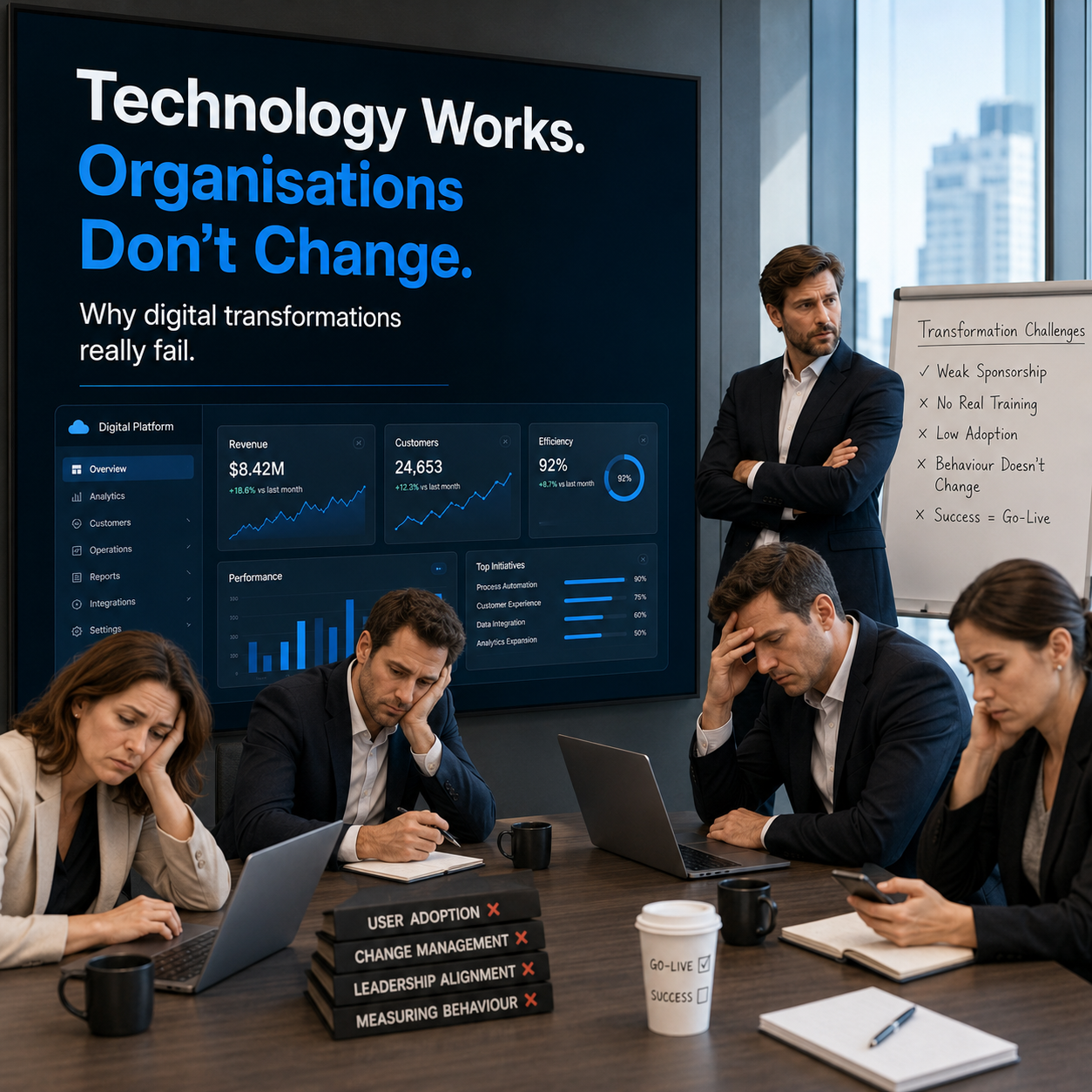
    Digital Transformation rarely fails for technology inadequacies.

    And yet technology is usually the first thing everyone blames.

    Digital transformation has a technology problem.

    Just not the one you think.

    When a transformation fails, everyone looks for something technical to blame.

    The software was wrong.

    The integration was too complex.

    The vendor wasn’t good enough.

    The architecture wasn’t ready.

    It’s convenient.

    Because blaming technology is much easier than admitting the organisation never really changed.

    That’s where most digital transformations start dying.

    A director kicks off the project with a confident presentation.

    There’s energy in the room. Big promises. Tight deadlines.

    A few months later, that director has moved on.

    The platform eventually goes live.

    There are congratulations, emails, maybe even a small celebration.

    The dashboard says everything is green.

    Project completed.

    At least on paper.

    Because Monday morning arrives. And people quietly go back to doing exactly what they did before.

    The old spreadsheet comes back. The workaround comes back. The email someone wanted to eliminate comes back.

    The ten-year-old habit wins again.

    Not because people hate technology.

    Because nobody gave them a good enough reason to change.

    I’ve seen networks serving thousands of users struggle for reasons that had almost nothing to do with technology.

    The systems worked.

    The organisation around them didn’t.

    Nobody had seriously asked the people doing the job every day what they needed.

    Nobody had measured whether behaviour was actually changing.

    They measured deadlines.

    Budgets.

    Milestones.

    Go-live dates.

    Everything except the thing that mattered.

    Did people start working differently?

    That should be one of the most important questions in any digital transformation.

    Instead, it is often asked too late.

    Or never.

    Everyone can install new Technology.

    Transformation can’t.

    You have to change habits, incentives, processes, responsibilities and sometimes even power structures.

    That’s messy.

    You can’t neatly fit it into a project plan.

    And you certainly can’t fix it by buying another software licence.

    The unpleasant truth is this:

    Most digital transformations don’t fail when the technology stops working.

    They fail when the technology works — and the organisation keeps behaving exactly as before.

    Let’s stop auditing only the budget.

    And start auditing the change.

    → Read all Digital Change articles