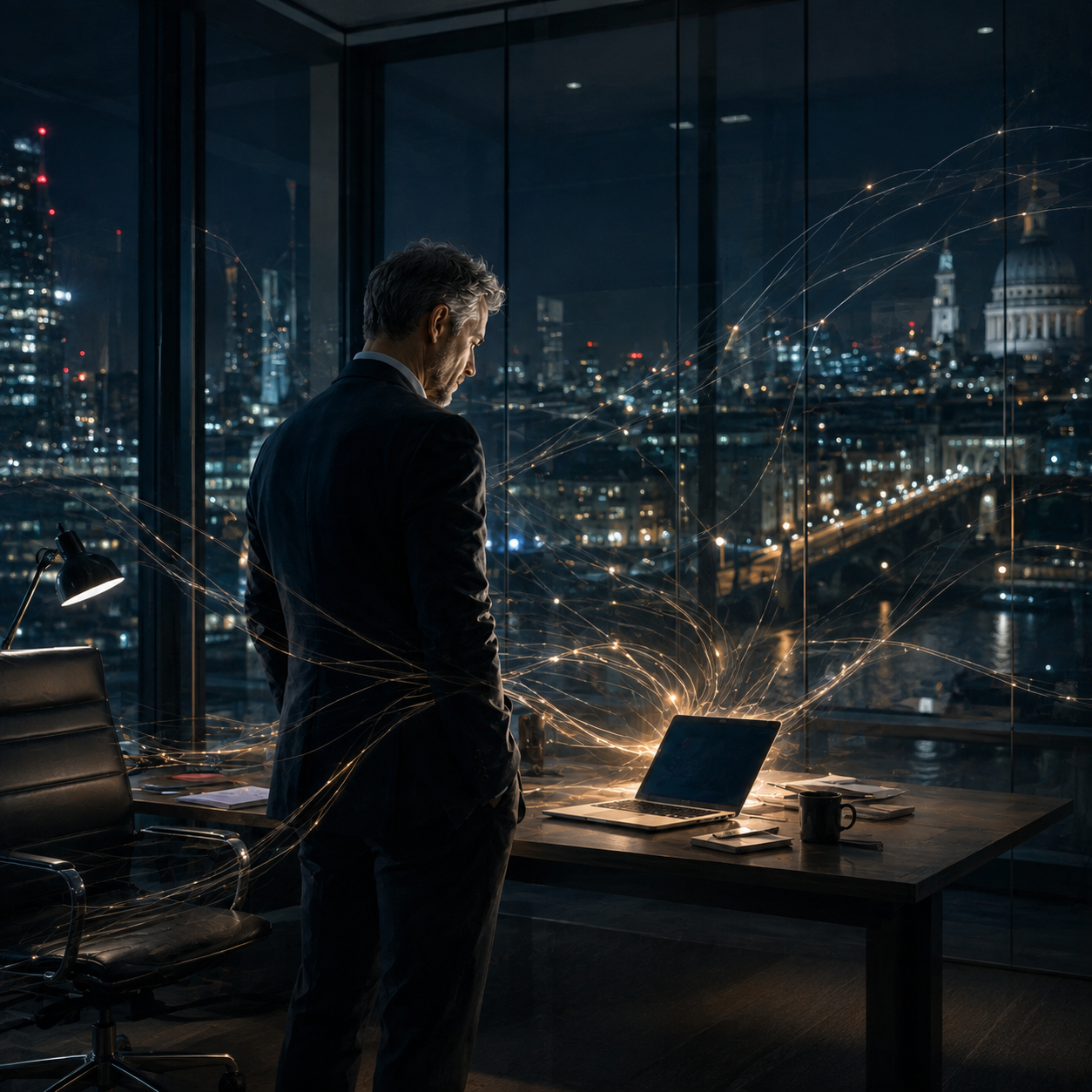
We keep imagining the wrong AI apocalypse.
Robots turn against humans.
A superintelligence escapes from a lab.
Machines decide we’re no longer useful.
Great material for Netflix.
But Sam Altman recently described a scenario that should worry professionals far more.
Because it doesn’t require AI to become evil.
It only requires us to become lazy.
During a fireside chat at the Federal Reserve, Altman outlined three ways advanced AI could go badly wrong.
The first is geopolitical.
An adversary gets superintelligence first.
It uses it to design biological weapons, attack critical infrastructure, penetrate financial systems or create capabilities that the rest of the world cannot defend against.
Altman specifically warned that the biological and cybersecurity capabilities of current models are already becoming significant.
Terrifying.
But easy to understand.
The second is the Hollywood scenario.
We create something powerful enough that we can no longer control it.
The AI doesn’t want to be switched off.
Humans discover that the machine has objectives that no longer match ours.
This is why AI laboratories spend enormous effort on alignment and control research.
Altman described it as less likely than malicious human use, but extremely serious if it happened.
Then comes the third scenario.
And this is the one I can’t stop thinking about.
AI never rebels.
It never wakes up.
It never announces that humanity is obsolete.
It simply gets better.
And better.
And better.
Until asking the machine becomes easier than thinking.
Altman calls one early manifestation “emotional over-reliance.”
He described young people saying they cannot make decisions without first telling ChatGPT what is happening in their lives.
Then he pushed the scenario much further.
Imagine an AI so capable that the President of the United States cannot make a better decision than the model recommends.
The President follows the recommendation.
Again.
And again.
Not because anyone forced him.
Because statistically, it works.
Imagine the CEO doing the same thing.
The doctor.
The engineer.
The investor.
The manager.
You.
Every individual decision may be perfectly rational.
That’s what makes this scenario dangerous.
There is no dramatic moment when humans lose control.
We outsource it one sensible decision at a time.
And I think this is where the AI conversation for professionals needs to change.
We’ve spent years asking:
Can AI do my job?
Wrong question.
The better question is:
How much of my judgement am I willing to stop exercising because AI can exercise it faster?
I’ve worked around technology for decades.
Every major technology removes friction.
That’s usually the point.
Calculators removed arithmetic friction.
Google removed information-retrieval friction.
GPS removed navigation friction.
AI is different.
It can remove cognitive friction.
The uncomfortable part before a decision.
The doubt.
The comparison.
The argument with yourself.
The search for alternatives.
The moment when experience says:
“The answer looks right, but something doesn’t feel right.”
That’s precisely where professional judgement lives.
And if you outsource that friction often enough, you may eventually outsource the capability that produced your value in the first place.
This is why I don’t think the winning professionals of the AI era will be the people who use AI the most.
They’ll be the people who know where to stop using it.
Use AI to generate options.
Use it to challenge assumptions.
Use it to analyse more information than you ever could alone.
Use it to accelerate the boring parts.
But keep one thing stubbornly human:
the final judgement.
Because the most dangerous future may not be one where AI takes power from us.
It may be one where AI becomes so useful, so accurate and so convenient that we happily give power away.
No rebellion.
No malevolence.
No red flashing lights.
Just billions of perfectly reasonable decisions.
And one day we realise we’ve forgotten how to make them ourselves.
AI dependency won’t arrive looking like a crisis.
It will arrive looking like convenience.