
In a world overflowing with technology, I often feel overwhelmed by the options.
But I’ve learned how to harness it to my advantage. This journey has shown me key strategies for using technology effectively in my personal and professional life.
By actively embracing these tools, I boost my productivity, enhance communication, and improve collaboration. Committing to adaptability and lifelong learning helps me ensure that technology is a valuable ally, not an added burden.
You likely haven’t decided to change your approach to adoption.
Your work changed first.
Then somebody gave the change a name.
That distinction matters.
Because we’ve been trained to think that professional change begins with a decision.
A new strategy.
A new tool.
A new programme.
A new slide deck with the word transformation somewhere near the top.
Real change is usually less polite.
It arrives while you’re busy doing your job.
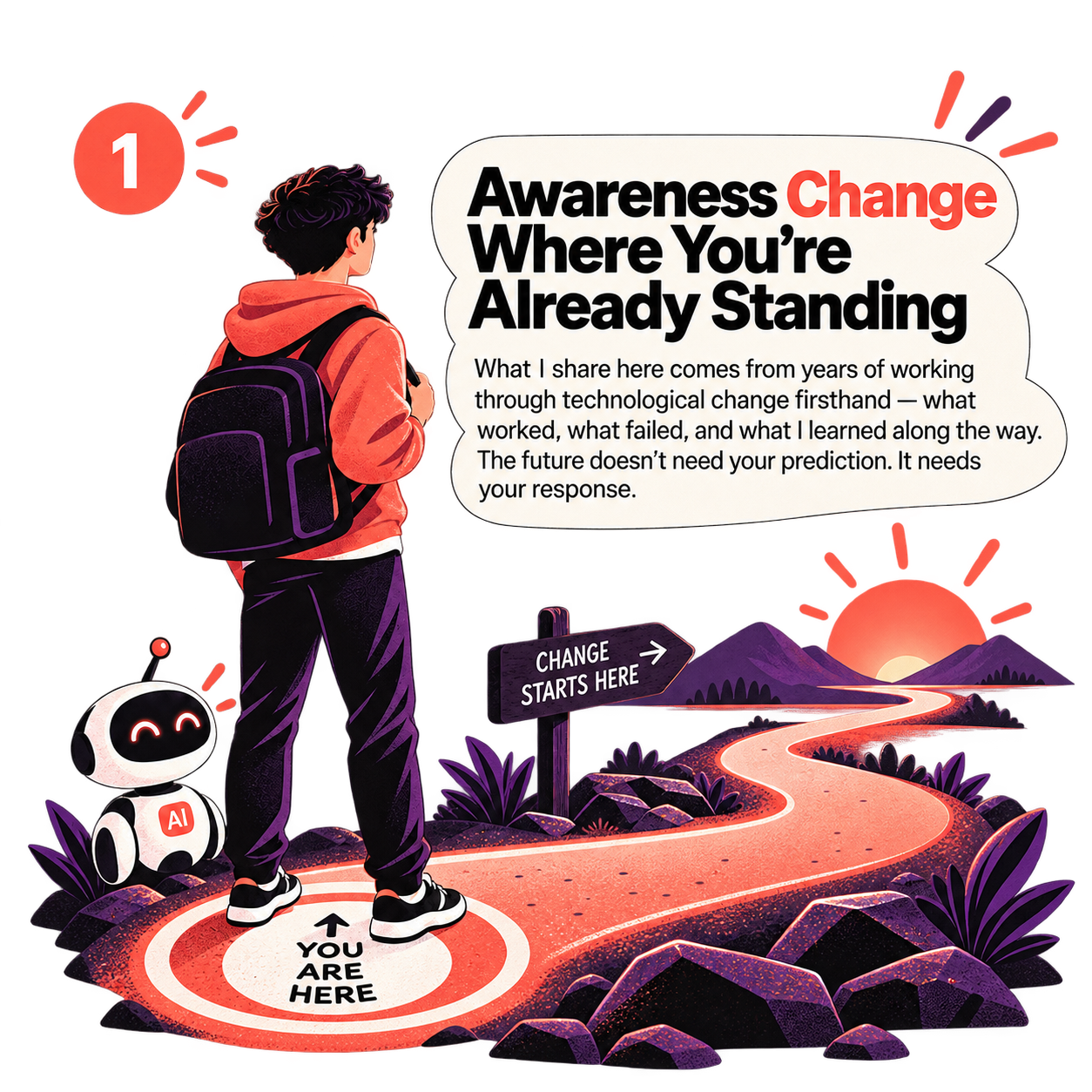
This is the first stop in the Start Here path because before talking about technology, AI, career growth or transformation, there’s a more useful question:
What has already changed while you weren’t looking?
Start where the change already happened
Most technology advice starts too late.
It tells you what to adopt next.
I want you to look backwards first.
Think about your job two or three years ago.
Then look at it today.
Maybe decisions happen faster.
Maybe customers expect answers immediately.
Maybe a task that once required three people now requires one person and an AI assistant.
Maybe nobody prints the report anymore.
Maybe expertise is no longer about knowing the answer, but knowing whether the answer generated in five seconds can be trusted.
Nobody may have formally announced these changes.
They still happened.
That is the point.
Transformation often becomes real long before the organisation decides to call it transformation.
And sometimes the most important professional skill isn’t predicting the next change.
It’s noticing the one that has already arrived.
Stop waiting for the starting gun
There’s a dangerous idea hidden inside the language of transformation.
It makes change sound like an event.
Someone approves it.
Someone launches it.
Someone manages it.
Then everyone else starts adapting.
That’s rarely how professional life works.
By the time a transformation programme has a name, a budget and a steering committee, people on the ground may already have been living parts of it for years.
The starting gun fired while nobody was listening.
So the question isn’t:
“When should I start adapting?”
A better question is:
“What am I already adapting to?”
That tiny change in language moves you from spectator to participant.
What you should be able to see after this
Don’t leave this article with another framework.
Leave with one sentence.
A sentence that describes something about your work that is materially different today.
Without using the words: digital transformation, innovation, disruption, future of work.
Just reality.
For example, I happened to think about when I was directly producing the monthly sales report, trying to add new information each time, and now I only decide whether the report is still in an acceptable format. So the question would become:
“Three years ago I produced the monthly sales report. Today AI produces it and I decide whether it deserves to survive.”
That sentence tells me far more about transformation than fifty slides about transformation maturity.
Self-check: Is the change already happening?
Ask yourself three questions.
- Can I describe how my role has changed over the last two or three years without using the word “digital”?
- Do I treat the change happening around me as something I need permission to respond to — or as something already underway, something I’m already part of?
- Would I have recognised that change if nobody had given it a label?
The third question is the uncomfortable one.
Because labels can help us understand change.
They can also stop us from seeing it.
A simple exercise
Write down one change that has already happened in my work.
Plain language only.
No framework.
No buzzwords.
No transformation language.
Describe what is different today from what was normal two or three years ago.
One sentence is enough.
Then leave it alone.
Come back to it in a few months.
If the sentence still feels accurate, the change is probably becoming normal.
If it suddenly sounds outdated, pay attention.
Something else has moved.
And you may have been too busy working to notice it.
Your turn
If you want, leave a comment below starting with:
MY CHANGE IS:
Before you leave, name the change.
Don’t predict what’s coming next.
Write down what has already changed — and what you will do differently because of it.
Leave a comment starting with:
MY CHANGE IS:
one sentence describing what is already different.
Then add:
SO TOMORROW I WILL:
one small thing you will do differently.
Come back in three months. If it is possible, I’ll add a few words to help you.
The interesting question won’t be whether you predicted the future.
It will be whether you started acting like the future had already arrived.
If you feel behind
You probably don’t need another transformation programme.
Start smaller.
Pick the part of your daily work that has changed the most.
Now ask:
If I assumed this change was permanent, what would I do differently tomorrow?
Write the answer down.
That is your starting point.
Not the framework.
Not the trend report.
Not the project plan.
The work already in front of you.
The future doesn’t need your prediction. It needs your response.
Leave a Reply