Everyone gets the same superpower. That doesn’t mean everyone gets the same result.
AI has been sold to us as The Great Equalizer.
I understand why.
A teenager with a laptop can now access capabilities that once required a company.
A freelancer can analyze data like a small consulting team.
A founder can create a prototype without hiring ten developers.
A writer can research a subject in minutes.
A salesperson can prepare for a meeting with the analytical firepower that once belonged to an entire sales operations department.
A student can have a private tutor available at 2:17 in the morning.
That sounds like equality.
It may not be.
Because we confuse equal access to intelligence with equal ability to use it.
Those are two very different things.
And that difference may define the next decade.
AI lowers the floor.
This is the part everyone can see.
You no longer need to know how to code to create simple software.
You don’t need to be a designer to make a decent presentation.
You don’t need perfect English to publish in English.
You don’t need to spend three days researching a market before walking into a meeting.
AI removes friction.
That is extraordinary.
It democratizes capability.
But something strange happens when a capability becomes universally available.
It stops being an advantage.
Think about calculators.
Owning a calculator doesn’t make you a mathematician.
Google gave billions of people access to almost unlimited information.
It didn’t make billions of people experts.
Social media gave everyone a publishing platform.
It didn’t turn everyone into a great writer.
Smartphones put a professional-quality camera in billions of pockets.
It didn’t create billions of photographers.
Technology repeatedly makes the tool abundant.
Then something else becomes scarce.
AI will be no different.
The Great Equaliser has a nasty second act.
Open LinkedIn.
Scroll for five minutes.
You can almost smell the AI.
Perfect structure.
Perfect grammar.
Perfect bullet points.
Perfect mediocrity.
People who once struggled to write a bad post can now produce twenty average ones before breakfast.
That’s progress of a sort.
Coders can generate code faster.
Marketers can create campaigns faster.
Managers can produce reports faster.
Students can write essays faster.
Consultants can make slides faster.
We are becoming incredibly efficient at producing things.
But here’s the uncomfortable question:
Are we becoming better at thinking?
Because those are not the same thing.
AI can dramatically increase output while quietly decreasing intellectual effort.
And if we’re not careful, we’ll mistake increased production for increased capability.
That’s dangerous.
You can now create something that looks intelligent without doing much thinking yourself.
The email sounds intelligent.
The strategy document looks intelligent.
The presentation feels intelligent.
The code appears intelligent.
The article reads intelligently.
But appearance is becoming cheap.
AI can manufacture it at an industrial scale.
That means the market will eventually stop rewarding appearance.
Mediocrity is about to become incredibly cheap.
This may be one of AI’s biggest economic consequences.
Average content is becoming nearly free.
Average analysis is becoming nearly free.
Average code is becoming cheaper.
Average presentations are becoming cheaper.
Average research is becoming cheaper.
Average advice is becoming cheaper.
That’s fantastic if you need average work.
It’s brutal if you sell average work.
The danger isn’t simply that AI will replace people.
The more immediate danger is that AI will make huge amounts of previously valuable work indistinguishable.
When everybody can produce a polished 1,000-word article in thirty seconds, producing 1,000 words isn’t valuable anymore.
When everybody can create a reasonable marketing plan, the plan isn’t the differentiator.
When everybody can generate code, typing code becomes less scarce.
When everybody can summarise the same information, summarising information stops being impressive.
The technology creates abundance.
Abundance creates a new scarcity.
That’s the part we should be obsessed with.
When intelligence becomes abundant, judgment becomes scarce.
This is where the Great Equaliser starts looking less equal.
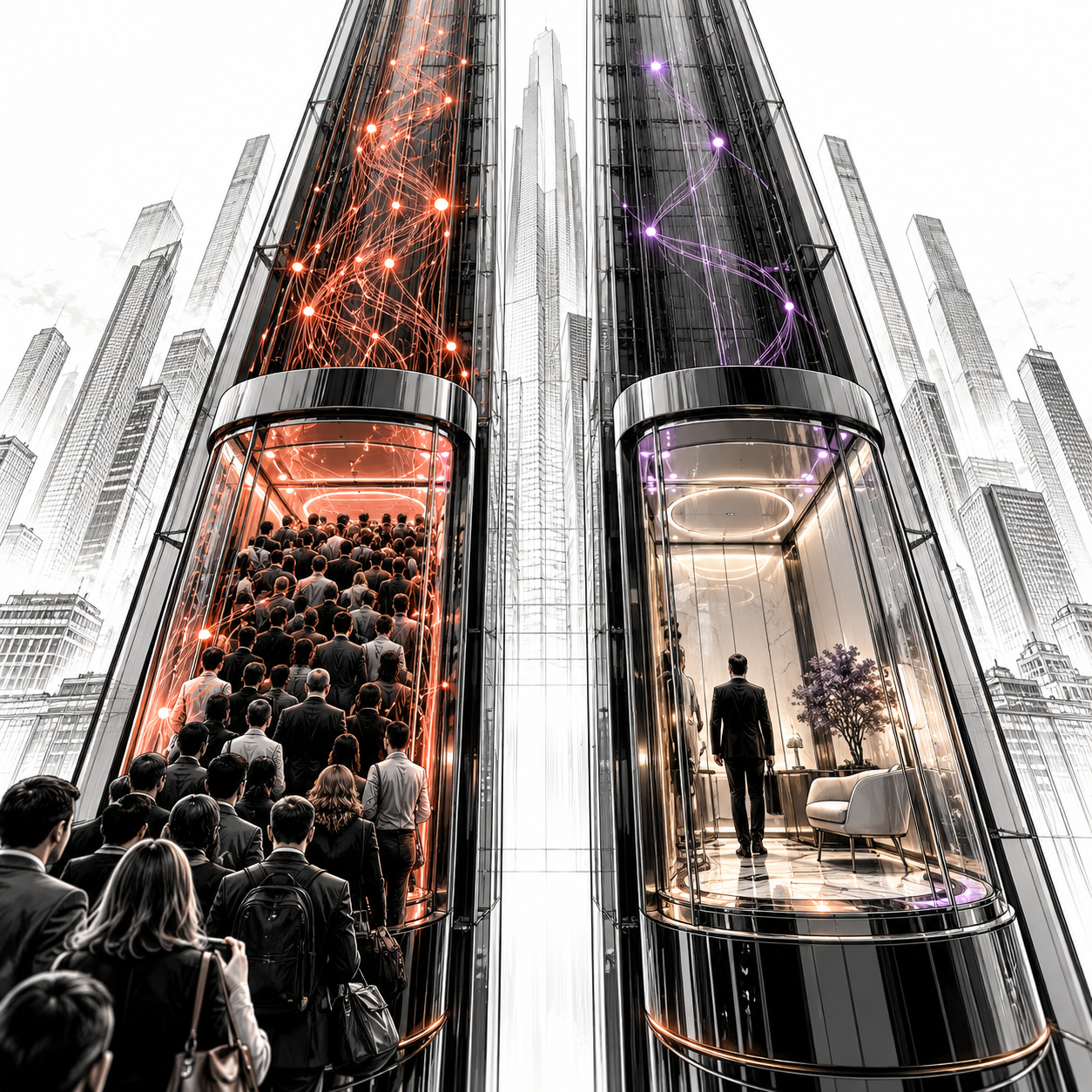
Give two people the same AI.
One asks:
“Write me a LinkedIn post about leadership.”
The other asks:
“Here are 20 customer interviews, our failed product launch, three years of sales data, my hypothesis about why customers are leaving, and the assumptions I think may be wrong. Challenge my reasoning before we decide what to do.”
Same AI.
Different human.
Different outcome.
The difference isn’t prompt engineering.
It’s thinking.
One person is outsourcing production.
The other is amplifying judgment.
That’s the divide that matters.
AI doesn’t eliminate expertise.
It can make expertise more leveraged.
A mediocre strategist with AI may become faster.
A brilliant strategist with AI can explore ten hypotheses, interrogate assumptions, simulate objections, synthesise research and test alternatives before the mediocre strategist has finished polishing the first PowerPoint slide.
That’s not equalisation.
That’s amplification.
AI doesn’t just raise the floor. It blows the roof off the ceiling.
This is the part of the conversation we’re missing.
AI can help beginners perform tasks they couldn’t perform yesterday.
That’s the democratizing effect.
But AI can also give highly capable people enormous leverage.
That’s the inequality effect.
Give a mediocre writer AI, and they may become competent.
Give an exceptional writer AI, and they can research faster, explore more ideas, challenge weak arguments, translate their work, repurpose it and distribute it across the world.
Give a beginner programmer AI, and they can build a basic app.
Give an experienced engineer AI, and they can use it across architecture, testing, debugging, documentation and experimentation while knowing when the machine is confidently wrong.
Give an average salesperson AI, and they can generate an email.
Give an exceptional salesperson AI, and they can analyse an account, map stakeholders, understand an industry, prepare objections, personalise a narrative and walk into the conversation better prepared than almost anyone else.
The first person gets productivity.
The second gets leverage.
That’s a huge difference.
The real divide won’t be AI users versus non-AI users.
That distinction will disappear.
Soon saying “I use AI” will sound as strange as saying:
“I use the internet.”
Of course you do.
The interesting question will be:
What happens to you when you use it?
Does AI make your thinking sharper?
Or does it save you from thinking?
Does it expand your curiosity?
Or give you an excuse to stop researching?
Does it challenge your assumptions?
Or produce elegant confirmation of whatever you already believe?
Does it make you more capable?
Or merely more productive?
Does it increase your judgment?
Or gradually make you dependent on borrowed judgment?
These questions are harder than learning prompts.
That’s why they matter more.
Human × AI sounds good. But multiplication has a problem.
There’s a popular idea emerging:
Human × AI.
I like it.
But multiplication contains an uncomfortable truth.
Anything multiplied by zero is still zero.
Weak judgment × powerful AI doesn’t magically become wisdom.
No curiosity × AI doesn’t produce discovery.
No original experience × AI doesn’t produce authenticity.
No responsibility × AI doesn’t produce leadership.
No taste × infinite generation gives you infinite things with no idea which one matters.
AI amplifies.
That means it can amplify capability.
It can also amplify stupidity.
Bias.
Noise.
Bad incentives.
Poor decisions.
And mediocrity.
Faster.
That’s why the real equation we should care about may be different:
Human + AI = +Human.
After introducing AI, does the system have more human capability left?
More judgment?
More curiosity?
More creativity?
More autonomy?
More ability to challenge an answer?
More capacity to make a decision when the machine cannot?
If the answer is no, we haven’t augmented the human.
We’ve created dependence with a productivity dashboard attached to it.
Access will become cheap. Agency won’t.
This is where inequality may accelerate.
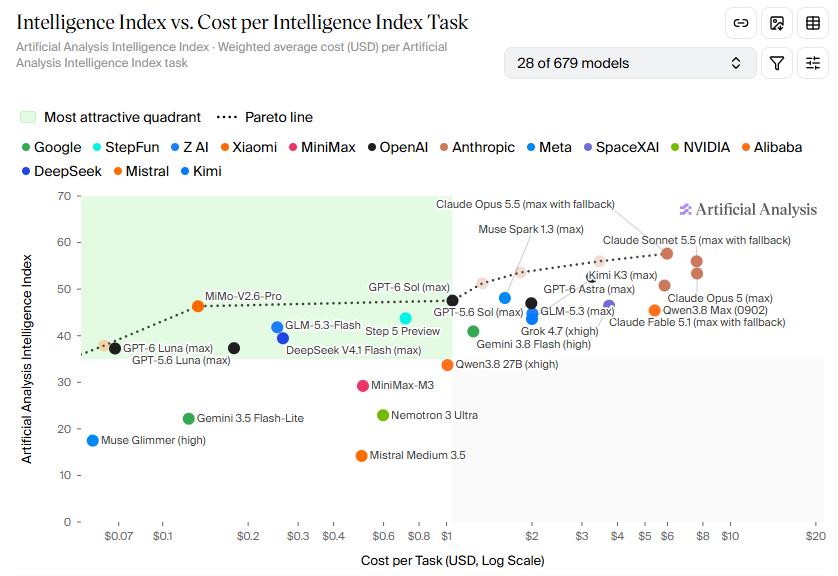
The scarce asset won’t be access to ChatGPT, Claude, Gemini, or whatever model wins next month’s leaderboard.
Models will improve.
Prices will fall.
Capabilities will spread.
Interfaces will become invisible.
AI will be everywhere.
Access will become boring.
But some people will combine AI with things that remain scarce:
Experience.
Reputation.
Capital.
Distribution.
Customer relationships.
Proprietary data.
Domain knowledge.
Taste.
Trust.
Networks.
Judgment.
Ownership.
The ability to decide what problem is worth solving.
AI sitting on top of those assets creates enormous leverage.
AI without them often creates more output.
That’s why the same technology can democratize capability while concentrating outcomes.
It can do both at once.
That’s the paradox.
Don’t become digital fodder.
There is a very tempting AI strategy right now:
Produce more.
More posts.
More emails.
More videos.
More code.
More presentations.
More proposals.
More everything.
The machine makes production cheap, so we naturally produce more.
But if everyone follows that strategy, we create a tsunami of synthetic abundance.
The internet fills with acceptable things nobody asked for.
Then attention becomes even scarcer.
Trust becomes scarcer.
Original thought becomes scarcer.
Credibility becomes scarcer.
And eventually the advantage shifts toward the people who can do something AI cannot easily manufacture:
Know what deserves to exist in the first place.
That requires judgment.
You don’t need AI to replace your thinking.
You need it to increase the surface area of your thinking.
Use it to attack your argument.
Ask it what you’ve missed.
Make it find counterexamples.
Use it to explore the option you dismissed too quickly.
Let it expose gaps in your knowledge.
Make it simulate the customer who hates your idea.
Ask it to distinguish evidence from assumption.
Then make the decision yourself.
That’s augmentation.
Everything else risks becoming intellectual autocomplete.
The next digital divide will be cognitive.
The old digital divide was largely about access.
Who had a computer?
Who had broadband?
Who had cloud infrastructure?
Who had data?
AI changes the shape of that divide.
Millions — eventually billions — of people may have access to similar baseline intelligence.
That sounds wonderfully democratic.
But equal access to a tool doesn’t produce equal outcomes.
The next divide may be between people who use AI to avoid difficult thinking and people who use AI to go deeper into it.
Between people who generate answers and people who formulate better questions.
Between people who consume intelligence and people who orchestrate it.
Between people who accept outputs and people who exercise judgment.
Between people who rent capability from a machine and people who turn that capability into assets they own.
The winners won’t necessarily be those with the best AI.
They may be the people who become better humans because they have AI.
That’s a very different race.
AI isn’t the Great Equalizer.
It’s the Great Amplifier.
It lowers barriers.
That’s real.
It gives millions of people capabilities they never had.
That’s worth celebrating.
But don’t confuse democratized capability with democratized outcomes.
The same technology that gives a beginner extraordinary new powers can give an expert extraordinary new leverage.
The same machine that helps one person write their first line of code can help another build a company.
The same AI that helps someone produce ten generic posts can help someone else turn thirty years of experience into an intellectual asset that reaches millions.
The technology doesn’t decide which happens.
We do.
So perhaps the most important question of the AI era isn’t:
“How powerful will AI become?”
We already know the direction of travel.
The better question is:
What becomes scarce when intelligence becomes abundant?
My bet?
Judgment.
Curiosity.
Taste.
Trust.
Experience.
Responsibility.
And the ability to know when the machine is wrong.
Those aren’t old-fashioned human skills that survived the AI revolution.
They may become more valuable because of it.
AI can level the playing field.
It can also tilt it dramatically.
The difference will increasingly come down to what you bring to the machine.
Don’t race AI.
Don’t surrender to it either.
Use it to become harder to replace, not easier to imitate.
The clock isn’t ticking because AI is coming.
It’s ticking because everybody already has it.
What are you becoming with yours?
👉 Ready to stay ahead of the curve? Join the conversation and read the latest deep dives on hightechstories.com.
Disclaimer: Content generated with the support of Artificial Intelligence (Gemini). The underlying ideas, analysis, and opinions are entirely human-led and reflect personal perspectives on the topic.
#ArtificialIntelligence #AIRevolution #FutureOfWork #Leadership #TechTrends #Inequality