
“Artificial Intelligence” has never really convinced me as a name.
Not now, and not back when I was an engineering student, when nobody talked about these things. If you had brought it up seriously over coffee, people would almost certainly have thought you were a bit crazy. So I kept the doubt to myself. It stayed with me anyway.
And over the years I’ve realised the problem isn’t “Artificial”.
It’s “Intelligence”.
We keep talking about human intelligence and machine intelligence as if they were two versions of the same thing. They aren’t, and I’m not even sure it makes sense to compare them.
Human intelligence comes from experience. From the body, emotions, relationships, values, memory, and a constant reading of context.
What the machine has comes from data, computation and mathematical models, plus the ability to find correlations at a scale that is simply out of our reach.
We live the world. The machine processes it.
We forget, we interpret, we doubt. The machine takes in millions of pieces of information and recombines them in seconds.
It isn’t a faster human being. It’s something else.
That’s also why “Super Intelligence” only half works for me. “Super” implies a race, as if sooner or later we’ll have to find out who’s smarter, us or it. I think that’s the wrong question.
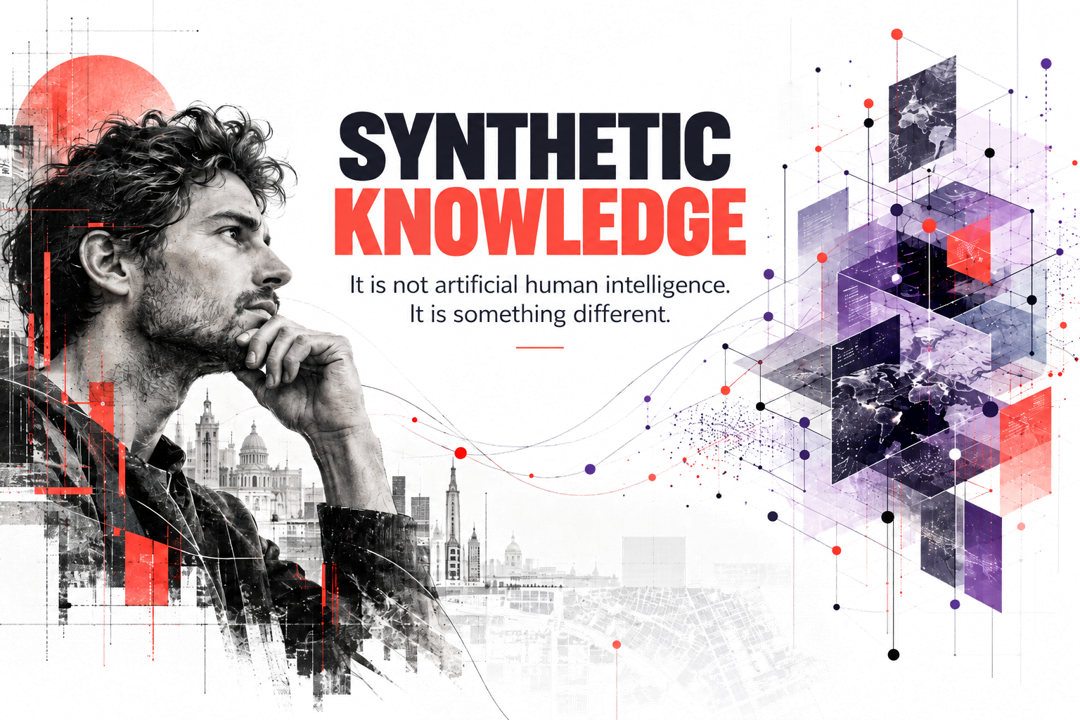
If I had to choose a name, I’d call it Synthetic Knowledge.
Synthetic because it doesn’t come from lived experience. It’s built, assembled, calculated, and then made available on demand.
Knowledge because that’s what I find genuinely interesting: a non-human ability to gather, compress, correlate and recombine huge amounts of what we know.
And that changes the game.
The future won’t be a contest between human and artificial intelligence. It will be a combination: human judgment plus synthetic knowledge.
Access to AI won’t be the advantage for long. It will become normal (at least at the levels we’ll be allowed to use).
The real advantage will be knowing when to trust synthetic knowledge, and having enough human intelligence to contradict it when it’s wrong.
We’ve spent a lot of time asking how intelligent AI will become.
Maybe the better question is this one:
How good will we need to become at governing knowledge that grows much faster than our ability to understand it?
#ArtificialIntelligence #SyntheticKnowledge #CriticalThinking #FutureOfWork #Leadership
Leave a Reply