Blog

  • I Put a Red Alert on My Own Website. Three Weeks Later, Nobody Saw It.

    I Put a Red Alert on My Own Website. Three Weeks Later, Nobody Saw It.

    I built a red bar across the top of my site last month.

    Full width. White text. High contrast — I checked the numbers, 7.3 to 1, comfortably past the accessibility threshold. It was, by every measure I could apply, impossible to miss.

    My regular readers missed it.

    Not because they’re careless. Because it was still there. It had been there on their last four visits, saying the same thing, and their brains had done what brains do with anything that never changes.

    They filed it as furniture.

    And the moment I understood that, I realised I’d been watching the same failure for thirty years in rooms where the stakes were considerably higher than a newsletter signup.

    The version that costs money

    Walk into any network operations centre and look at the alarm board.

    Count the amber.

    Now ask how long each one has been amber.

    I have had that conversation more times than I can reconstruct, and the answer is almost never “since this morning.” It’s “that one’s been like that since we migrated.” It’s “oh, that’s just the link to the old site, ignore it.” It’s, occasionally and memorably, “I don’t actually know, it was like that when I got here.”

    The board is not showing the operator what’s wrong. It’s showing them what has been wrong long enough to become normal.

    Every one of those permanent ambers is doing something worse than nothing. It’s raising the floor. It’s teaching the room that colour doesn’t mean urgency, that the board is decorative, that judgement happens somewhere other than the screen everyone paid for.

    Post-incident reviews in process industries have been saying this for decades: when something goes genuinely wrong, the alarm that mattered arrived in a flood of alarms that didn’t, and the operator had already learned to discount all of them.

    The failure isn’t inattention.

    The failure is that we asked people to ignore things, they learned to, and then we were surprised.

    Why permanence kills signal

    Here’s the part that took me years to state properly.

    Information lives in change, not in presence.

    A warning that is always on carries no information. It’s a constant. You could delete it and the operator’s picture of the world would be identical, because they’d already deleted it themselves — just internally, where you can’t see them do it.

    This is not a discipline problem. You cannot train it away. Attention is a filter that adapts to its environment, and the environment you built taught it that red means nothing.

    Which produces the ugly conclusion:

    Your most urgent channel is your most fragile one.

    The louder the mechanism, the faster it burns out under permanence. A red banner is more susceptible to this than a plain sentence, because red is a promise. Break the promise a few times and the reader stops reading the colour, and now you’ve spent something you can’t easily buy back.

    I spent it on my own site in three weeks.

    The bit that connects to everything else I write

    Every permanent alert is a decision somebody didn’t make.

    That’s the whole thing.

    Nobody decided the link would stay degraded. Somebody deferred fixing it, then deferred deciding whether it mattered, and the amber became the record of that deferral — a small monument to a choice postponed.

    Multiply by the forty of them on the board, and the alarm system stops being a monitoring tool and becomes an archive of everything the organisation has quietly agreed not to resolve.

    That’s the complexity tax in its most visible form. Not an abstraction. A screen full of it, in colour, that everyone has stopped reading.

    And it arrives with a second bill: the next real incident costs more, because the mechanism that should have caught it early has been taught to be ignored.

    Three rules I now apply to anything that shouts

    Every permanent signal gets an expiry date.

    Not “we’ll review it.” A date. When the date arrives, either the condition is fixed or the alert is deliberately downgraded to something quieter — a log line, a report entry, a dashboard the right person actually opens. What is not allowed is for it to simply continue.

    My red bar now has a calendar entry. Six weeks, then it changes or it goes.

    Count what you’re asking people to ignore.

    This is the single most useful audit I know, and almost nobody runs it. Not “how many alerts do we have” — how many are we asking a human being to look past every day?

    If the number is above about five, you don’t have a monitoring system. You have a training programme in not looking.

    Test by removal.

    If you switch it off and nobody notices for a week, it was never doing its job. That’s not an argument for leaving it on. That’s the evidence you needed to take it out and put the attention somewhere it will be spent.

    The part I got wrong

    I want to be honest about what my instinct was when I saw the banner wasn’t working.

    Make it brighter.

    That’s the reflex — the alert isn’t landing, so increase the volume. Bigger type. Stronger red. Maybe animate it.

    It’s the same reflex that adds a fifth severity level to an alarm system that already has four nobody respects. It escalates the format instead of fixing the reason, and it always buys a few days before the new level gets absorbed into the furniture too.

    The answer was never more contrast.

    The answer was fewer permanent things, each of which changes when something actually changes.

    Go and look at your board

    Whatever your board is.

    The alarm console. The risk register nobody has reordered since the audit. The compliance dashboard that has shown the same two ambers since the NIS2 assessment. The banner on your own website.

    Count the things that have been in the same state for more than a month.

    That number is not a measure of your monitoring.

    It’s a measure of how much your organisation has agreed to stop seeing.

    And the thing about what you’ve stopped seeing is that it’s still there, still costing, still perfectly visible to whoever eventually writes the incident report.


    5 min read · estimated

    Read the article →

  • I Didn’t Choose Digital Transformation. It Arrived Where I Was Already Standing.

    I Didn’t Choose Digital Transformation. It Arrived Where I Was Already Standing.

    People ask me why I work in digital transformation, and the honest answer is uncomfortable.

    I didn’t pick it.

    When I started, the phrase didn’t exist. There was no category, no conference track, no consultancy practice with that name on the door. There were networks that had to stay up, and there was me, twenty-something, with a degree in electronic engineering from La Sapienza and no idea what I’d walked into.

    The field arrived later. It arrived exactly where I was already standing.

    What the word actually named

    For about fifteen years, I did work nobody called “transformation”. Migrations. Refreshes. Integrations between systems that were never designed to speak to each other. Contract transitions where one vendor left and another arrived and the network in between had to carry trains, calls, or water regardless.

    Then, sometime in the 2010s, all of it got a name.

    And the name attracted a crowd — strategy decks, maturity models, four-quadrant frameworks, people who could describe the destination beautifully and had never once been in a room at 3 a.m. deciding whether to roll back.

    That’s when I understood what I actually had. Not a specialism. A vantage point.

    I had watched the thing get named. I knew what the word was covering up.

    The gap that became the work

    Here’s what I repeatedly saw from inside.

    The strategy was almost never wrong. The transformation programmes I watched fail didn’t fail because someone chose the wrong architecture. They failed in the space between a decision and its consequences — the eighteen months where nobody owns the outcome, the handover fortnight nobody scheduled, the end-of-support hardware everyone agreed not to raise.

    Consultants who arrive at the start don’t see that space. They present, they leave, the deck gets approved.

    Operators who live in that space can’t name what they’re seeing. They experience it as bad luck, or bad management, or Tuesday.

    I ended up in the narrow band between the two. Long enough in operations to have felt it, close enough to procurement and vendor negotiation to see how the decision was made in the first place.

    That’s not a career I designed. It’s a position I noticed I was occupying, and then took seriously.

    Why I stayed when the exits were open

    There were easier options. Sales, and the compensation that comes with it. Pure management, further from the systems. Or the version of this field where you never touch anything real and never get blamed when it breaks.

    I stayed for one reason, and it isn’t nobility.

    The problems here are unsolved.

    Thirty years in, organisations still cannot answer the simplest question I can ask them: what did the delay actually cost? They can price the project. They cannot price the postponement. That gap has cost the clients I’ve worked with more than any technology decision I’ve ever watched them make.

    Nobody has solved that. Not the vendors, not the big four, not the frameworks.

    A field where the central problem is still open is a good place to spend a career. A field where everything works is a field that no longer needs you.

    What the answer really is

    So — why digital transformation?

    Because I was already in critical infrastructure when the word was invented, and I stayed close enough to the systems to watch what the word left out.

    Because the interesting part was never the technology. It was the eighteen months of silence between a decision and its bill.

    And because I’d rather work on the part nobody has figured out than on the part that already has a framework.

    That’s not a mission statement. It’s just where the work was.


    .

    4 min read · estimated

    Read the article →

  • Thirty Years in Infrastructure ICT Taught Me One Career Rule. It Isn’t the One You Expect.

    Thirty Years in Infrastructure ICT Taught Me One Career Rule. It Isn’t the One You Expect.

    I was twenty-four when a man twice my age handed me a folder and said: “If this network stops, trains stop.”

    I laughed.

    He didn’t.

    That was the last time I found the sentence funny. Everything I’ve learned about surviving a career happened in the thirty years after it.

    Here’s the part nobody warns you about: I have outlived every technology I was hired for. The equipment I was trained on is scrap. The protocols I memorised are footnotes. The vendors I built my early reputation around have been merged, rebranded, or quietly discontinued.

    And I’m still here.

    Not because I’m brilliant. I’ve watched brilliant people get walked out of buildings.

    Because of one rule I didn’t understand until year fifteen.

    The rule you’re expecting

    You already know what you think I’m going to say.

    Keep learning. Reinvent yourself. Stay current.

    Every career article ends there. Learn the new thing. Get the certification. Adapt or die.

    It isn’t wrong.

    It’s just not the rule.

    I know engineers who did all of it. Certified in everything. First in the room on every new platform. Genuinely current, genuinely skilled.

    Some of them are consultants now. Not by choice.

    Because “stay current” is a treadmill with no finish line, and there is always someone younger running it faster and cheaper than you. If your only asset is knowing the newest thing, your value resets to zero every four years and you compete, forever, against people with more energy and fewer mortgages.

    That’s not a career.

    That’s a subscription you keep paying.

    The rule that actually held

    Here it is.

    Stay close to the systems that cannot be switched off.

    That’s it. That’s the whole thing.

    Not the newest system. Not the most exciting one. Not the one with the best conference talks and the nicest documentation.

    The one where consequence lives.

    The one where somebody, somewhere, cannot afford for it to stop.

    Trains. Water. Power. Emergency networks. Payment rails. Hospital systems. The unglamorous infrastructure that carries real weight and gets discussed only when it fails.

    Everything about my career that worked came from proximity to consequence. Everything that stalled came from drifting away from it.

    Why consequence compounds and novelty doesn’t

    Think about what actually happens when a system cannot be switched off.

    Nobody rips it out. They layer on top of it.

    Which means the knowledge of how it was built, why it was built that way, and what will break if you touch the wrong thing — that knowledge doesn’t expire.

    It compounds.

    I have sat in rooms where a decision worth millions turned on one person remembering why a link had been configured a certain way in 2009. Not a certification. A memory. A piece of context that existed in one head and nowhere else.

    That person is not replaceable by someone younger and cheaper.

    That person is not replaceable by a model, either, and I say that as someone who works with these tools every day. The tool can tell you what the configuration says. It cannot tell you which of the three people who signed off on it was lying about the timeline.

    Novelty knowledge depreciates. Consequence knowledge accrues interest.

    Most people spend their careers buying the depreciating asset.

    What this looks like in practice, and what it costs

    I want to be honest about the price, because most career advice sells you the upside and hides the bill.

    Staying close to consequence is not fun.

    It means the four-hour migration window at three in the morning, because that’s the only time the system can be touched. It means the maintenance contract handover nobody scheduled, where the outgoing vendor has stopped caring and the incoming one doesn’t have the passwords yet. It means 1,613 devices past end-of-support that everyone has agreed to not talk about, and being the one who counts them anyway.

    It means your LinkedIn will never look as exciting as the person doing generative AI pilots at a startup.

    It also means that when the reorganisation comes — and it always comes — the conversation about your role happens differently.

    I’ve been through more restructurings than I can reconstruct from memory. Every single time, the same pattern: the roles that got cut fastest were the ones furthest from consequence. Strategy functions with no operational surface. Innovation teams with impressive decks and no system anyone depended on.

    The people who ran the thing that couldn’t stop were never in the first three conversations.

    Sometimes we were in the fifth. But by then the panic had passed, and panic is what makes bad decisions about people.

    The trap inside the rule

    Now the part that took me another decade to learn, because the rule has a failure mode and I walked straight into it.

    Proximity to consequence makes you safe. It does not make you visible.

    I spent years believing the work would speak. That if the network held, someone upstairs would know why it held.

    They don’t. They can’t. A system that never fails produces no evidence of the effort keeping it up. That’s the cruel arithmetic of infrastructure: your best work is indistinguishable from nothing happening.

    So the rule has a second half, and without it the first half traps you.

    Stay close to consequence. Then translate it upward.

    Learn to say, in language a CFO understands, what the deferral actually costs. Not “these devices are end-of-support.” Instead: here is the failure probability, here is what four hours of downtime costs this business, here is the curve of what waiting another year does to both numbers.

    The day I learned to write that sentence, my career changed more than it had in the previous ten years of technical work.

    Not because the technical work stopped mattering. Because it finally became legible to the people making decisions about it.

    Most engineers never make this jump. They resent having to. I resented it too. I thought translation was politics, and politics was for people who couldn’t do the real work.

    I was wrong. Translation is the work. The system doesn’t just need to hold — someone has to fund it holding, and that decision is made in a room where nobody speaks your language.

    If you’re twenty years behind me

    Three things.

    Ask where the consequence sits. In your company, in your sector, find the system that cannot be switched off. It may not be the one with the budget or the attention. Go there anyway.

    Stop optimising for interesting. The most valuable position I ever held was, on paper, the least exciting one available. Boring compounds. Excitement resets.

    Build the sentence. Whatever domain you’re in, learn to state its risk in money and time to someone who will never understand its mechanics. If you can’t, you will spend your career being overruled by people who can.

    Thirty years in, that’s what I have.

    Not a technology. Not a certification. A habit of standing close to things that matter and being able to explain, in plain numbers, what it costs when nobody does.

    The trains still run.

    Most days, nobody notices.

    That’s the job.

    6 min read · estimated

    Read the article →

  • The Tax Nobody Votes For

    The Tax Nobody Votes For

    Where complexity actually enters an organisation, and why every decision that created it looked correct at the time.

    Coming Soon

    1 min read · estimated

    Read the article →

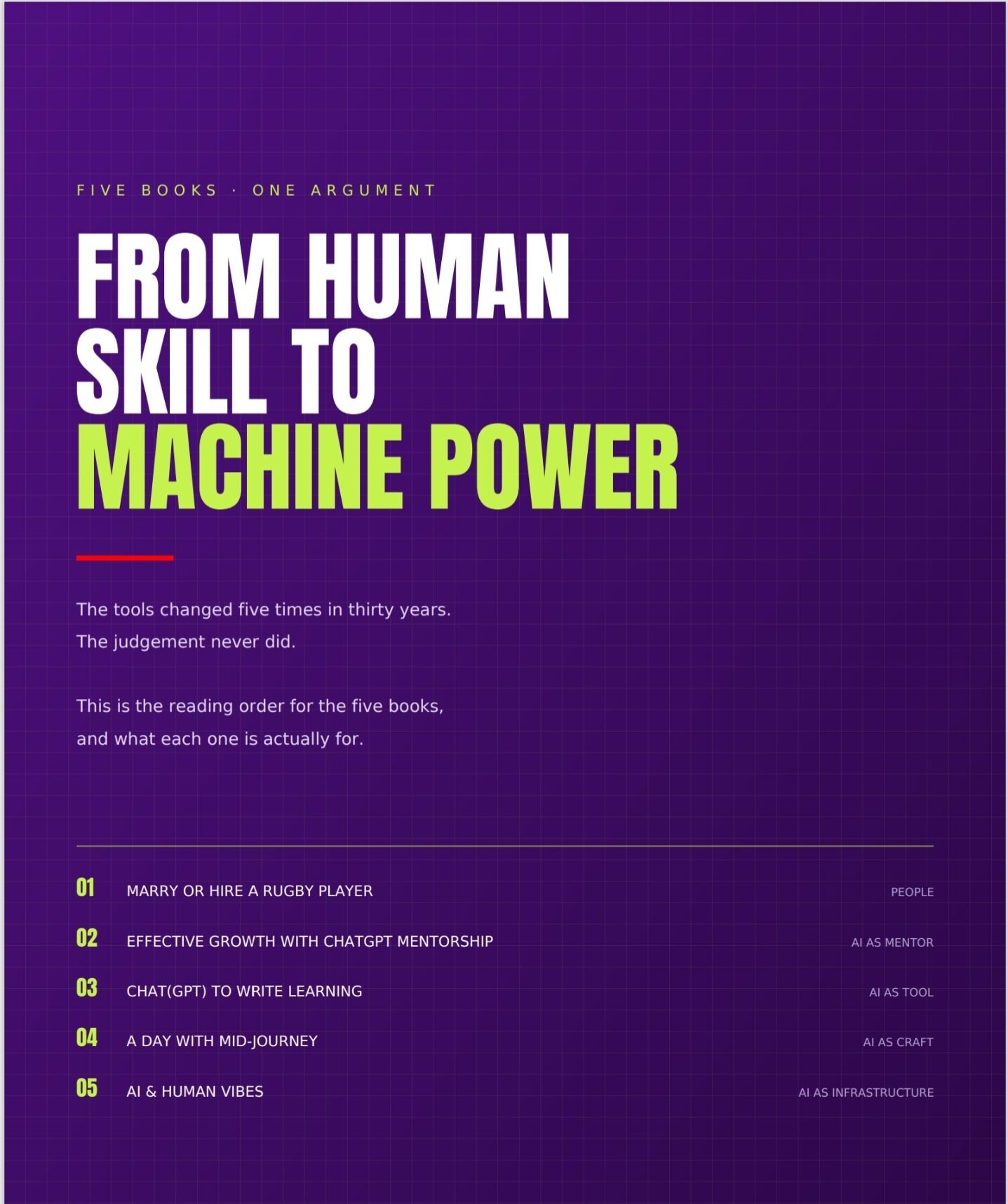
  • From Human Skill To Machine Power

    From Human Skill To Machine Power

    Some books – One topic

    The Tools Changed.
    The Judgement Didn’t.

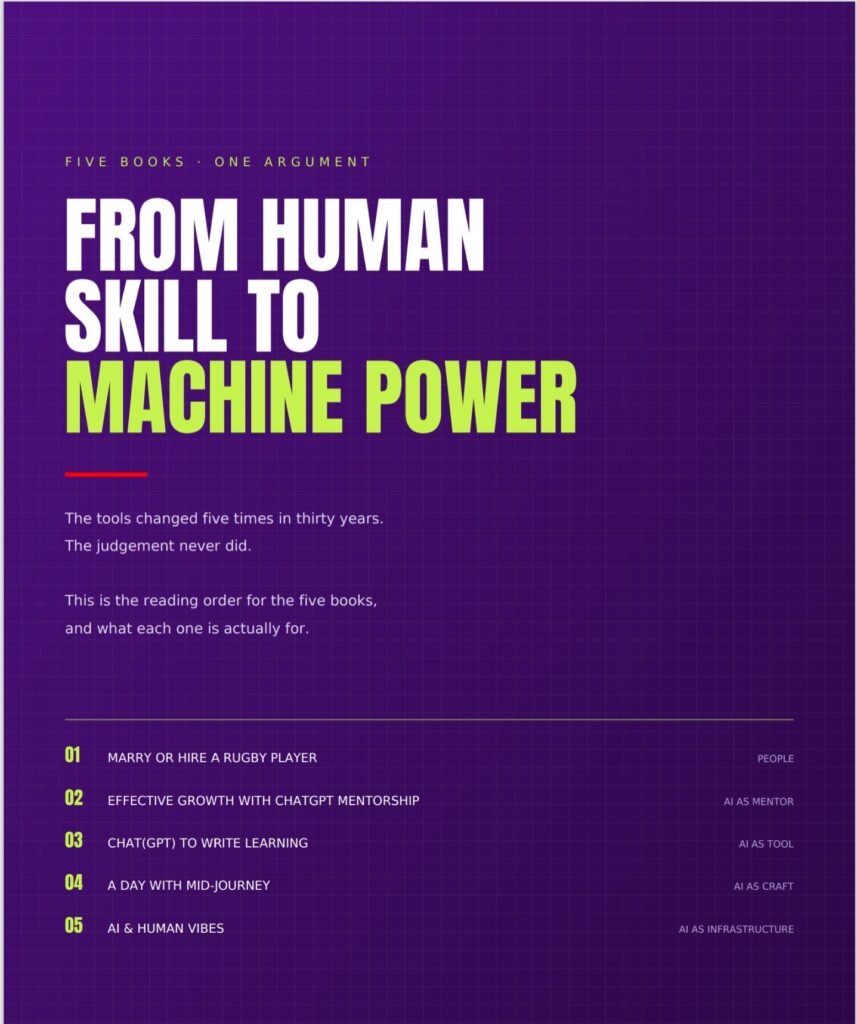
    Five books written across five technology cycles. Read in order, they argue one thing: that every wave arrives promising to replace judgement, and every wave ends up needing more of it.

    Each one below tells you what it’s for and who it’s written for — so you can skip the four that aren’t yours.

    Cover of “From Human Skill to Machine Power”

    1 min read · estimated

    Read the article →

  • How do you use AI without losing your judgement?

    How do you use AI without losing your judgement?

    It’s the one that looks completely right.

    Clean. Logical. Confident.

    Ready to copy into an email, a proposal, or a presentation.

    That’s the trap.

    Everyone tells professionals to embrace AI.

    Use it faster. Automate more. Become more productive.

    Almost nobody talks about what happens when you stop checking what comes back. That’s the risk.

    I studied Expert Systems more than thirty years ago.

    Back then, the interesting question was whether a machine could reproduce some form of human reasoning.

    Today, the question is different.

    It’s about whether humans will continue to reason after the machine gives them an answer.

    AI can generate ten hypotheses while you are still formulating the first one.

    That’s incredibly useful.

    But speed doesn’t turn a hypothesis into a decision.

    A professional should use AI as an accelerator of possibilities, not as an oracle. Use it to generate more options, explore alternative explanations, challenge assumptions, and summarise complexity. Then do the part the machine cannot do for you: decide what to trust, what to reject, and what to act on.

    Generate more options. Explore alternative explanations. Challenge assumptions—Summarise complexity.

    Then do the part the machine cannot do for you.

    Ask:

    Does this make sense for this client?
    Inside this organisation?
    Given this history?
    With these people?

    And considering consequences the model cannot possibly see?

    That is where professional judgement begins: after the machine gives you an answer, check whether it makes sense for this client, inside this organisation, given this history, with these people, and considering consequences the model cannot possibly see. Then decide what to trust, what to reject, and what to act on.

    AI gives you plausible answers in seconds, but your value is knowing when plausibility isn’t enough.

    Your value is knowing when plausibility isn’t enough.

    The professionals most at risk from AI aren’t necessarily those who refuse to use it.

    They may be the ones who use it constantly and slowly stop questioning it.

    The competitive advantage won’t come from having access to AI.

    Everyone will have that.

    It will come from knowing when to trust the machine,

    and, more importantly, when not to.

    → Explore Human + AI

    2 min read · estimated

    Read the article →

  • Why a Digital Transformation Fail?

    Why a Digital Transformation Fail?

    And why does nobody audit the reasons, and everyone audit the budget?

    Digital Transformation rarely fails for technology inadequacies.

    And yet technology is usually the first thing everyone blames.

    Digital transformation has a technology problem.

    Just not the one you think.

    When a transformation fails, everyone looks for something technical to blame.

    The software was wrong.

    The integration was too complex.

    The vendor wasn’t good enough.

    The architecture wasn’t ready.

    It’s convenient.

    Because blaming technology is much easier than admitting the organisation never really changed.

    That’s where most digital transformations start dying.

    A director kicks off the project with a confident presentation.

    There’s energy in the room. Big promises. Tight deadlines.

    A few months later, that director has moved on.

    The platform eventually goes live.

    There are congratulations, emails, maybe even a small celebration.

    The dashboard says everything is green.

    Project completed.

    At least on paper.

    Because Monday morning arrives. And people quietly go back to doing exactly what they did before.

    The old spreadsheet comes back. The workaround comes back. The email someone wanted to eliminate comes back.

    The ten-year-old habit wins again.

    Not because people hate technology.

    Because nobody gave them a good enough reason to change.

    I’ve seen networks serving thousands of users struggle for reasons that had almost nothing to do with technology.

    The systems worked.

    The organisation around them didn’t.

    Nobody had seriously asked the people doing the job every day what they needed.

    Nobody had measured whether behaviour was actually changing.

    They measured deadlines.

    Budgets.

    Milestones.

    Go-live dates.

    Everything except the thing that mattered.

    Did people start working differently?

    That should be one of the most important questions in any digital transformation.

    Instead, it is often asked too late.

    Or never.

    Everyone can install new Technology.

    Transformation can’t.

    You have to change habits, incentives, processes, responsibilities and sometimes even power structures.

    That’s messy.

    You can’t neatly fit it into a project plan.

    And you certainly can’t fix it by buying another software licence.

    The unpleasant truth is this:

    Most digital transformations don’t fail when the technology stops working.

    They fail when the technology works — and the organisation keeps behaving exactly as before.

    Let’s stop auditing only the budget.

    And start auditing the change.

    → Read all Digital Change articles

    2 min read · estimated

    Read the article →

  • Who is Giuseppe Cordone?

    Who is Giuseppe Cordone?

    I didn’t build a personal brand.
    I built a career.

    For more than thirty years, I’ve sat across conference tables helping organizations buy, adopt, implement — and sometimes resist — technology.

    Long before AI became a buzzword.

    Long before LinkedIn became a stage.

    I’m an Electronic Engineer, graduated from La Sapienza University in Rome. Today, I work as a Key Account Manager for an Italian ICT system integrator, after spending more than three decades designing, selling, and bringing technology solutions into large networks and infrastructure environments.

    But none of this started with a blog.

    It started with a client telling me:

    “This will never work.”

    My job wasn’t to immediately convince him he was wrong.

    My job was to understand why he might be right.

    I studied Electronic Engineering and Expert Systems at a time when talking about artificial intelligence during a job interview didn’t make you sound visionary.

    Sometimes it simply made the interview shorter.

    Then came thirty years in the field.

    Technology deals.

    Large networks.

    Skeptical executives.

    Impossible deadlines.

    Projects that looked brilliant in PowerPoint and became painfully complicated in the real world.

    Failures.

    Negotiations.

    And the occasional breakthrough that genuinely changed the way people worked.

    That experience taught me something technology presentations rarely mention:

    Technology changes fast.

    People don’t.

    Writing came much later.

    Not to build an audience.

    Not to become an influencer.

    I started writing to make sense of what I was witnessing firsthand.

    Digital transformations that promised revolutions and then collided with organizational reality.

    Artificial intelligence changing professional work faster than many companies can absorb it.

    Experienced professionals trying to grow without throwing away the judgement they spent decades developing.

    And complex technology deals that were often won or lost long before anybody signed a contract.

    Over time, those observations became part of a framework I call Experiential Selling in ICT.

    It isn’t another sales methodology.

    It is a way of looking at complex technology selling through what actually happens in the field: conversations, resistance, mistakes, negotiations, trust, organizational dynamics, and the way real people make decisions when technology enters their business.

    Today, I mainly write about:

    • Digital Change — what really happens when technology, organizations, and people have to change together;

    3 min read · estimated

    Read the article →

  • Human + AI — how professionals can use AI as an accelerator without outsourcing judgement, accountability, or critical thinking;
  • Professional Growth — what a long career teaches you about learning, adapting, and remaining relevant;
  • Experiential Selling in ICT — lessons from decades of selling complex technology in the real world.

You won’t find recycled advice from keynote speakers here.

Or another collection of corporate slogans pretending change is easy.

You’ll find what happens when technology collides with reality.

Stories from conference rooms.

Lessons from the sales floor.

Projects that worked.

Projects that taught me more because they didn’t.

Conversations with customers who had very good reasons to say no.

And thirty years of watching technological change happen one difficult decision at a time.

Because after three decades in this business, I’ve learned that the most useful professional stories are rarely the perfect ones.

They’re the ones that actually happened.


→ Read the full story (About)

3 min read · estimated

Read the article →

  • The AI Act Just Landed.

    The AI Act Just Landed.

    Nobody’s Coming to Save You.


    August 2, 2026 came and went.

    The EU AI Act’s transparency rules are live. Not “coming soon.” Not “under consultation.” Live.

    Here’s the part that should keep you up tonight.

    Deloitte. EY. KPMG. PwC. All four got caught shipping AI-hallucinated garbage with sources that never existed. Firms that bill €500 an hour. Firms with compliance departments bigger than most startups.

    They still got caught.

    So tell me again why your automated post is safe.

    You’re already thinking it: their problem, not mine.

    Wrong.

    If you publish on health, finance, or public policy, the liability just moved addresses. It lives at yours now. Personally.

    There’s an exception, obviously. There’s always an exception.

    But it only covers the people who never needed covering — the ones using AI as a spellchecker on work they already researched, already verified, already sweated through at 11pm with sixteen tabs open.

    If that’s not you, the exception isn’t yours.

    So do two things.

    Verify every single number. Assume it’s a lie until a human source says otherwise.

    Say what you used and how you used it. Trust is the currency now, and you can’t print more of it.

    The people who survive this aren’t the fastest publishers.

    They’re the ones who can prove they were right.


    📌 Disclosure — Art. 50 EU AI Act
    Opinion piece. AI used for style and editing only. All research, review, and accountability are human. Image generated from the author’s own prompts using Gemini.

    Source: Tom’s Hardware

    2 min read · estimated

    Read the article →