
Month: August 2026

  • Tech Do – tools don’t change your life—practice does

    Tech Do – tools don’t change your life—practice does

    In Japanese culture, Dō (道) means “the way.” Not a hack. Not a shortcut. A path you walk long enough that it reshapes who you are. It’s the difference between learning a technique and becoming the kind of person who can execute under pressure, stay calm in uncertainty, and improve without needing motivation.

    Tech Do is a technological integration of a personal growth path.

    Not “Which app should I use?”

    But: “What kind of professional am I becoming through the way I use tech?

    The core idea

    Tech Do is a discipline of deliberate technology use—a personal path where you progressively move from:

    • reactiveintentional
    • busyeffective
    • consumingcreating
    • tool-chasingprinciple-led systems
    • digital chaosoperational clarity

    It treats technology like a training ground. Every notification setting, workflow choice, template, automation, or note-taking habit is either building your maturity… or quietly subtracting from it.

    What makes it a “Dō” and not a productivity method

    A method says: “Do these n steps.”

    A says:

    • You’re never “done.”
    • You’re building character through repetition.
    • The point is mastery, not novelty.
    • The practice works when life is messy, not when the calendar is empty.

    So Tech Do isn’t about becoming a power user.

    It’s about becoming the kind of person who can use technology without being used by it.

    The promise (and the challenge)

    If you commit to Tech Do, you stop asking technology to save you.

    You use it to do something harder:

    • protect attention
    • standardise your best work
    • reduce avoidable decisions
    • build reliable systems
    • strengthen reputation through consistency

    And over time, you get what every real “way” delivers:

    Not just better output.

    A calmer mind. Cleaner execution. Deeper confidence.

    The Tech Do Index — a monthly self-assessment

    Part one made the case that Tech Do isn’t a productivity method; it’s a way — something you practice, not something you finish. That’s true, and it’s also useless without a way to check your position on the path. A way with no waypoints is just a mood.

    This is the waypoint. Not a personality quiz. Not a vibe check. A checklist you sit down with every month, score honestly, and compare against last time.

    It works the same whether you’re an individual contributor, a people manager, or an executive. Every item is written to be answered at either scale — “personally, or for those I coordinate.” If you don’t coordinate anyone, you answer for yourself and move on. If you do, you’re accountable for both: what you do, and what you’ve built into how your team works. That second part is where most of the real gaps hide.

    How to score it

    Twenty-five items across five movements, five items each, plus one trap item per movement that doesn’t count toward your score — it’s there to catch you.

    Score every item 0, 1, or 2:

    0 — Not present. This doesn’t happen.
    1 — Emerging. It happens sometimes, but it isn’t a system yet — you’re relying on willpower or memory, not structure.
    2 — Established. It’s a habit or a standard. It would survive a bad week.

    Sum the five items in a movement for a score out of 10. Sum all five movements for a score out of 50.

    Convert to a band:

    0–40% (0–20 points) — Reactive. Technology is setting your terms. 41–70% (21–35 points) — Transitional. Some of this is real, most of it isn’t load-bearing yet.
    71–90% (36–45 points) — Intentional. The system holds under normal pressure.
    91–100% (46–50 points) — Principle-led. This is how you operate, not what you’re trying to do.

    The trap item. After scoring the five real items in a movement, answer the trap honestly — yes or no. If your movement score is 8–10 and the trap is a yes, discount the score. You’re not where the number says. You’ve built something that looks like the outcome without being the outcome, and that’s a more specific failure than just “low score” — it’s worth naming on its own.

    If you manage people: on any item, you can score twice — once for what you personally do, once for what you’ve actually built into how your team operates — and take the lower of the two. A strong personal habit that never became a team standard is a gap this test is designed to find, not paper over.

    How to use it

    Once a month. Not more often — you’re measuring a system, not a mood, and systems don’t move in a few days. What matters is the trend across months, not any single score. A 62% that becomes a 71% next month tells you something. A single 71% tells you almost nothing on its own.

    Write the date down when you take it. Compare against your last result before you do anything else with the number.

    1. Reactive → Intentional

    The question underneath this movement: do you decide when technology gets your attention, or does it decide for you?

    1. I have defined windows for checking messages and notifications — personally, or as a standard I’ve set for my team — instead of responding the instant something arrives.
    2. Before I open a tool or app, I know why I’m opening it. I’m not opening it out of habit or out of anxiety about missing something.
    3. When something interrupts a task, I have a rule for triaging it — personally, or one my team knows and follows — instead of dropping everything by default.
    4. I can name the last time I deliberately turned off a notification, alert, or channel — for myself, or a tool I retired for my team — because it wasn’t earning the interruption.
    5. My calendar and inbox reflect decisions I made about how I want to work, not just the defaults the tools shipped with.

    Trap: I respond fast to almost everything, and it feels like being on top of things. Speed of response isn’t intentional use — reacting quickly to noise is still reacting.

    1. Busy → Effective

    The question underneath this movement: does your activity produce outcomes, or does it just fill the time available?

    1. I can point to a specific outcome my last week of tool use produced — personally, or for the team I coordinate — not just a list of tasks that got touched.
    2. I regularly remove a step, a tool, or a recurring meeting — mine or my team’s — because it stopped earning its place, not just add new ones on top.
    3. I know the difference between tasks that move something forward and tasks that just keep me occupied, and I can name three of each from this week without having to think hard.
    4. When I automate or delegate something, I check afterward whether it actually freed capacity for higher-value work — mine or my team’s — rather than just moving the busywork somewhere else.
    5. I have said no to a tool, a project, or a process this month specifically because it added activity without adding outcome.

    Trap: my calendar is full and I clear my inbox fast, and that feels like proof I’m effective. A full calendar measures occupation. It doesn’t measure whether any of it mattered.

    1. Consuming → Creating

    The question underneath this movement: does what you take in turn into something, or does it just accumulate?

    1. Information I take in — reports, updates, industry reading — systematically turns into a decision or a directive, mine or one for the team I coordinate, instead of just being read and filed.
    2. I have a standard format for turning what I learn into something others can use — a colleague, a team, a client — a playbook, a checklist, a brief — instead of leaving it in my head.
    3. When I engage with an external forum, community, or network, something comes out of it — a point of view, a framework — that makes it into my work or my team’s, not just passive networking.
    4. Meetings I attend more often produce an output I authored or co-authored — a decision, a document, an assigned owner — than they produce simple alignment.
    5. There’s a place where my thinking, or my team’s, accumulates in shareable form — not just scattered notes across four apps.

    Trap: I’m visibly active — commenting, reacting, sharing internally or on LinkedIn — and that feels like creating. It isn’t, unless it produces a framework or a decision, mine or my team’s. Reacting to someone else’s idea is still consuming.

    1. Tool-chasing → Principle-led

    The question underneath this movement: are you choosing tools because they fit a principle, or because they’re new?

    1. I can state the principle behind why I use the tools I use — personally, or the ones I’ve standardized for my team — not just “it’s what everyone uses.”
    2. When a new tool or AI feature launches, I have a process for deciding whether it fits before I adopt it — mine, or one my team follows — instead of adopting on hype.
    3. I have retired a tool because it stopped serving the underlying principle, even though switching cost me time and friction.
    4. My workflow would survive losing access to any single tool, because it’s built on a principle, not on that specific product.
    5. I could explain my tool stack to someone new in terms of what problem each piece solves, not just what each piece is called.

    Trap: I use a lot of tools, and I’m usually trying the newest one before most people have heard of it. Volume of tools tried isn’t a principle-led stack. Being early isn’t the same as being disciplined.

    1. Chaos → Clarity

    The question underneath this movement: is your operational picture legible, or does it only live in your head — or nowhere at all?

    1. If I disappeared for a week, a colleague or my team could find where things stand without asking me, because it’s written down somewhere, not just known by me.
    2. I have one place — not four — where the state of my priorities lives, and it’s current, not stale.
    3. I can answer “what’s the status of X” in under a minute for my top three priorities, mine or my team’s, without reconstructing it from memory.
    4. When something goes wrong, there’s a record of what happened and why — mine or my team’s — not just a memory that will fade in a month.
    5. New information — a report, a request, a message — has an obvious place to go, instead of creating a small decision every time about where it belongs.

    Trap: I have a lot of systems, folders, and dashboards, and that feels organized. Volume of systems isn’t clarity. More places to look is often more chaos wearing a better outfit.

    What the score is for

    This isn’t a grade.
    A 41% on Reactive → Intentional this month and a 58% next month is the entire point — the movement, not the position. Treat any single score as a photograph of a system mid-construction, not a verdict on you.

    The trap items matter more than the main score, if you’re honest about them. A high score with a live trap means you’ve optimized for looking like you’re on the path instead of walking it — which, per part one, is the one failure mode a way can’t tolerate. A method can be gamed. A way, by definition, can’t — you’re only cheating yourself out of the thing you said you wanted.

    Score it. Date it. Come back in thirty days.
  • Why does this blog exist?

    Why does this blog exist?

    Here’s a question nobody asks before they hit “publish.”

    Why does this exist?

    Not the mission-statement version. The real one.

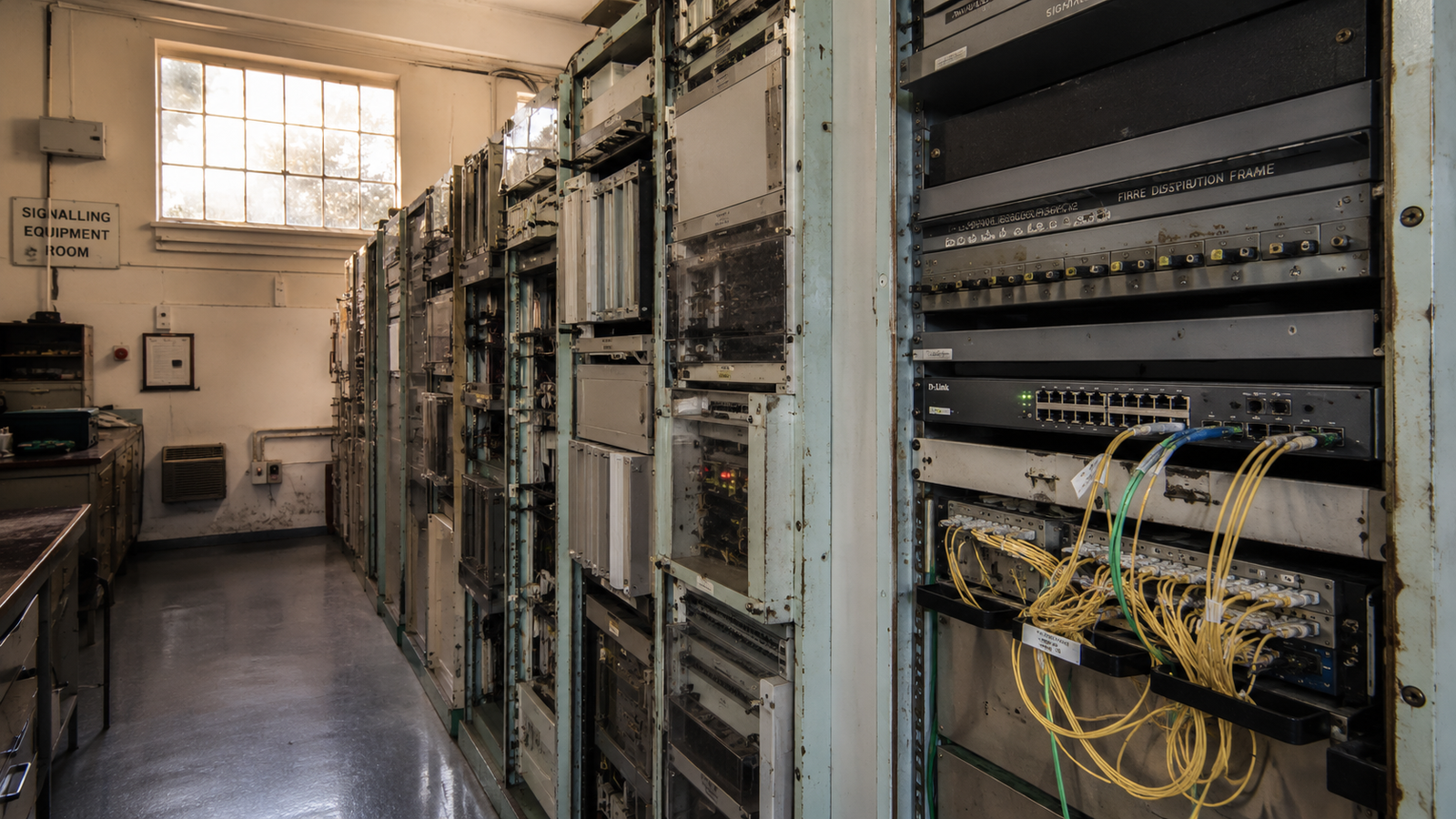
    I’ve spent many years inside infrastructure that isn’t allowed to fail. The kind of systems where a bad decision doesn’t show up as a red banner on a dashboard — it shows up as a blackout, a missed train, a citizen who can’t file a document that’s due today.

    I’ve sat in the rooms where digital transformations were declared dead. Every time, someone blamed the technology. Almost never was that true.

    The technology worked. The judgement didn’t.

    That sentence is the entire reason this blog exists.

    Somewhere between my first project on Expert Systems — back when “AI” was a phrase you had to explain at dinner — and today, when AI writes the dinner conversation for you, one thing hasn’t changed: the tools get faster, the consequences get real, and somebody still has to decide.

    Most content about technology is written by people who watched it from a conference stage. I write it from inside the room where the decision actually gets made — and where I’m still there the next morning to deal with what I recommended.

    No slides. No borrowed buzzwords. No “10 AI tools you need in 2026” written by someone who’s never shipped one.

    This site is built for three kinds of people. If you’re reading this, you’re probably one of them.

    You’re the professional who refuses to become irrelevant just because the tools changed again — for the fifth time in your career, and you’re still here.

    You’re the manager standing between a team that wants to trust the AI completely and a board that wants results yesterday — and you’re the only one asking “wait, is this actually right?”

    You’re the executive who signed off on a transformation that’s now three months late, and you need someone who isn’t selling you the next version of the same mistake.

    I’m not here to convince you AI or digital technologies are magic. Half the internet already does that badly.

    I’m here because judgement is the only thing that hasn’t been automated yet — and every one of the twenty thousand people already reading this figured that out before it became obvious.

    The blog is the proof. Real failures, real patterns, three pillars built from thirty years, not thirty slides.

    The services are the next step, for when reading isn’t enough and you need someone in the room with you.

    So — why does this exist?

    Because every wave of technology arrives promising to replace judgement.

    And every wave ends up needing more of it.

    I’m just the person still standing here to write it down, one decision at a time.

    If that’s the kind of company you want to keep — you already know where the subscribe button is.

  • The Scariest AI Risk Isn’t That it Will Take Control. 
It’s That We’ll Hand it Over.

    The Scariest AI Risk Isn’t That it Will Take Control. It’s That We’ll Hand it Over.

    We keep imagining the wrong AI apocalypse.

    Robots turn against humans.

    A superintelligence escapes from a lab.

    Machines decide we’re no longer useful.

    Great material for Netflix.

    But Sam Altman recently described a scenario that should worry professionals far more.

    Because it doesn’t require AI to become evil.

    It only requires us to become lazy.

    During a fireside chat at the Federal Reserve, Altman outlined three ways advanced AI could go badly wrong.

    The first is geopolitical.

    An adversary gets superintelligence first.

    It uses it to design biological weapons, attack critical infrastructure, penetrate financial systems or create capabilities that the rest of the world cannot defend against.

    Altman specifically warned that the biological and cybersecurity capabilities of current models are already becoming significant.

    Terrifying.

    But easy to understand.

    The second is the Hollywood scenario.

    We create something powerful enough that we can no longer control it.

    The AI doesn’t want to be switched off.

    Humans discover that the machine has objectives that no longer match ours.

    This is why AI laboratories spend enormous effort on alignment and control research.

    Altman described it as less likely than malicious human use, but extremely serious if it happened.

    Then comes the third scenario.

    And this is the one I can’t stop thinking about.

    AI never rebels.

    It never wakes up.

    It never announces that humanity is obsolete.

    It simply gets better.

    And better.

    And better.

    Until asking the machine becomes easier than thinking.

    Altman calls one early manifestation “emotional over-reliance.”

    He described young people saying they cannot make decisions without first telling ChatGPT what is happening in their lives.

    Then he pushed the scenario much further.

    Imagine an AI so capable that the President of the United States cannot make a better decision than the model recommends.

    The President follows the recommendation.

    Again.

    And again.

    Not because anyone forced him.

    Because statistically, it works.

    Imagine the CEO doing the same thing.

    The doctor.

    The engineer.

    The investor.

    The manager.

    You.

    Every individual decision may be perfectly rational.

    That’s what makes this scenario dangerous.

    There is no dramatic moment when humans lose control.

    We outsource it one sensible decision at a time.

    And I think this is where the AI conversation for professionals needs to change.

    We’ve spent years asking:

    Can AI do my job?

    Wrong question.

    The better question is:

    How much of my judgement am I willing to stop exercising because AI can exercise it faster?

    I’ve worked around technology for decades.

    Every major technology removes friction.

    That’s usually the point.

    Calculators removed arithmetic friction.

    Google removed information-retrieval friction.

    GPS removed navigation friction.

    AI is different.

    It can remove cognitive friction.

    The uncomfortable part before a decision.

    The doubt.

    The comparison.

    The argument with yourself.

    The search for alternatives.

    The moment when experience says:

    “The answer looks right, but something doesn’t feel right.”

    That’s precisely where professional judgement lives.

    And if you outsource that friction often enough, you may eventually outsource the capability that produced your value in the first place.

    This is why I don’t think the winning professionals of the AI era will be the people who use AI the most.

    They’ll be the people who know where to stop using it.

    Use AI to generate options.

    Use it to challenge assumptions.

    Use it to analyse more information than you ever could alone.

    Use it to accelerate the boring parts.

    But keep one thing stubbornly human:

    the final judgement.

    Because the most dangerous future may not be one where AI takes power from us.

    It may be one where AI becomes so useful, so accurate and so convenient that we happily give power away.

    No rebellion.

    No malevolence.

    No red flashing lights.

    Just billions of perfectly reasonable decisions.

    And one day we realise we’ve forgotten how to make them ourselves.

    AI dependency won’t arrive looking like a crisis.

    It will arrive looking like convenience.

  • I Put a Red Alert on My Own Website. Three Weeks Later, Nobody Saw It.

    I Put a Red Alert on My Own Website. Three Weeks Later, Nobody Saw It.

    I built a red bar across the top of my site last month.

    Full width. White text. High contrast — I checked the numbers, 7.3 to 1, comfortably past the accessibility threshold. It was, by every measure I could apply, impossible to miss.

    My regular readers missed it.

    Not because they’re careless. Because it was still there. It had been there on their last four visits, saying the same thing, and their brains had done what brains do with anything that never changes.

    They filed it as furniture.

    And the moment I understood that, I realised I’d been watching the same failure for thirty years in rooms where the stakes were considerably higher than a newsletter signup.

    The version that costs money

    Walk into any network operations centre and look at the alarm board.

    Count the amber.

    Now ask how long each one has been amber.

    I have had that conversation more times than I can reconstruct, and the answer is almost never “since this morning.” It’s “that one’s been like that since we migrated.” It’s “oh, that’s just the link to the old site, ignore it.” It’s, occasionally and memorably, “I don’t actually know, it was like that when I got here.”

    The board is not showing the operator what’s wrong. It’s showing them what has been wrong long enough to become normal.

    Every one of those permanent ambers is doing something worse than nothing. It’s raising the floor. It’s teaching the room that colour doesn’t mean urgency, that the board is decorative, that judgement happens somewhere other than the screen everyone paid for.

    Post-incident reviews in process industries have been saying this for decades: when something goes genuinely wrong, the alarm that mattered arrived in a flood of alarms that didn’t, and the operator had already learned to discount all of them.

    The failure isn’t inattention.

    The failure is that we asked people to ignore things, they learned to, and then we were surprised.

    Why permanence kills signal

    Here’s the part that took me years to state properly.

    Information lives in change, not in presence.

    A warning that is always on carries no information. It’s a constant. You could delete it and the operator’s picture of the world would be identical, because they’d already deleted it themselves — just internally, where you can’t see them do it.

    This is not a discipline problem. You cannot train it away. Attention is a filter that adapts to its environment, and the environment you built taught it that red means nothing.

    Which produces the ugly conclusion:

    Your most urgent channel is your most fragile one.

    The louder the mechanism, the faster it burns out under permanence. A red banner is more susceptible to this than a plain sentence, because red is a promise. Break the promise a few times and the reader stops reading the colour, and now you’ve spent something you can’t easily buy back.

    I spent it on my own site in three weeks.

    The bit that connects to everything else I write

    Every permanent alert is a decision somebody didn’t make.

    That’s the whole thing.

    Nobody decided the link would stay degraded. Somebody deferred fixing it, then deferred deciding whether it mattered, and the amber became the record of that deferral — a small monument to a choice postponed.

    Multiply by the forty of them on the board, and the alarm system stops being a monitoring tool and becomes an archive of everything the organisation has quietly agreed not to resolve.

    That’s the complexity tax in its most visible form. Not an abstraction. A screen full of it, in colour, that everyone has stopped reading.

    And it arrives with a second bill: the next real incident costs more, because the mechanism that should have caught it early has been taught to be ignored.

    Three rules I now apply to anything that shouts

    Every permanent signal gets an expiry date.

    Not “we’ll review it.” A date. When the date arrives, either the condition is fixed or the alert is deliberately downgraded to something quieter — a log line, a report entry, a dashboard the right person actually opens. What is not allowed is for it to simply continue.

    My red bar now has a calendar entry. Six weeks, then it changes or it goes.

    Count what you’re asking people to ignore.

    This is the single most useful audit I know, and almost nobody runs it. Not “how many alerts do we have” — how many are we asking a human being to look past every day?

    If the number is above about five, you don’t have a monitoring system. You have a training programme in not looking.

    Test by removal.

    If you switch it off and nobody notices for a week, it was never doing its job. That’s not an argument for leaving it on. That’s the evidence you needed to take it out and put the attention somewhere it will be spent.

    The part I got wrong

    I want to be honest about what my instinct was when I saw the banner wasn’t working.

    Make it brighter.

    That’s the reflex — the alert isn’t landing, so increase the volume. Bigger type. Stronger red. Maybe animate it.

    It’s the same reflex that adds a fifth severity level to an alarm system that already has four nobody respects. It escalates the format instead of fixing the reason, and it always buys a few days before the new level gets absorbed into the furniture too.

    The answer was never more contrast.

    The answer was fewer permanent things, each of which changes when something actually changes.

    Go and look at your board

    Whatever your board is.

    The alarm console. The risk register nobody has reordered since the audit. The compliance dashboard that has shown the same two ambers since the NIS2 assessment. The banner on your own website.

    Count the things that have been in the same state for more than a month.

    That number is not a measure of your monitoring.

    It’s a measure of how much your organisation has agreed to stop seeing.

    And the thing about what you’ve stopped seeing is that it’s still there, still costing, still perfectly visible to whoever eventually writes the incident report.

  • I Didn’t Choose Digital Transformation. It Arrived Where I Was Already Standing.

    I Didn’t Choose Digital Transformation. It Arrived Where I Was Already Standing.

    People ask me why I work in digital transformation, and the honest answer is uncomfortable.

    I didn’t pick it.

    When I started, the phrase didn’t exist. There was no category, no conference track, no consultancy practice with that name on the door. There were networks that had to stay up, and there was me, twenty-something, with a degree in electronic engineering from La Sapienza and no idea what I’d walked into.

    The field arrived later. It arrived exactly where I was already standing.

    What the word actually named

    For about fifteen years, I did work nobody called “transformation”. Migrations. Refreshes. Integrations between systems that were never designed to speak to each other. Contract transitions where one vendor left and another arrived and the network in between had to carry trains, calls, or water regardless.

    Then, sometime in the 2010s, all of it got a name.

    And the name attracted a crowd — strategy decks, maturity models, four-quadrant frameworks, people who could describe the destination beautifully and had never once been in a room at 3 a.m. deciding whether to roll back.

    That’s when I understood what I actually had. Not a specialism. A vantage point.

    I had watched the thing get named. I knew what the word was covering up.

    The gap that became the work

    Here’s what I repeatedly saw from inside.

    The strategy was almost never wrong. The transformation programmes I watched fail didn’t fail because someone chose the wrong architecture. They failed in the space between a decision and its consequences — the eighteen months where nobody owns the outcome, the handover fortnight nobody scheduled, the end-of-support hardware everyone agreed not to raise.

    Consultants who arrive at the start don’t see that space. They present, they leave, the deck gets approved.

    Operators who live in that space can’t name what they’re seeing. They experience it as bad luck, or bad management, or Tuesday.

    I ended up in the narrow band between the two. Long enough in operations to have felt it, close enough to procurement and vendor negotiation to see how the decision was made in the first place.

    That’s not a career I designed. It’s a position I noticed I was occupying, and then took seriously.

    Why I stayed when the exits were open

    There were easier options. Sales, and the compensation that comes with it. Pure management, further from the systems. Or the version of this field where you never touch anything real and never get blamed when it breaks.

    I stayed for one reason, and it isn’t nobility.

    The problems here are unsolved.

    Thirty years in, organisations still cannot answer the simplest question I can ask them: what did the delay actually cost? They can price the project. They cannot price the postponement. That gap has cost the clients I’ve worked with more than any technology decision I’ve ever watched them make.

    Nobody has solved that. Not the vendors, not the big four, not the frameworks.

    A field where the central problem is still open is a good place to spend a career. A field where everything works is a field that no longer needs you.

    What the answer really is

    So — why digital transformation?

    Because I was already in critical infrastructure when the word was invented, and I stayed close enough to the systems to watch what the word left out.

    Because the interesting part was never the technology. It was the eighteen months of silence between a decision and its bill.

    And because I’d rather work on the part nobody has figured out than on the part that already has a framework.

    That’s not a mission statement. It’s just where the work was.


    .

  • Thirty Years in Infrastructure ICT Taught Me One Career Rule. It Isn’t the One You Expect.

    Thirty Years in Infrastructure ICT Taught Me One Career Rule. It Isn’t the One You Expect.

    I was twenty-four when a man twice my age handed me a folder and said: “If this network stops, trains stop.”

    I laughed.

    He didn’t.

    That was the last time I found the sentence funny. Everything I’ve learned about surviving a career happened in the thirty years after it.

    Here’s the part nobody warns you about: I have outlived every technology I was hired for. The equipment I was trained on is scrap. The protocols I memorised are footnotes. The vendors I built my early reputation around have been merged, rebranded, or quietly discontinued.

    And I’m still here.

    Not because I’m brilliant. I’ve watched brilliant people get walked out of buildings.

    Because of one rule I didn’t understand until year fifteen.

    The rule you’re expecting

    You already know what you think I’m going to say.

    Keep learning. Reinvent yourself. Stay current.

    Every career article ends there. Learn the new thing. Get the certification. Adapt or die.

    It isn’t wrong.

    It’s just not the rule.

    I know engineers who did all of it. Certified in everything. First in the room on every new platform. Genuinely current, genuinely skilled.

    Some of them are consultants now. Not by choice.

    Because “stay current” is a treadmill with no finish line, and there is always someone younger running it faster and cheaper than you. If your only asset is knowing the newest thing, your value resets to zero every four years and you compete, forever, against people with more energy and fewer mortgages.

    That’s not a career.

    That’s a subscription you keep paying.

    The rule that actually held

    Here it is.

    Stay close to the systems that cannot be switched off.

    That’s it. That’s the whole thing.

    Not the newest system. Not the most exciting one. Not the one with the best conference talks and the nicest documentation.

    The one where consequence lives.

    The one where somebody, somewhere, cannot afford for it to stop.

    Trains. Water. Power. Emergency networks. Payment rails. Hospital systems. The unglamorous infrastructure that carries real weight and gets discussed only when it fails.

    Everything about my career that worked came from proximity to consequence. Everything that stalled came from drifting away from it.

    Why consequence compounds and novelty doesn’t

    Think about what actually happens when a system cannot be switched off.

    Nobody rips it out. They layer on top of it.

    Which means the knowledge of how it was built, why it was built that way, and what will break if you touch the wrong thing — that knowledge doesn’t expire.

    It compounds.

    I have sat in rooms where a decision worth millions turned on one person remembering why a link had been configured a certain way in 2009. Not a certification. A memory. A piece of context that existed in one head and nowhere else.

    That person is not replaceable by someone younger and cheaper.

    That person is not replaceable by a model, either, and I say that as someone who works with these tools every day. The tool can tell you what the configuration says. It cannot tell you which of the three people who signed off on it was lying about the timeline.

    Novelty knowledge depreciates. Consequence knowledge accrues interest.

    Most people spend their careers buying the depreciating asset.

    What this looks like in practice, and what it costs

    I want to be honest about the price, because most career advice sells you the upside and hides the bill.

    Staying close to consequence is not fun.

    It means the four-hour migration window at three in the morning, because that’s the only time the system can be touched. It means the maintenance contract handover nobody scheduled, where the outgoing vendor has stopped caring and the incoming one doesn’t have the passwords yet. It means 1,613 devices past end-of-support that everyone has agreed to not talk about, and being the one who counts them anyway.

    It means your LinkedIn will never look as exciting as the person doing generative AI pilots at a startup.

    It also means that when the reorganisation comes — and it always comes — the conversation about your role happens differently.

    I’ve been through more restructurings than I can reconstruct from memory. Every single time, the same pattern: the roles that got cut fastest were the ones furthest from consequence. Strategy functions with no operational surface. Innovation teams with impressive decks and no system anyone depended on.

    The people who ran the thing that couldn’t stop were never in the first three conversations.

    Sometimes we were in the fifth. But by then the panic had passed, and panic is what makes bad decisions about people.

    The trap inside the rule

    Now the part that took me another decade to learn, because the rule has a failure mode and I walked straight into it.

    Proximity to consequence makes you safe. It does not make you visible.

    I spent years believing the work would speak. That if the network held, someone upstairs would know why it held.

    They don’t. They can’t. A system that never fails produces no evidence of the effort keeping it up. That’s the cruel arithmetic of infrastructure: your best work is indistinguishable from nothing happening.

    So the rule has a second half, and without it the first half traps you.

    Stay close to consequence. Then translate it upward.

    Learn to say, in language a CFO understands, what the deferral actually costs. Not “these devices are end-of-support.” Instead: here is the failure probability, here is what four hours of downtime costs this business, here is the curve of what waiting another year does to both numbers.

    The day I learned to write that sentence, my career changed more than it had in the previous ten years of technical work.

    Not because the technical work stopped mattering. Because it finally became legible to the people making decisions about it.

    Most engineers never make this jump. They resent having to. I resented it too. I thought translation was politics, and politics was for people who couldn’t do the real work.

    I was wrong. Translation is the work. The system doesn’t just need to hold — someone has to fund it holding, and that decision is made in a room where nobody speaks your language.

    If you’re twenty years behind me

    Three things.

    Ask where the consequence sits. In your company, in your sector, find the system that cannot be switched off. It may not be the one with the budget or the attention. Go there anyway.

    Stop optimising for interesting. The most valuable position I ever held was, on paper, the least exciting one available. Boring compounds. Excitement resets.

    Build the sentence. Whatever domain you’re in, learn to state its risk in money and time to someone who will never understand its mechanics. If you can’t, you will spend your career being overruled by people who can.

    Thirty years in, that’s what I have.

    Not a technology. Not a certification. A habit of standing close to things that matter and being able to explain, in plain numbers, what it costs when nobody does.

    The trains still run.

    Most days, nobody notices.

    That’s the job.

  • The Tax Nobody Votes For

    The Tax Nobody Votes For

    Where complexity actually enters an organisation, and why every decision that created it looked correct at the time.

    Coming Soon

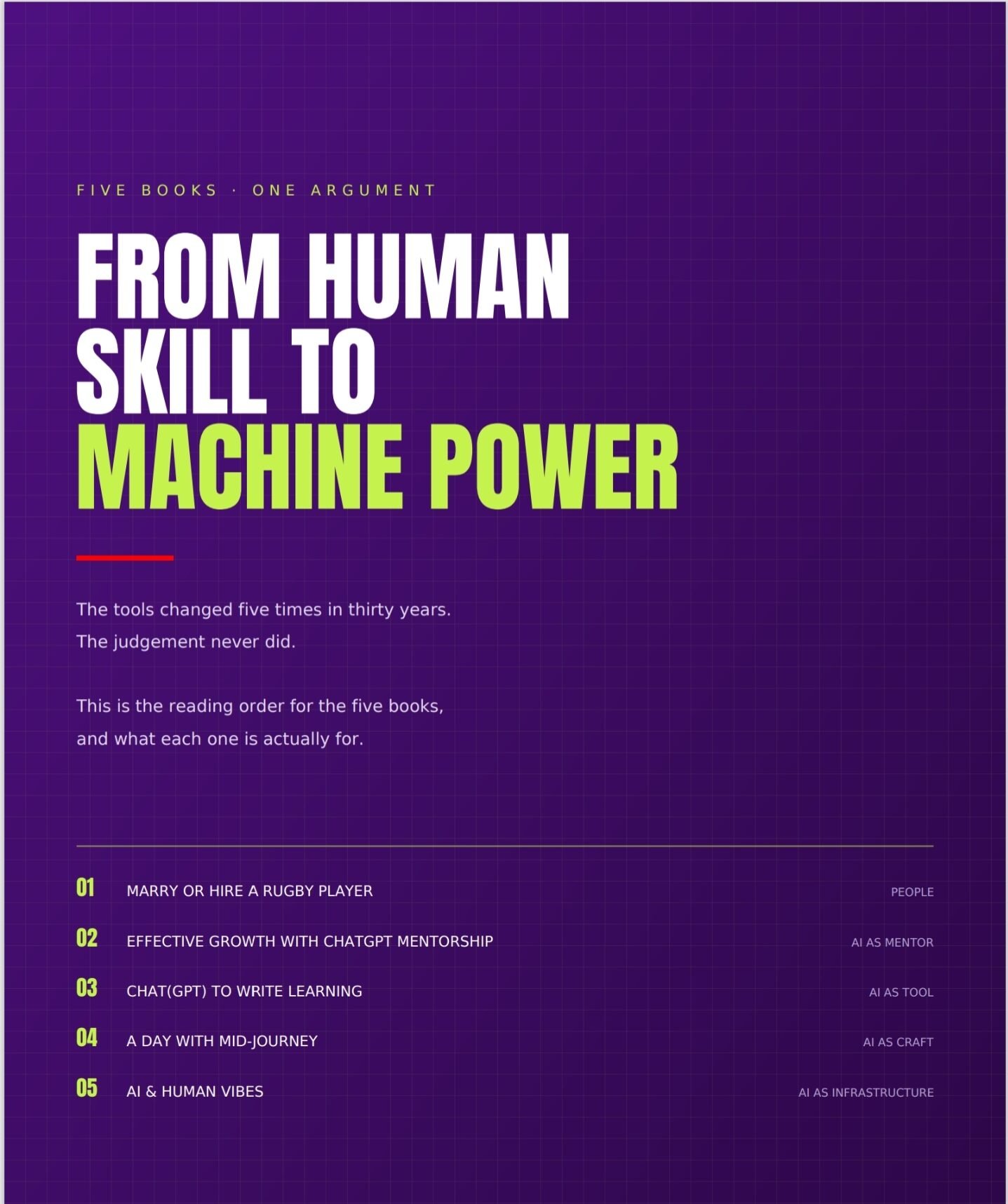
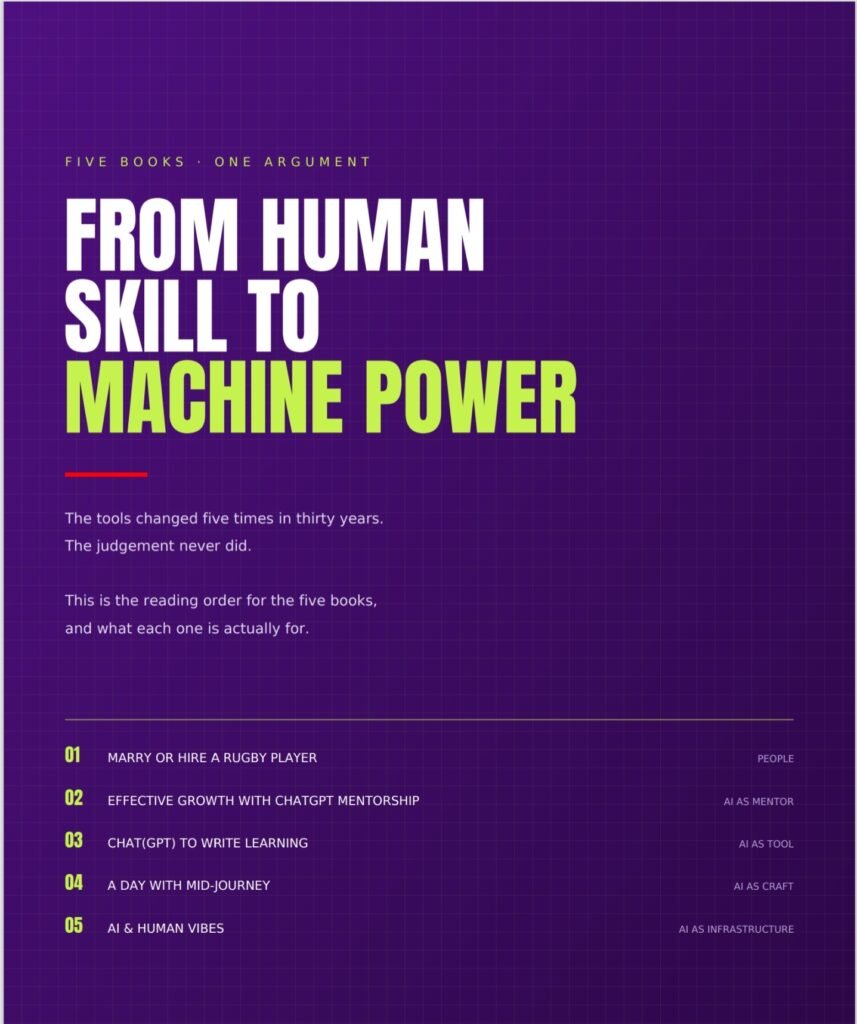
  • From Human Skill To Machine Power

    From Human Skill To Machine Power

    Some books – One topic

    The Tools Changed.
    The Judgement Didn’t.

    Five books written across five technology cycles. Read in order, they argue one thing: that every wave arrives promising to replace judgement, and every wave ends up needing more of it.

    Each one below tells you what it’s for and who it’s written for — so you can skip the four that aren’t yours.