
Month: August 2026

  • How do you use AI without losing your judgement?

    How do you use AI without losing your judgement?

    It’s the one that looks completely right.

    Clean. Logical. Confident.

    Ready to copy into an email, a proposal, or a presentation.

    That’s the trap.

    Everyone tells professionals to embrace AI.

    Use it faster. Automate more. Become more productive.

    Almost nobody talks about what happens when you stop checking what comes back. That’s the risk.

    I studied Expert Systems more than thirty years ago.

    Back then, the interesting question was whether a machine could reproduce some form of human reasoning.

    Today, the question is different.

    It’s about whether humans will continue to reason after the machine gives them an answer.

    AI can generate ten hypotheses while you are still formulating the first one.

    That’s incredibly useful.

    But speed doesn’t turn a hypothesis into a decision.

    A professional should use AI as an accelerator of possibilities, not as an oracle. Use it to generate more options, explore alternative explanations, challenge assumptions, and summarise complexity. Then do the part the machine cannot do for you: decide what to trust, what to reject, and what to act on.

    Generate more options. Explore alternative explanations. Challenge assumptions—Summarise complexity.

    Then do the part the machine cannot do for you.

    Ask:

    Does this make sense for this client?
    Inside this organisation?
    Given this history?
    With these people?

    And considering consequences the model cannot possibly see?

    That is where professional judgement begins: after the machine gives you an answer, check whether it makes sense for this client, inside this organisation, given this history, with these people, and considering consequences the model cannot possibly see. Then decide what to trust, what to reject, and what to act on.

    AI gives you plausible answers in seconds, but your value is knowing when plausibility isn’t enough.

    Your value is knowing when plausibility isn’t enough.

    The professionals most at risk from AI aren’t necessarily those who refuse to use it.

    They may be the ones who use it constantly and slowly stop questioning it.

    The competitive advantage won’t come from having access to AI.

    Everyone will have that.

    It will come from knowing when to trust the machine,

    and, more importantly, when not to.

    Explore Human + AI

  • Why a Digital Transformation Fail?

    Why a Digital Transformation Fail?

    And why does nobody audit the reasons, and everyone audit the budget?

    Digital Transformation rarely fails for technology inadequacies.

    And yet technology is usually the first thing everyone blames.

    Digital transformation has a technology problem.

    Just not the one you think.

    When a transformation fails, everyone looks for something technical to blame.

    The software was wrong.

    The integration was too complex.

    The vendor wasn’t good enough.

    The architecture wasn’t ready.

    It’s convenient.

    Because blaming technology is much easier than admitting the organisation never really changed.

    That’s where most digital transformations start dying.

    A director kicks off the project with a confident presentation.

    There’s energy in the room. Big promises. Tight deadlines.

    A few months later, that director has moved on.

    The platform eventually goes live.

    There are congratulations, emails, maybe even a small celebration.

    The dashboard says everything is green.

    Project completed.

    At least on paper.

    Because Monday morning arrives. And people quietly go back to doing exactly what they did before.

    The old spreadsheet comes back. The workaround comes back. The email someone wanted to eliminate comes back.

    The ten-year-old habit wins again.

    Not because people hate technology.

    Because nobody gave them a good enough reason to change.

    I’ve seen networks serving thousands of users struggle for reasons that had almost nothing to do with technology.

    The systems worked.

    The organisation around them didn’t.

    Nobody had seriously asked the people doing the job every day what they needed.

    Nobody had measured whether behaviour was actually changing.

    They measured deadlines.

    Budgets.

    Milestones.

    Go-live dates.

    Everything except the thing that mattered.

    Did people start working differently?

    That should be one of the most important questions in any digital transformation.

    Instead, it is often asked too late.

    Or never.

    Everyone can install new Technology.

    Transformation can’t.

    You have to change habits, incentives, processes, responsibilities and sometimes even power structures.

    That’s messy.

    You can’t neatly fit it into a project plan.

    And you certainly can’t fix it by buying another software licence.

    The unpleasant truth is this:

    Most digital transformations don’t fail when the technology stops working.

    They fail when the technology works — and the organisation keeps behaving exactly as before.

    Let’s stop auditing only the budget.

    And start auditing the change.

    → Read all Digital Change articles

  • Who is Giuseppe Cordone?

    Who is Giuseppe Cordone?

    I didn’t build a personal brand.
    I built a career.

    For more than thirty years, I’ve sat across conference tables helping organizations buy, adopt, implement — and sometimes resist — technology.

    Long before AI became a buzzword.

    Long before LinkedIn became a stage.

    I’m an Electronic Engineer, graduated from La Sapienza University in Rome. Today, I work as a Key Account Manager for an Italian ICT system integrator, after spending more than three decades designing, selling, and bringing technology solutions into large networks and infrastructure environments.

    But none of this started with a blog.

    It started with a client telling me:

    “This will never work.”

    My job wasn’t to immediately convince him he was wrong.

    My job was to understand why he might be right.

    I studied Electronic Engineering and Expert Systems at a time when talking about artificial intelligence during a job interview didn’t make you sound visionary.

    Sometimes it simply made the interview shorter.

    Then came thirty years in the field.

    Technology deals.

    Large networks.

    Skeptical executives.

    Impossible deadlines.

    Projects that looked brilliant in PowerPoint and became painfully complicated in the real world.

    Failures.

    Negotiations.

    And the occasional breakthrough that genuinely changed the way people worked.

    That experience taught me something technology presentations rarely mention:

    Technology changes fast.

    People don’t.

    Writing came much later.

    Not to build an audience.

    Not to become an influencer.

    I started writing to make sense of what I was witnessing firsthand.

    Digital transformations that promised revolutions and then collided with organizational reality.

    Artificial intelligence changing professional work faster than many companies can absorb it.

    Experienced professionals trying to grow without throwing away the judgement they spent decades developing.

    And complex technology deals that were often won or lost long before anybody signed a contract.

    Over time, those observations became part of a framework I call Experiential Selling in ICT.

    It isn’t another sales methodology.

    It is a way of looking at complex technology selling through what actually happens in the field: conversations, resistance, mistakes, negotiations, trust, organizational dynamics, and the way real people make decisions when technology enters their business.

    Today, I mainly write about:

    • Digital Change — what really happens when technology, organizations, and people have to change together;
    • Human + AI — how professionals can use AI as an accelerator without outsourcing judgement, accountability, or critical thinking;
    • Professional Growth — what a long career teaches you about learning, adapting, and remaining relevant;
    • Experiential Selling in ICT — lessons from decades of selling complex technology in the real world.

    You won’t find recycled advice from keynote speakers here.

    Or another collection of corporate slogans pretending change is easy.

    You’ll find what happens when technology collides with reality.

    Stories from conference rooms.

    Lessons from the sales floor.

    Projects that worked.

    Projects that taught me more because they didn’t.

    Conversations with customers who had very good reasons to say no.

    And thirty years of watching technological change happen one difficult decision at a time.

    Because after three decades in this business, I’ve learned that the most useful professional stories are rarely the perfect ones.

    They’re the ones that actually happened.


    → Read the full story (About)

  • The AI Act Just Landed.

    The AI Act Just Landed.

    Nobody’s Coming to Save You.


    August 2, 2026 came and went.

    The EU AI Act’s transparency rules are live. Not “coming soon.” Not “under consultation.” Live.

    Here’s the part that should keep you up tonight.

    Deloitte. EY. KPMG. PwC. All four got caught shipping AI-hallucinated garbage with sources that never existed. Firms that bill €500 an hour. Firms with compliance departments bigger than most startups.

    They still got caught.

    So tell me again why your automated post is safe.

    You’re already thinking it: their problem, not mine.

    Wrong.

    If you publish on health, finance, or public policy, the liability just moved addresses. It lives at yours now. Personally.

    There’s an exception, obviously. There’s always an exception.

    But it only covers the people who never needed covering — the ones using AI as a spellchecker on work they already researched, already verified, already sweated through at 11pm with sixteen tabs open.

    If that’s not you, the exception isn’t yours.

    So do two things.

    Verify every single number. Assume it’s a lie until a human source says otherwise.

    Say what you used and how you used it. Trust is the currency now, and you can’t print more of it.

    The people who survive this aren’t the fastest publishers.

    They’re the ones who can prove they were right.


    📌 Disclosure — Art. 50 EU AI Act
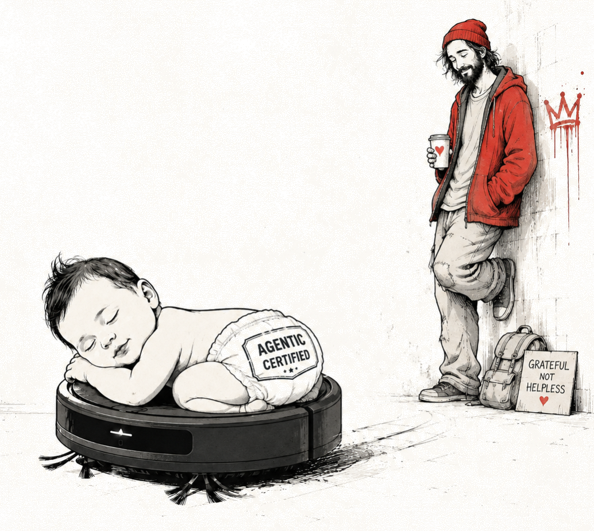
    Opinion piece. AI used for style and editing only. All research, review, and accountability are human. Image generated from the author’s own prompts using Gemini.

    Source: Tom’s Hardware