
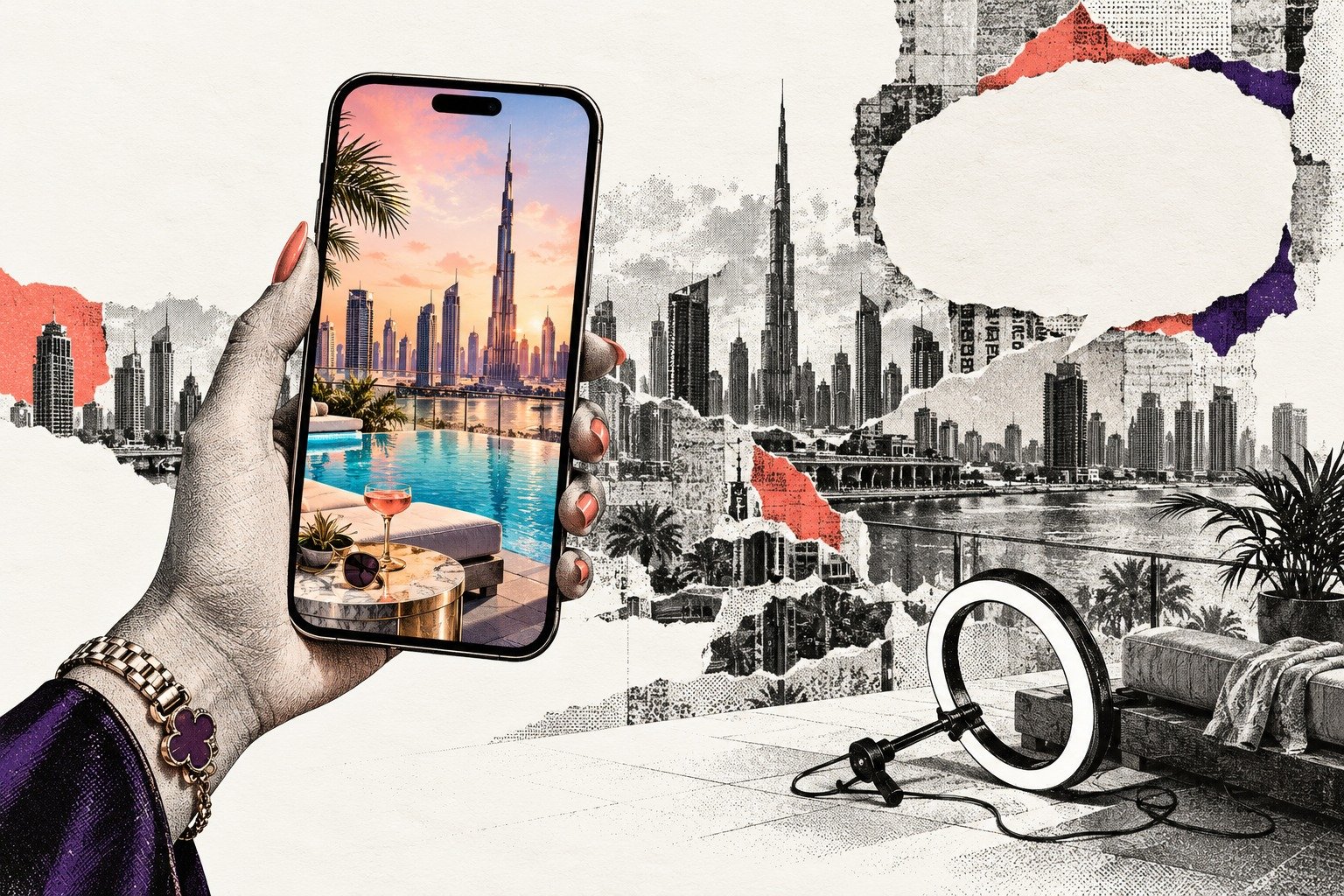
The luxury feeds met a reality that could not be edited out.
Dubai looked extraordinary through a smartphone.
Rooftop pools. Supercars. Apartments above the clouds. Entrepreneurs explaining financial freedom from restaurants where lunch could swallow somebody else’s weekly salary.
The message was persuasive: this was where successful people went to live.
Then came a harder question.
What happens when your business depends on presenting paradise—and paradise becomes a news story?
When the content changed
During the Iranian attacks in March 2026, some Dubai-based influencers briefly exchanged lifestyle content for eyewitness updates. Videos showed smoke, anxious reactions and events unfolding near familiar luxury locations.
ABC News reported on March 10 that fitness creator Will Bailey had posted footage and spoken to international media, then stopped posting. Other accounts shifted towards messages praising the UAE’s leadership and security response. The report also described official warnings over misinformation and material that could cause public panic.
That does not establish that every silent creator was censored, or that every reassuring post was commissioned.
It does establish something more useful: a social feed becomes difficult to interpret when personal safety, commercial interests and restrictions on expression overlap.
Silence can have several explanations. An upbeat video can, too.
Neither should automatically be treated as an independent assessment of conditions on the ground.
The disappearance story is too convenient
“Dubai’s influencers have vanished” makes an excellent headline.
It also bundles different people into a single fictional character.
A fitness coach, a property salesperson, a travel creator and a business owner may share a skyline. They do not necessarily share an income model, political opinion or reason for staying.
An April 9 Deutsche Welle analysis examined the competing claims that the “Dubai dream” had ended or that life was continuing normally. Its framing challenged the temptation to turn a complex economic and social situation into a verdict based on influencer narratives.
The evidence discussed here concerns particular episodes in March and April. It does not provide a comprehensive October census of who left, who stayed or who returned.
We should resist inventing one.
When the location becomes the product
For some creators, Dubai is more than a place to live.
It is part of the sales proposition.
The background helps communicate success before the speaker has explained what they actually do. A skyline becomes evidence. A hotel becomes a credential. Proximity to wealth becomes a suggestion of expertise.
This is my interpretation of the business model, rather than a claim about every Dubai-based creator.
But it explains the tension.
If your content sells the promise of security, prosperity and frictionless opportunity, uncomfortable developments can threaten both your confidence and your commercial positioning.
That creates an incentive to reassure.
It does not prove dishonesty. It gives audiences a reason to examine incentives.
The creator economy has rules beyond the algorithm
Dubai’s influencer ecosystem also operates within a regulated advertising market.
The UAE’s official Advertiser Permit framework covers individuals conducting social-media advertising, whether compensated or unpaid, subject to stated exemptions. It requires compliance with media standards and display of the permit number; visiting advertisers apply through licensed agencies. These are advertising requirements, not evidence that every personal post requires a permit.
For creators, the practical lesson extends beyond Dubai.
Your audience may be global. Your platform may be American. Your sponsors may be international.
Your physical location still matters.
So do local rules, residency arrangements and the organisations on which your business depends.
“Digital independence” can conceal considerable dependence.
What audiences should take away
There is nothing inherently suspicious about enjoying Dubai, building a business there or choosing to remain during uncertainty.
There is also nothing inconsistent about leaving when circumstances change.
The credibility test is how a creator explains that change.
Do they distinguish personal experience from verified information? Disclose commercial relationships? Acknowledge uncertainty? Correct earlier claims?
A creator saying, “I feel safe where I am,” offers a personal observation.
A creator saying, “There is no risk,” makes a much broader claim.
Followers should hear the difference.
The skyline was never the guarantee
Perhaps the most revealing question is not where Dubai’s influencers went.
It is why audiences accepted so much lifestyle imagery as evidence of sound judgment.
Beautiful surroundings can demonstrate access. They cannot establish competence, independence or foresight.
The same applies to people selling AI expertise, investment wisdom or career transformation.
Watch how someone handles an inconvenient fact. It tells you more than their most impressive backdrop.
When reality interrupts the sales pitch, does the creator help you understand what changed—or simply change the camera angle?
Sources and editorial note
ABC News, March 10, 2026 · Deutsche Welle, April 9, 2026 · UAE Advertiser Permit framework.
Prepared October 23, 2026. This commentary distinguishes documented reporting from the author’s interpretation. Text and illustration prepared with AI support and subject to editorial review.
Leave a Reply