
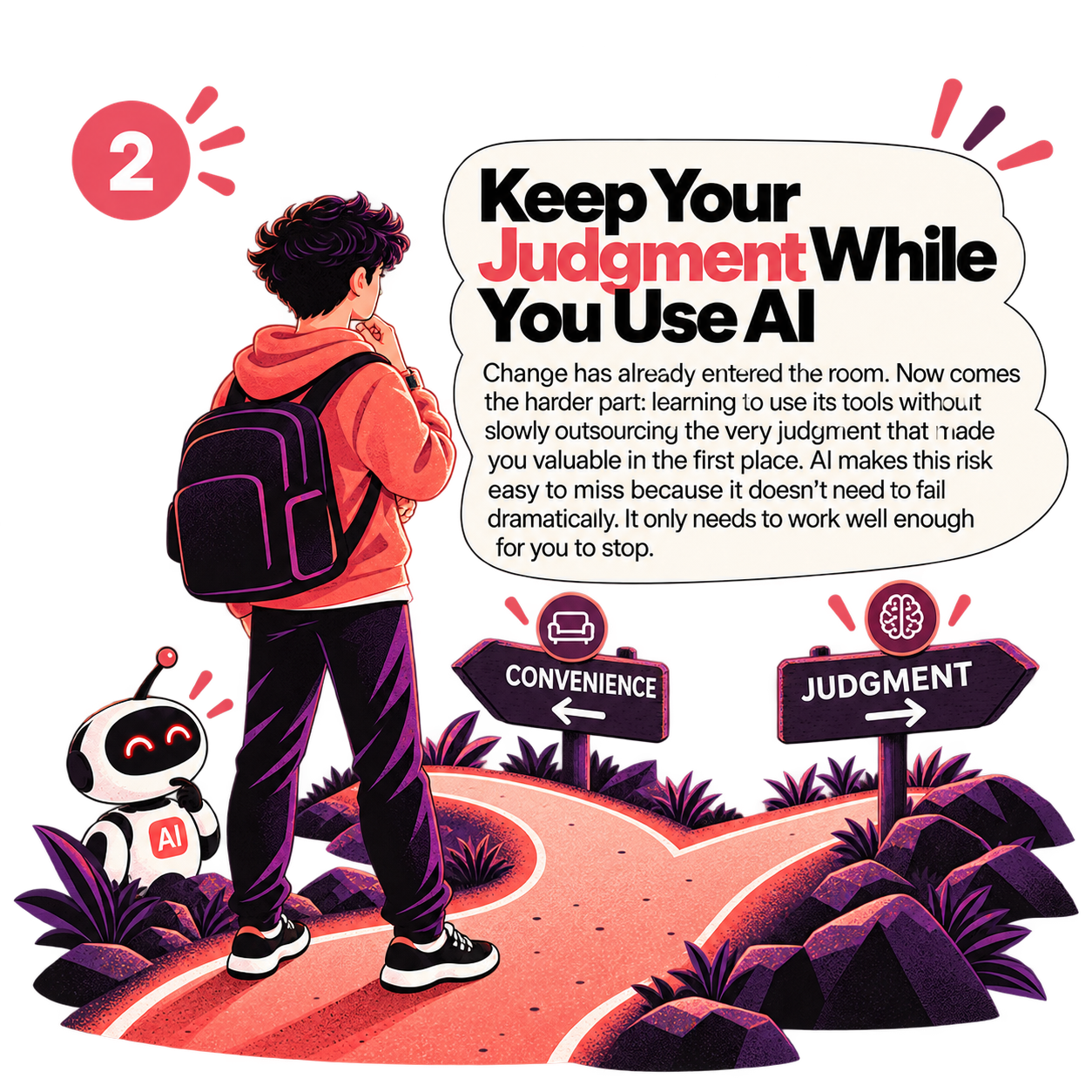
Once you’ve accepted that change has already arrived, the next question is how you use the tools inside it without quietly handing over your own thinking.
The following article emphasises that the biggest risk with AI isn’t that it’s wrong. It’s that it’s right often enough to make you stop thinking. AI can boost your productivity.
But your real advantage has never been speed.
It’s judgment.
The question isn’t how much work AI can do for you. It’s how to use it without losing the critical thinking that makes your expertise valuable.
Why this matters
The dangerous AI answer isn’t the obviously wrong one — it’s the one that looks completely right: clean, logical, confident, ready to paste into an email or a decision. This article names that trap directly and gives a concrete boundary: use AI as an accelerator of possibilities, not as a skilled servant.
That distinction is the difference between a professional who gets faster and one who gets replaceable.
Expected outcomes
After reading and applying this, you should notice yourself pausing before copying an AI-generated answer into anything that matters; generating multiple options with AI instead of accepting the first one; and being able to explain, in your own words, why a recommendation is right — not just that AI produced it.
Self-check
In the last week, did I ever act on an AI output without checking it against my own experience?
Can I currently explain the reasoning behind my last AI-assisted decision without reopening the tool?
Do I use AI to generate options, or do I let it generate my final answer?
Best practices
Treat every AI answer as a first draft of thinking, not a conclusion.
Ask for two or three alternative framings before you settle on one.
Keep the habit of writing your reasoning down in your own words — even briefly — after using AI to explore a decision.
Remediation
If you notice you’ve been rubber-stamping AI output for a while: pick your next five AI-assisted tasks and force yourself to write, before accepting the answer, one reason it could be wrong.
If you can’t come up with one, that’s the actual warning sign.
Further reading
-
The Scariest AI Risk Isn’t That it Will Take Control. It’s That We’ll Hand it Over.

We keep imagining the wrong AI apocalypse. Robots turn against humans. A superintelligence escapes from a lab. Machines decide we’re no longer useful. Great material for Netflix. But Sam Altman recently described a scenario that should worry professionals far more. Because it doesn’t require AI to become evil. It only requires us to become lazy.…
A sharper look at what’s actually at stake when the handover happens gradually, by habit, not by decision.
Leave a Reply