Category: Rising Careers

How do I remaine valuable as my profession changes?
Core verb: Growth

  • Technical Credibility Isn’t Business Influence: How to Make Decision-Makers Listen

    You can be the most technically right person in the room and still lose the decision.

    It happens more often than anyone admits: an engineer, an architect, a specialist walks into a meeting with the correct answer, the honest risk assessment, the number that should end the conversation — and watches the room decide to do something else. Something more expensive to fix later.

    Being right is not the same as being heard

    In more than three decades around technology projects — networks, migrations, integrations, transformations that didn’t have that name yet when I started — I’ve watched the same pattern repeat across companies, industries, and generations of tools. The technical case was correct. It didn’t matter.

    Decision-makers aren’t evaluating your competence. They’re evaluating exposure: budget, timeline, political capital, reputational risk, what they’ll have to explain upward if it goes wrong. When a technical case is presented as “this is objectively correct,” it’s competing for attention with framings that speak that language — and usually losing.

    From proving to translating

    The shift that changes outcomes isn’t getting more technically thorough. It’s translating the same truth into the currency the room actually trades in. Three moves that consistently work:

    1. Lead with the decision, not the derivation. State the recommendation and its consequence in the first sentence. Put the architecture diagram on slide six, not slide one.

    2. Translate technical risk into business risk. “Unpatched dependency” becomes “a single point of failure that can stop billing for 48 hours.” Same fact. Different weight.

    3. Offer a choice, not a verdict. Decision-makers resist being told what to do. They respond to two or three options with visible trade-offs — cost, time, risk — because a choice lets them own the outcome instead of just approving yours.

    What gets in the way

    The most common failure isn’t lack of expertise. It’s jargon-first slides, a recommendation buried on the last page, technical purism that treats “good enough” as an insult, and — quietly the most damaging — no named owner for the decision once it leaves the room.

    If nobody owns the decision, the correct technical answer simply evaporates under the next budget cycle.

    A practical exercise

    Before your next proposal, rewrite the opening line so that a non-technical stakeholder could repeat it accurately after hearing it once. If they can’t, the rest of the deck won’t save it.

    Technical credibility gets you into the room. Business translation is what keeps the room listening.

  • Why does this blog exist?

    Why does this blog exist?

    Here’s a question nobody asks before they hit “publish.”

    Why does this exist?

    Not the mission-statement version. The real one.

    I’ve spent many years inside infrastructure that isn’t allowed to fail. The kind of systems where a bad decision doesn’t show up as a red banner on a dashboard — it shows up as a blackout, a missed train, a citizen who can’t file a document that’s due today.

    I’ve sat in the rooms where digital transformations were declared dead. Every time, someone blamed the technology. Almost never was that true.

    The technology worked. The judgement didn’t.

    That sentence is the entire reason this blog exists.

    Somewhere between my first project on Expert Systems — back when “AI” was a phrase you had to explain at dinner — and today, when AI writes the dinner conversation for you, one thing hasn’t changed: the tools get faster, the consequences get real, and somebody still has to decide.

    Most content about technology is written by people who watched it from a conference stage. I write it from inside the room where the decision actually gets made — and where I’m still there the next morning to deal with what I recommended.

    No slides. No borrowed buzzwords. No “10 AI tools you need in 2026” written by someone who’s never shipped one.

    This site is built for three kinds of people. If you’re reading this, you’re probably one of them.

    You’re the professional who refuses to become irrelevant just because the tools changed again — for the fifth time in your career, and you’re still here.

    You’re the manager standing between a team that wants to trust the AI completely and a board that wants results yesterday — and you’re the only one asking “wait, is this actually right?”

    You’re the executive who signed off on a transformation that’s now three months late, and you need someone who isn’t selling you the next version of the same mistake.

    I’m not here to convince you AI or digital technologies are magic. Half the internet already does that badly.

    I’m here because judgement is the only thing that hasn’t been automated yet — and every one of the twenty thousand people already reading this figured that out before it became obvious.

    The blog is the proof. Real failures, real patterns, three pillars built from thirty years, not thirty slides.

    The services are the next step, for when reading isn’t enough and you need someone in the room with you.

    So — why does this exist?

    Because every wave of technology arrives promising to replace judgement.

    And every wave ends up needing more of it.

    I’m just the person still standing here to write it down, one decision at a time.

    If that’s the kind of company you want to keep — you already know where the subscribe button is.

  • The Scariest AI Risk Isn’t That it Will Take Control. 
It’s That We’ll Hand it Over.

    The Scariest AI Risk Isn’t That it Will Take Control. It’s That We’ll Hand it Over.

    We keep imagining the wrong AI apocalypse.

    Robots turn against humans.

    A superintelligence escapes from a lab.

    Machines decide we’re no longer useful.

    Great material for Netflix.

    But Sam Altman recently described a scenario that should worry professionals far more.

    Because it doesn’t require AI to become evil.

    It only requires us to become lazy.

    During a fireside chat at the Federal Reserve, Altman outlined three ways advanced AI could go badly wrong.

    The first is geopolitical.

    An adversary gets superintelligence first.

    It uses it to design biological weapons, attack critical infrastructure, penetrate financial systems or create capabilities that the rest of the world cannot defend against.

    Altman specifically warned that the biological and cybersecurity capabilities of current models are already becoming significant.

    Terrifying.

    But easy to understand.

    The second is the Hollywood scenario.

    We create something powerful enough that we can no longer control it.

    The AI doesn’t want to be switched off.

    Humans discover that the machine has objectives that no longer match ours.

    This is why AI laboratories spend enormous effort on alignment and control research.

    Altman described it as less likely than malicious human use, but extremely serious if it happened.

    Then comes the third scenario.

    And this is the one I can’t stop thinking about.

    AI never rebels.

    It never wakes up.

    It never announces that humanity is obsolete.

    It simply gets better.

    And better.

    And better.

    Until asking the machine becomes easier than thinking.

    Altman calls one early manifestation “emotional over-reliance.”

    He described young people saying they cannot make decisions without first telling ChatGPT what is happening in their lives.

    Then he pushed the scenario much further.

    Imagine an AI so capable that the President of the United States cannot make a better decision than the model recommends.

    The President follows the recommendation.

    Again.

    And again.

    Not because anyone forced him.

    Because statistically, it works.

    Imagine the CEO doing the same thing.

    The doctor.

    The engineer.

    The investor.

    The manager.

    You.

    Every individual decision may be perfectly rational.

    That’s what makes this scenario dangerous.

    There is no dramatic moment when humans lose control.

    We outsource it one sensible decision at a time.

    And I think this is where the AI conversation for professionals needs to change.

    We’ve spent years asking:

    Can AI do my job?

    Wrong question.

    The better question is:

    How much of my judgement am I willing to stop exercising because AI can exercise it faster?

    I’ve worked around technology for decades.

    Every major technology removes friction.

    That’s usually the point.

    Calculators removed arithmetic friction.

    Google removed information-retrieval friction.

    GPS removed navigation friction.

    AI is different.

    It can remove cognitive friction.

    The uncomfortable part before a decision.

    The doubt.

    The comparison.

    The argument with yourself.

    The search for alternatives.

    The moment when experience says:

    “The answer looks right, but something doesn’t feel right.”

    That’s precisely where professional judgement lives.

    And if you outsource that friction often enough, you may eventually outsource the capability that produced your value in the first place.

    This is why I don’t think the winning professionals of the AI era will be the people who use AI the most.

    They’ll be the people who know where to stop using it.

    Use AI to generate options.

    Use it to challenge assumptions.

    Use it to analyse more information than you ever could alone.

    Use it to accelerate the boring parts.

    But keep one thing stubbornly human:

    the final judgement.

    Because the most dangerous future may not be one where AI takes power from us.

    It may be one where AI becomes so useful, so accurate and so convenient that we happily give power away.

    No rebellion.

    No malevolence.

    No red flashing lights.

    Just billions of perfectly reasonable decisions.

    And one day we realise we’ve forgotten how to make them ourselves.

    AI dependency won’t arrive looking like a crisis.

    It will arrive looking like convenience.

  • Thirty Years in Infrastructure ICT Taught Me One Career Rule. It Isn’t the One You Expect.

    Thirty Years in Infrastructure ICT Taught Me One Career Rule. It Isn’t the One You Expect.

    I was twenty-four when a man twice my age handed me a folder and said: “If this network stops, trains stop.”

    I laughed.

    He didn’t.

    That was the last time I found the sentence funny. Everything I’ve learned about surviving a career happened in the thirty years after it.

    Here’s the part nobody warns you about: I have outlived every technology I was hired for. The equipment I was trained on is scrap. The protocols I memorised are footnotes. The vendors I built my early reputation around have been merged, rebranded, or quietly discontinued.

    And I’m still here.

    Not because I’m brilliant. I’ve watched brilliant people get walked out of buildings.

    Because of one rule I didn’t understand until year fifteen.

    The rule you’re expecting

    You already know what you think I’m going to say.

    Keep learning. Reinvent yourself. Stay current.

    Every career article ends there. Learn the new thing. Get the certification. Adapt or die.

    It isn’t wrong.

    It’s just not the rule.

    I know engineers who did all of it. Certified in everything. First in the room on every new platform. Genuinely current, genuinely skilled.

    Some of them are consultants now. Not by choice.

    Because “stay current” is a treadmill with no finish line, and there is always someone younger running it faster and cheaper than you. If your only asset is knowing the newest thing, your value resets to zero every four years and you compete, forever, against people with more energy and fewer mortgages.

    That’s not a career.

    That’s a subscription you keep paying.

    The rule that actually held

    Here it is.

    Stay close to the systems that cannot be switched off.

    That’s it. That’s the whole thing.

    Not the newest system. Not the most exciting one. Not the one with the best conference talks and the nicest documentation.

    The one where consequence lives.

    The one where somebody, somewhere, cannot afford for it to stop.

    Trains. Water. Power. Emergency networks. Payment rails. Hospital systems. The unglamorous infrastructure that carries real weight and gets discussed only when it fails.

    Everything about my career that worked came from proximity to consequence. Everything that stalled came from drifting away from it.

    Why consequence compounds and novelty doesn’t

    Think about what actually happens when a system cannot be switched off.

    Nobody rips it out. They layer on top of it.

    Which means the knowledge of how it was built, why it was built that way, and what will break if you touch the wrong thing — that knowledge doesn’t expire.

    It compounds.

    I have sat in rooms where a decision worth millions turned on one person remembering why a link had been configured a certain way in 2009. Not a certification. A memory. A piece of context that existed in one head and nowhere else.

    That person is not replaceable by someone younger and cheaper.

    That person is not replaceable by a model, either, and I say that as someone who works with these tools every day. The tool can tell you what the configuration says. It cannot tell you which of the three people who signed off on it was lying about the timeline.

    Novelty knowledge depreciates. Consequence knowledge accrues interest.

    Most people spend their careers buying the depreciating asset.

    What this looks like in practice, and what it costs

    I want to be honest about the price, because most career advice sells you the upside and hides the bill.

    Staying close to consequence is not fun.

    It means the four-hour migration window at three in the morning, because that’s the only time the system can be touched. It means the maintenance contract handover nobody scheduled, where the outgoing vendor has stopped caring and the incoming one doesn’t have the passwords yet. It means 1,613 devices past end-of-support that everyone has agreed to not talk about, and being the one who counts them anyway.

    It means your LinkedIn will never look as exciting as the person doing generative AI pilots at a startup.

    It also means that when the reorganisation comes — and it always comes — the conversation about your role happens differently.

    I’ve been through more restructurings than I can reconstruct from memory. Every single time, the same pattern: the roles that got cut fastest were the ones furthest from consequence. Strategy functions with no operational surface. Innovation teams with impressive decks and no system anyone depended on.

    The people who ran the thing that couldn’t stop were never in the first three conversations.

    Sometimes we were in the fifth. But by then the panic had passed, and panic is what makes bad decisions about people.

    The trap inside the rule

    Now the part that took me another decade to learn, because the rule has a failure mode and I walked straight into it.

    Proximity to consequence makes you safe. It does not make you visible.

    I spent years believing the work would speak. That if the network held, someone upstairs would know why it held.

    They don’t. They can’t. A system that never fails produces no evidence of the effort keeping it up. That’s the cruel arithmetic of infrastructure: your best work is indistinguishable from nothing happening.

    So the rule has a second half, and without it the first half traps you.

    Stay close to consequence. Then translate it upward.

    Learn to say, in language a CFO understands, what the deferral actually costs. Not “these devices are end-of-support.” Instead: here is the failure probability, here is what four hours of downtime costs this business, here is the curve of what waiting another year does to both numbers.

    The day I learned to write that sentence, my career changed more than it had in the previous ten years of technical work.

    Not because the technical work stopped mattering. Because it finally became legible to the people making decisions about it.

    Most engineers never make this jump. They resent having to. I resented it too. I thought translation was politics, and politics was for people who couldn’t do the real work.

    I was wrong. Translation is the work. The system doesn’t just need to hold — someone has to fund it holding, and that decision is made in a room where nobody speaks your language.

    If you’re twenty years behind me

    Three things.

    Ask where the consequence sits. In your company, in your sector, find the system that cannot be switched off. It may not be the one with the budget or the attention. Go there anyway.

    Stop optimising for interesting. The most valuable position I ever held was, on paper, the least exciting one available. Boring compounds. Excitement resets.

    Build the sentence. Whatever domain you’re in, learn to state its risk in money and time to someone who will never understand its mechanics. If you can’t, you will spend your career being overruled by people who can.

    Thirty years in, that’s what I have.

    Not a technology. Not a certification. A habit of standing close to things that matter and being able to explain, in plain numbers, what it costs when nobody does.

    The trains still run.

    Most days, nobody notices.

    That’s the job.

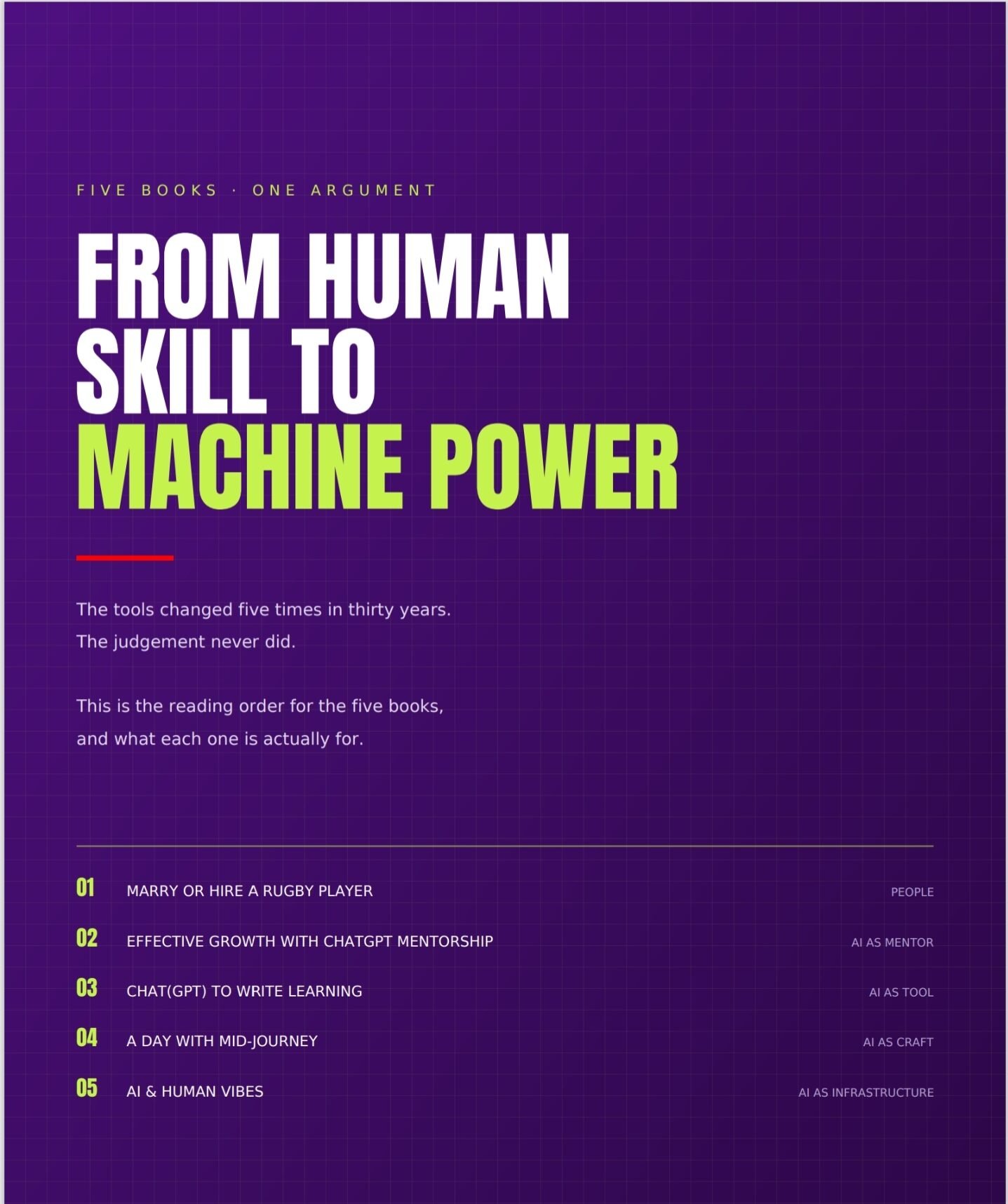
  • From Human Skill To Machine Power

    From Human Skill To Machine Power

    Some books – One topic

    The Tools Changed.
    The Judgement Didn’t.

    Five books written across five technology cycles. Read in order, they argue one thing: that every wave arrives promising to replace judgement, and every wave ends up needing more of it.

    Each one below tells you what it’s for and who it’s written for — so you can skip the four that aren’t yours.

  • How do you stay relevant in a tech career?

    How do you stay relevant in a tech career?

    Someone younger, cheaper, and more current is already in the room.

    That sentence makes many experienced professionals uncomfortable.

    It should.

    Because somewhere inside your company, your industry, or your next client meeting, there is probably someone who knows a newer tool than you do.

    They may code faster.

    They may know the latest platform.

    They may cost less.

    And they may have learned in six months what took you years to understand.

    That sounds like bad news.

    It isn’t.

    Unless your entire professional value is based on knowing how technology works.

    Because technical knowledge has an expiry date.

    Experience doesn’t.

    At least, not when you know how to use it.

    I’ve spent decades around technology.

    I’ve seen platforms become obsolete.

    Programming languages disappear.

    Architectures become unfashionable.

    Vendors that once looked untouchable become irrelevant.

    Every generation of technology eventually becomes someone else’s legacy system.

    Your skills are not immune.

    That certification you worked hard for?

    Someone else will get it.

    That platform you mastered will be replaced.

    That technology everyone is talking about today?

    One day it will appear in a PowerPoint slide titled “Legacy Environment.”

    That’s how technology works.

    It moves on.

    The mistake is believing your career has to move at the same speed.

    It doesn’t.

    Your real value is not knowing the technology.

    Years ago, I started noticing something strange.

    Some of the smartest engineers I knew were almost invisible.

    They could diagnose incredibly complex problems.

    They understood systems better than anyone else in the room.

    They knew how things worked.

    But when the meeting moved from technology to business, they disappeared.

    Not physically.

    Professionally.

    They started speaking a language nobody outside the technical team understood.

    Latency.

    Architecture.

    Protocols.

    Redundancy.

    Scalability.

    All important.

    But the person holding the budget was thinking about something else.

    “How much will this cost me?”

    “What problem does this solve?”

    “What happens if I do nothing?”

    “How quickly will I see a result?”

    “Why should I care?”

    That gap is where careers are made.

    And lost.

    The board doesn’t buy technology.

    People rarely buy technology because technology is interesting.

    Engineers sometimes forget this.

    A client doesn’t wake up in the morning wanting a better network architecture.

    They want fewer outages.

    A CEO doesn’t dream about cloud migration.

    They want flexibility, lower risk, faster growth or less capital tied up in infrastructure.

    A manager doesn’t want artificial intelligence.

    They want decisions made faster.

    Costs reduced.

    Customers served better.

    Problems detected earlier.

    Technology is the mechanism.

    Value is the reason.

    The professional who can connect the two becomes difficult to replace.

    Learn to explain “why it matters”

    This is one of the most valuable skills I’ve learned in technology.

    You should be able to explain a complex technology to someone who does not care about the technology.

    Not because they are stupid.

    Because they have a different job.

    The CFO does not need your architecture diagram.

    The CEO does not need your configuration parameters.

    The client does not need twenty-seven features.

    They need the consequence.

    Tell them what changes.

    Tell them what becomes easier.

    Tell them what risk disappears.

    Tell them what opportunity becomes possible.

    Do that in two minutes.

    If you can’t, you probably don’t understand the value well enough yet.

    I call it experiential selling.

    Selling technology is often treated as a feature comparison.

    Our product is faster.

    Our platform has more functions.

    Our solution supports another protocol.

    Our architecture scales better.

    Fine.

    But people do not experience specifications.

    They experience outcomes.

    That is why I prefer to think in terms of experiential selling.

    You are not selling a switch.

    You are selling what happens when the network stops becoming a problem.

    You are not selling cloud infrastructure.

    You are selling what a team can suddenly do faster because that infrastructure exists.

    You are not selling AI.

    You are selling the hours someone gets back.

    The decisions they can improve.

    The mistakes they can avoid.

    The customer experience they can redesign.

    The technology is backstage.

    The experience is what people remember.

    Brilliant engineers can stay invisible for twenty years.

    I’ve seen it happen.

    People with extraordinary technical ability.

    Reliable.

    Precise.

    Deeply competent.

    Everyone called them when something went wrong.

    But few called them when important decisions had to be made.

    That distinction matters.

    Being useful is not the same as being influential.

    And being technically indispensable is not the same as being professionally indispensable.

    Then I’ve seen the opposite.

    People who were not the strongest technologists in the room.

    But they could listen.

    They could simplify.

    They understood the business problem before discussing the solution.

    They could translate complexity into a story a client understood.

    They became the people executives wanted in the meeting.

    They became trusted.

    They became visible.

    Eventually, they became difficult to replace.

    Not because they knew more technology.

    Because they made technology mean something.

    This becomes even more important with AI.

    AI is making technical knowledge cheaper.

    That doesn’t mean technical professionals are becoming useless.

    It means information is becoming less scarce.

    Knowing the answer is no longer enough.

    Everyone has access to answers.

    The value moves somewhere else.

    Judgement.

    Context.

    Communication.

    Experience.

    The ability to ask the right question.

    The ability to understand what the client is really worried about.

    The ability to recognise when the technically elegant solution is the wrong business decision.

    AI can explain how something works.

    That makes your ability to explain why it matters more valuable, not less.

    Don’t stop studying

    This isn’t an argument against technical depth.

    Quite the opposite.

    You still need to understand the technology.

    You still need to study.

    Experiment.

    Stay curious.

    Keep updating yourself.

    Technical credibility matters.

    But don’t confuse the foundation with the whole building.

    If your only defence against a younger professional is:

    “I know more than they do,”

    you have a problem.

    Eventually, they may know more too.

    And they may learn it faster.

    Your advantage has to become something harder to download.

    Pattern recognition.

    Business understanding.

    Judgement.

    Trust.

    Communication.

    A network of relationships.

    The ability to connect technology with consequences.

    That is where decades of experience can finally compound instead of becoming obsolete.

    Your technical skills have an expiry date.

    Accept that now.

    Not five years from now.

    Not when your company restructures.

    Not when a new technology suddenly becomes mandatory.

    Not when someone half your age walks into the room knowing the platform better than you do.

    Accept it while you still have time to build the skills that don’t expire so quickly.

    Keep learning the technology.

    But learn the business too.

    Learn how your client makes money.

    Learn what your CEO worries about.

    Learn how decisions are made.

    Learn to simplify without becoming simplistic.

    Learn to tell the story behind the architecture.

    Because the safest professional in the room is rarely the person who knows the most.

    It’s the person who makes what everyone knows useful.

    Someone younger, cheaper and more current may already be in the room.

    Good.

    Let them know how the technology works.

    You learn to explain why it matters.

    → Go to Professional Growth